<?xml version="1.0" encoding="utf-8"?>
<feed xmlns="http://www.w3.org/2005/Atom">
    <id>https://bitdive.io/blog/</id>
    <title>BitDive Blog</title>
    <updated>2026-04-30T00:00:00.000Z</updated>
    <generator>https://github.com/jpmonette/feed</generator>
    <link rel="alternate" href="https://bitdive.io/blog/"/>
    <subtitle>BitDive Blog</subtitle>
    <icon>https://bitdive.io/favicon.svg</icon>
    <entry>
        <title type="html"><![CDATA[Spring Boot Testcontainers integration testing: what to test with real PostgreSQL, Kafka, and Redis]]></title>
        <id>https://bitdive.io/blog/spring-boot-testcontainers-integration-testing/</id>
        <link href="https://bitdive.io/blog/spring-boot-testcontainers-integration-testing/"/>
        <updated>2026-04-30T00:00:00.000Z</updated>
        <summary type="html"><![CDATA[A guide to Testcontainers in Spring Boot. Learn when to use real database containers vs runtime replay, and how to automate data seeding for integration testing.]]></summary>
        <content type="html"><![CDATA[
<p><img decoding="async" loading="lazy" alt="Spring Boot Testcontainers Integration Testing with Real PostgreSQL and Kafka" src="https://bitdive.io/assets/images/spring-boot-testcontainers-integration-testing-real-database-576704b01fb89c29854db56ec04991c8.png" width="1536" height="698" class="img_ev3q"></p>
<p><strong>TL;DR:</strong> Testcontainers changed Spring Boot integration testing by replacing in-memory databases like H2 with real Docker containers. But starting a container is only part of the work. Seeding it with realistic data is still difficult. This post explores when to use Testcontainers, when to use pure trace replay, and how BitDive combines both to give you real databases auto-seeded with production data.</p>
<h2 class="anchor anchorTargetStickyNavbar_Vzrq" id="the-end-of-the-h2-era">The end of the H2 era<a href="https://bitdive.io/blog/spring-boot-testcontainers-integration-testing/#the-end-of-the-h2-era" class="hash-link" aria-label="Direct link to The end of the H2 era" title="Direct link to The end of the H2 era" translate="no">​</a></h2>
<p>For years, the standard advice for Spring Boot database testing was to use an in-memory H2 database. It was fast and required no setup.</p>
<p>But H2 is not PostgreSQL. It doesn't support the same JSONB dialects, window functions, or indexing behaviors. When your <code>@DataJpaTest</code> passed in H2, it only proved that your JPQL was syntactically valid for H2. It did not prove your code would work against production PostgreSQL.</p>
<p>Testcontainers solved this. By starting disposable Docker containers during tests, your integration tests run against the same infrastructure as production.</p>
<h2 class="anchor anchorTargetStickyNavbar_Vzrq" id="when-you-need-testcontainers">When you need Testcontainers<a href="https://bitdive.io/blog/spring-boot-testcontainers-integration-testing/#when-you-need-testcontainers" class="hash-link" aria-label="Direct link to When you need Testcontainers" title="Direct link to When you need Testcontainers" translate="no">​</a></h2>
<p>You should use real database or message broker containers for tests that evaluate infrastructure constraints or schema drift.</p>
<h3 class="anchor anchorTargetStickyNavbar_Vzrq" id="1-complex-sql-and-dialect-specific-features">1. Complex SQL and dialect-specific features<a href="https://bitdive.io/blog/spring-boot-testcontainers-integration-testing/#1-complex-sql-and-dialect-specific-features" class="hash-link" aria-label="Direct link to 1. Complex SQL and dialect-specific features" title="Direct link to 1. Complex SQL and dialect-specific features" translate="no">​</a></h3>
<p>If your repository uses native queries, JSONB operations, or advanced JPA criteria building, mocking the repository or using H2 is risky. Testcontainers ensures your query executes against a real query planner.</p>
<h3 class="anchor anchorTargetStickyNavbar_Vzrq" id="2-database-migrations-flyway-or-liquibase">2. Database migrations (Flyway or Liquibase)<a href="https://bitdive.io/blog/spring-boot-testcontainers-integration-testing/#2-database-migrations-flyway-or-liquibase" class="hash-link" aria-label="Direct link to 2. Database migrations (Flyway or Liquibase)" title="Direct link to 2. Database migrations (Flyway or Liquibase)" translate="no">​</a></h3>
<p>An integration test that boots a PostgreSQL container and runs migrations before the test executes is the only way to prove your application will start up successfully in the next deployment.</p>
<h3 class="anchor anchorTargetStickyNavbar_Vzrq" id="3-transaction-isolation-and-concurrency">3. Transaction isolation and concurrency<a href="https://bitdive.io/blog/spring-boot-testcontainers-integration-testing/#3-transaction-isolation-and-concurrency" class="hash-link" aria-label="Direct link to 3. Transaction isolation and concurrency" title="Direct link to 3. Transaction isolation and concurrency" translate="no">​</a></h3>
<p>If you are testing serializable isolation or pessimistic locking behavior, a real database is required. Mocks and replays cannot simulate lock contention.</p>
<h2 class="anchor anchorTargetStickyNavbar_Vzrq" id="the-testcontainers-data-bottleneck">The Testcontainers data bottleneck<a href="https://bitdive.io/blog/spring-boot-testcontainers-integration-testing/#the-testcontainers-data-bottleneck" class="hash-link" aria-label="Direct link to The Testcontainers data bottleneck" title="Direct link to The Testcontainers data bottleneck" translate="no">​</a></h2>
<p>If Testcontainers is effective, why don't teams use it for every test?</p>
<p>The answer is the data problem.</p>
<p>A fresh PostgreSQL container is empty. To test an <code>OrderService</code>, you must first write a lot of builder code or SQL scripts to insert a <code>User</code>, a <code>Tenant</code>, a <code>Product</code>, and an <code>AccountBalance</code>.</p>
<div class="language-java codeBlockContainer_Ckt0 theme-code-block" style="--prism-color:#F8F8F2;--prism-background-color:#282A36"><div class="codeBlockContent_QJqH"><pre tabindex="0" class="prism-code language-java codeBlock_bY9V thin-scrollbar" style="color:#F8F8F2;background-color:#282A36"><code class="codeBlockLines_e6Vv"><span class="token-line" style="color:#F8F8F2"><span class="token plain">@Test</span><br></span><span class="token-line" style="color:#F8F8F2"><span class="token plain">void testOrderProcessing() {</span><br></span><span class="token-line" style="color:#F8F8F2"><span class="token plain">    // Significant setup is required to get the database </span><br></span><span class="token-line" style="color:#F8F8F2"><span class="token plain">    // into a state where the test won't crash.</span><br></span><span class="token-line" style="color:#F8F8F2"><span class="token plain">    User u = userRepository.save(new User("Alice"));</span><br></span><span class="token-line" style="color:#F8F8F2"><span class="token plain">    Product p = productRepository.save(new Product("Laptop", 1000));</span><br></span><span class="token-line" style="color:#F8F8F2"><span class="token plain">    Inventory i = inventoryRepository.save(new Inventory(p.getId(), 5));</span><br></span><span class="token-line" style="color:#F8F8F2"><span class="token plain">    </span><br></span><span class="token-line" style="color:#F8F8F2"><span class="token plain">    OrderResult result = orderService.process(u.getId(), p.getId());</span><br></span><span class="token-line" style="color:#F8F8F2"><span class="token plain">    assertThat(result.isSuccess()).isTrue();</span><br></span><span class="token-line" style="color:#F8F8F2"><span class="token plain">}</span><br></span></code></pre></div></div>
<p>This makes tests slow to write and hard to maintain. When the <code>User</code> schema adds a mandatory field, many test setup scripts break.</p>
<h2 class="anchor anchorTargetStickyNavbar_Vzrq" id="hybrid-trace-based-testing">Hybrid trace-based testing<a href="https://bitdive.io/blog/spring-boot-testcontainers-integration-testing/#hybrid-trace-based-testing" class="hash-link" aria-label="Direct link to Hybrid trace-based testing" title="Direct link to Hybrid trace-based testing" translate="no">​</a></h2>
<p>You have two choices for <a class="" href="https://bitdive.io/java-integration-tests/">Spring Boot integration testing</a>:</p>
<p><strong>Option A: Pure replay</strong>
You don't need a database container. BitDive intercepts the JDBC calls and replays the exact <code>ResultSet</code> captured from a real environment. This is fast and requires zero setup, but it doesn't test the schema itself.</p>
<p><strong>Option B: Testcontainers mode with automated seeding</strong>
What if you want to use a real PostgreSQL container but don't want to write the setup data?</p>
<p>Through the <a class="" href="https://bitdive.io/trace-based-testing/">Autonomous Verification Layer</a>, BitDive solves the Testcontainers data bottleneck.</p>
<p>When you capture a trace of your application, BitDive records the state of the data involved. When you run the resulting JUnit test in testcontainers mode:</p>
<ol>
<li class="">BitDive starts the Testcontainer.</li>
<li class="">BitDive extracts the required rows from the captured trace and seeds the container.</li>
<li class="">Your test runs against a real database, populated with real data, with no manual setup scripts.</li>
</ol>
<h3 class="anchor anchorTargetStickyNavbar_Vzrq" id="example-bitdive-testcontainers-mode">Example: BitDive testcontainers mode<a href="https://bitdive.io/blog/spring-boot-testcontainers-integration-testing/#example-bitdive-testcontainers-mode" class="hash-link" aria-label="Direct link to Example: BitDive testcontainers mode" title="Direct link to Example: BitDive testcontainers mode" translate="no">​</a></h3>
<div class="language-java codeBlockContainer_Ckt0 theme-code-block" style="--prism-color:#F8F8F2;--prism-background-color:#282A36"><div class="codeBlockContent_QJqH"><pre tabindex="0" class="prism-code language-java codeBlock_bY9V thin-scrollbar" style="color:#F8F8F2;background-color:#282A36"><code class="codeBlockLines_e6Vv"><span class="token-line" style="color:#F8F8F2"><span class="token plain">@Test</span><br></span><span class="token-line" style="color:#F8F8F2"><span class="token plain">@BitDiveReplay(scenarioId = "checkout-v1", mode = ReplayMode.TESTCONTAINERS)</span><br></span><span class="token-line" style="color:#F8F8F2"><span class="token plain">void testOrderProcessing_WithRealDB() {</span><br></span><span class="token-line" style="color:#F8F8F2"><span class="token plain">    // 1. BitDive starts PostgreSQL container.</span><br></span><span class="token-line" style="color:#F8F8F2"><span class="token plain">    // 2. BitDive seeds the tables based on the recorded production trace.</span><br></span><span class="token-line" style="color:#F8F8F2"><span class="token plain">    // 3. BitDive stubs the outbound external HTTP calls.</span><br></span><span class="token-line" style="color:#F8F8F2"><span class="token plain">    </span><br></span><span class="token-line" style="color:#F8F8F2"><span class="token plain">    orderService.process(new OrderRequest());</span><br></span><span class="token-line" style="color:#F8F8F2"><span class="token plain">}</span><br></span></code></pre></div></div>
<h2 class="anchor anchorTargetStickyNavbar_Vzrq" id="summary">Summary<a href="https://bitdive.io/blog/spring-boot-testcontainers-integration-testing/#summary" class="hash-link" aria-label="Direct link to Summary" title="Direct link to Summary" translate="no">​</a></h2>
<ul>
<li class="">Use Testcontainers when you need to verify migrations, complex SQL dialects, and locking behavior.</li>
<li class="">Use trace-based testing to capture data states from running environments and automatically inject them into your test containers.</li>
</ul>
<p>By combining Testcontainers with real runtime context, you get high fidelity <a class="" href="https://bitdive.io/java-integration-tests/">integration testing</a> without the maintenance cost of manual test data.</p>]]></content>
        <author>
            <name>Evgenii Frolikov</name>
            <uri>https://www.linkedin.com/in/evgeniy-frolikov-java-developer/</uri>
        </author>
        <category label="Trace-Based Testing" term="Trace-Based Testing"/>
        <category label="Integration Tests" term="Integration Tests"/>
        <category label="Testcontainers" term="Testcontainers"/>
        <category label="Spring Boot" term="Spring Boot"/>
    </entry>
    <entry>
        <title type="html"><![CDATA[Feign client integration testing in Spring Boot: WireMock, MockBean, or runtime replay?]]></title>
        <id>https://bitdive.io/blog/feign-client-integration-testing-spring-boot/</id>
        <link href="https://bitdive.io/blog/feign-client-integration-testing-spring-boot/"/>
        <updated>2026-04-28T00:00:00.000Z</updated>
        <summary type="html"><![CDATA[Compare the three ways to test Spring Cloud OpenFeign clients: @MockBean, WireMock servers, and automated trace replay. Discover how to stop writing manual HTTP stubs.]]></summary>
        <content type="html"><![CDATA[
<p><img decoding="async" loading="lazy" alt="Feign Client Integration Testing: WireMock vs BitDive Trace Replay" src="https://bitdive.io/assets/images/feign-client-integration-testing-wiremock-vs-bitdive-d4b1e54dcee7a90b94d7ae37b6ee1c92.png" width="1536" height="698" class="img_ev3q"></p>
<p><strong>TL;DR:</strong> Testing Spring Cloud OpenFeign clients is difficult to get right. Mocking the Java interface misses serialization and interceptor logic. WireMock tests the full HTTP stack but requires constant manual updates to JSON stubs. A more reliable alternative is runtime replay. You capture real HTTP exchanges from production and virtualize the Feign boundaries during your <a class="" href="https://bitdive.io/java-integration-tests/">Spring Boot integration tests</a>.</p>
<h2 class="anchor anchorTargetStickyNavbar_Vzrq" id="the-feign-testing-dilemma">The Feign testing dilemma<a href="https://bitdive.io/blog/feign-client-integration-testing-spring-boot/#the-feign-testing-dilemma" class="hash-link" aria-label="Direct link to The Feign testing dilemma" title="Direct link to The Feign testing dilemma" translate="no">​</a></h2>
<p>Spring Cloud OpenFeign makes REST APIs feel like local methods. It handles URLs, encoding, decoding, headers, and retries.</p>
<p>Because it hides the HTTP complexity, developers often assume testing the interface is enough. This often leads to bugs where the client passes tests in CI but fails in production because a header was missing or the JSON format was slightly different.</p>
<p>When writing an integration test for a service that uses Feign, you have three options to handle that outbound dependency:</p>
<ol>
<li class="">Mock the Java interface using <code>@MockBean</code></li>
<li class="">Stub the HTTP server with <code>WireMock</code></li>
<li class="">Use <strong><a class="" href="https://bitdive.io/trace-based-testing/">trace-based testing</a></strong> (runtime replay)</li>
</ol>
<h2 class="anchor anchorTargetStickyNavbar_Vzrq" id="approach-1-the-fast-path-mockbean">Approach 1: The fast path (@MockBean)<a href="https://bitdive.io/blog/feign-client-integration-testing-spring-boot/#approach-1-the-fast-path-mockbean" class="hash-link" aria-label="Direct link to Approach 1: The fast path (@MockBean)" title="Direct link to Approach 1: The fast path (@MockBean)" translate="no">​</a></h2>
<p>The most common approach in Spring Boot is to mock the Feign interface using Mockito's <code>@MockBean</code>.</p>
<div class="language-java codeBlockContainer_Ckt0 theme-code-block" style="--prism-color:#F8F8F2;--prism-background-color:#282A36"><div class="codeBlockContent_QJqH"><pre tabindex="0" class="prism-code language-java codeBlock_bY9V thin-scrollbar" style="color:#F8F8F2;background-color:#282A36"><code class="codeBlockLines_e6Vv"><span class="token-line" style="color:#F8F8F2"><span class="token plain">@SpringBootTest</span><br></span><span class="token-line" style="color:#F8F8F2"><span class="token plain">class OrderServiceIntegrationTest {</span><br></span><span class="token-line" style="color:#F8F8F2"><span class="token plain" style="display:inline-block"></span><br></span><span class="token-line" style="color:#F8F8F2"><span class="token plain">    @MockBean</span><br></span><span class="token-line" style="color:#F8F8F2"><span class="token plain">    private PaymentClient paymentClient;</span><br></span><span class="token-line" style="color:#F8F8F2"><span class="token plain">    </span><br></span><span class="token-line" style="color:#F8F8F2"><span class="token plain">    @Test</span><br></span><span class="token-line" style="color:#F8F8F2"><span class="token plain">    void processOrder_CallsPaymentClient() {</span><br></span><span class="token-line" style="color:#F8F8F2"><span class="token plain">        PaymentResponse response = new PaymentResponse("SUCCESS", "tx-123");</span><br></span><span class="token-line" style="color:#F8F8F2"><span class="token plain">        when(paymentClient.charge(any())).thenReturn(response);</span><br></span><span class="token-line" style="color:#F8F8F2"><span class="token plain">        </span><br></span><span class="token-line" style="color:#F8F8F2"><span class="token plain">        orderService.processOrder(new OrderRequest());</span><br></span><span class="token-line" style="color:#F8F8F2"><span class="token plain">        </span><br></span><span class="token-line" style="color:#F8F8F2"><span class="token plain">        verify(paymentClient).charge(any());</span><br></span><span class="token-line" style="color:#F8F8F2"><span class="token plain">    }</span><br></span><span class="token-line" style="color:#F8F8F2"><span class="token plain">}</span><br></span></code></pre></div></div>
<h3 class="anchor anchorTargetStickyNavbar_Vzrq" id="the-pros">The pros<a href="https://bitdive.io/blog/feign-client-integration-testing-spring-boot/#the-pros" class="hash-link" aria-label="Direct link to The pros" title="Direct link to The pros" translate="no">​</a></h3>
<ul>
<li class="">It is fast. There are no network calls, no Jackson serialization, and no HTTP servers.</li>
<li class="">It is easy to write. You instantiate standard Java objects.</li>
</ul>
<h3 class="anchor anchorTargetStickyNavbar_Vzrq" id="the-flaws">The flaws<a href="https://bitdive.io/blog/feign-client-integration-testing-spring-boot/#the-flaws" class="hash-link" aria-label="Direct link to The flaws" title="Direct link to The flaws" translate="no">​</a></h3>
<p>You are testing the mock, not the Feign configuration. <code>@MockBean</code> removes the entire HTTP stack. This approach won't catch:</p>
<ul>
<li class="">Missing <code>@RequestHeader</code> annotations on the Feign interface.</li>
<li class="">Typos in the <code>@GetMapping</code> path.</li>
<li class="">Custom <code>ErrorDecoder</code> failures. For example, if the API returns a 400 error, does your service handle the custom exception?</li>
<li class="">Jackson serialization drift. This happens if the remote API expects <code>snake_case</code> but your Feign configuration defaults to <code>camelCase</code>.</li>
<li class=""><code>RequestInterceptor</code> bugs, such as failing to attach OAuth2 tokens to outbound requests.</li>
</ul>
<p><strong>Verdict:</strong> Good for narrow business logic unit tests, but insufficient for integration tests.</p>
<h2 class="anchor anchorTargetStickyNavbar_Vzrq" id="approach-2-the-realistic-path-wiremock">Approach 2: The realistic path (WireMock)<a href="https://bitdive.io/blog/feign-client-integration-testing-spring-boot/#approach-2-the-realistic-path-wiremock" class="hash-link" aria-label="Direct link to Approach 2: The realistic path (WireMock)" title="Direct link to Approach 2: The realistic path (WireMock)" translate="no">​</a></h2>
<p>To test the actual HTTP boundary, you need to spin up a mock server. WireMock intercepts the real HTTP call generated by Feign.</p>
<div class="language-java codeBlockContainer_Ckt0 theme-code-block" style="--prism-color:#F8F8F2;--prism-background-color:#282A36"><div class="codeBlockContent_QJqH"><pre tabindex="0" class="prism-code language-java codeBlock_bY9V thin-scrollbar" style="color:#F8F8F2;background-color:#282A36"><code class="codeBlockLines_e6Vv"><span class="token-line" style="color:#F8F8F2"><span class="token plain">@SpringBootTest</span><br></span><span class="token-line" style="color:#F8F8F2"><span class="token plain">@AutoConfigureWireMock(port = 8081)</span><br></span><span class="token-line" style="color:#F8F8F2"><span class="token plain">class OrderServiceWireMockTest {</span><br></span><span class="token-line" style="color:#F8F8F2"><span class="token plain" style="display:inline-block"></span><br></span><span class="token-line" style="color:#F8F8F2"><span class="token plain">    @Test</span><br></span><span class="token-line" style="color:#F8F8F2"><span class="token plain">    void processOrder_WithWireMock() {</span><br></span><span class="token-line" style="color:#F8F8F2"><span class="token plain">        stubFor(post(urlEqualTo("/api/payments"))</span><br></span><span class="token-line" style="color:#F8F8F2"><span class="token plain">            .withHeader("Authorization", containing("Bearer"))</span><br></span><span class="token-line" style="color:#F8F8F2"><span class="token plain">            .willReturn(aResponse()</span><br></span><span class="token-line" style="color:#F8F8F2"><span class="token plain">                .withStatus(200)</span><br></span><span class="token-line" style="color:#F8F8F2"><span class="token plain">                .withHeader("Content-Type", "application/json")</span><br></span><span class="token-line" style="color:#F8F8F2"><span class="token plain">                .withBody("{ \"status\": \"SUCCESS\", \"transactionId\": \"tx-123\" }")));</span><br></span><span class="token-line" style="color:#F8F8F2"><span class="token plain">                </span><br></span><span class="token-line" style="color:#F8F8F2"><span class="token plain">        orderService.processOrder(new OrderRequest());</span><br></span><span class="token-line" style="color:#F8F8F2"><span class="token plain">    }</span><br></span><span class="token-line" style="color:#F8F8F2"><span class="token plain">}</span><br></span></code></pre></div></div>
<h3 class="anchor anchorTargetStickyNavbar_Vzrq" id="the-pros-1">The pros<a href="https://bitdive.io/blog/feign-client-integration-testing-spring-boot/#the-pros-1" class="hash-link" aria-label="Direct link to The pros" title="Direct link to The pros" translate="no">​</a></h3>
<ul>
<li class="">It is realistic. The test forces Spring Boot to serialize the request, pass it through Feign interceptors, and receive the JSON.</li>
<li class="">It catches configuration errors. It proves your timeouts, URL bindings, and Jackson modules are correct.</li>
</ul>
<h3 class="anchor anchorTargetStickyNavbar_Vzrq" id="the-flaws-1">The flaws<a href="https://bitdive.io/blog/feign-client-integration-testing-spring-boot/#the-flaws-1" class="hash-link" aria-label="Direct link to The flaws" title="Direct link to The flaws" translate="no">​</a></h3>
<ul>
<li class="">It is hard to maintain. You have to manually maintain JSON strings or files. When the remote API changes its payload, your hardcoded string doesn't update.</li>
<li class="">It is complex. Replicating paginated responses or deeply nested JSON takes a lot of time.</li>
</ul>
<p><strong>Verdict:</strong> Highly realistic, but creates a significant maintenance burden.</p>
<h2 class="anchor anchorTargetStickyNavbar_Vzrq" id="approach-3-the-deterministic-path-runtime-replay">Approach 3: The deterministic path (runtime replay)<a href="https://bitdive.io/blog/feign-client-integration-testing-spring-boot/#approach-3-the-deterministic-path-runtime-replay" class="hash-link" aria-label="Direct link to Approach 3: The deterministic path (runtime replay)" title="Direct link to Approach 3: The deterministic path (runtime replay)" translate="no">​</a></h2>
<p>The problem with both <code>@MockBean</code> and WireMock is that you are guessing the behavior of the external system.</p>
<p>What if you didn't have to write the stub?</p>
<p>This is where the <a class="" href="https://bitdive.io/trace-based-testing/">Autonomous Verification Layer</a> comes in. Tools like BitDive capture real HTTP exchanges from a running environment and automatically build deterministic tests.</p>
<p>Instead of writing a WireMock stub, you let the application make a real call to the Payment API once. BitDive records the exact request headers, body, and the response.</p>
<h3 class="anchor anchorTargetStickyNavbar_Vzrq" id="how-it-looks-in-bitdive">How it looks in BitDive:<a href="https://bitdive.io/blog/feign-client-integration-testing-spring-boot/#how-it-looks-in-bitdive" class="hash-link" aria-label="Direct link to How it looks in BitDive:" title="Direct link to How it looks in BitDive:" translate="no">​</a></h3>
<div class="language-java codeBlockContainer_Ckt0 theme-code-block" style="--prism-color:#F8F8F2;--prism-background-color:#282A36"><div class="codeBlockContent_QJqH"><pre tabindex="0" class="prism-code language-java codeBlock_bY9V thin-scrollbar" style="color:#F8F8F2;background-color:#282A36"><code class="codeBlockLines_e6Vv"><span class="token-line" style="color:#F8F8F2"><span class="token plain">@Test</span><br></span><span class="token-line" style="color:#F8F8F2"><span class="token plain">@BitDiveReplay(scenarioId = "order-success-payment-v1")</span><br></span><span class="token-line" style="color:#F8F8F2"><span class="token plain">void processOrder_replay() {</span><br></span><span class="token-line" style="color:#F8F8F2"><span class="token plain">    // Full Spring Context boots.</span><br></span><span class="token-line" style="color:#F8F8F2"><span class="token plain">    // HTTP call to OrderService is triggered.</span><br></span><span class="token-line" style="color:#F8F8F2"><span class="token plain">    // BitDive intercepts the Feign call and injects the recorded response.</span><br></span><span class="token-line" style="color:#F8F8F2"><span class="token plain">}</span><br></span></code></pre></div></div>
<h3 class="anchor anchorTargetStickyNavbar_Vzrq" id="the-pros-2">The pros<a href="https://bitdive.io/blog/feign-client-integration-testing-spring-boot/#the-pros-2" class="hash-link" aria-label="Direct link to The pros" title="Direct link to The pros" translate="no">​</a></h3>
<ul>
<li class="">There is no mock maintenance. The HTTP stub is generated from the recorded execution trace.</li>
<li class="">It has high fidelity. Because the trace contains the exact bytes returned by the real server, you test your Jackson configuration against reality.</li>
<li class="">It is safer for AI-native teams. When AI coding agents like Cursor refactor Feign clients, they can compare traces to ensure they didn't drop a header or alter the serialization contract. See <a class="" href="https://bitdive.io/ai-runtime-context/">runtime context for AI</a>.</li>
</ul>
<h3 class="anchor anchorTargetStickyNavbar_Vzrq" id="the-flaws-2">The flaws<a href="https://bitdive.io/blog/feign-client-integration-testing-spring-boot/#the-flaws-2" class="hash-link" aria-label="Direct link to The flaws" title="Direct link to The flaws" translate="no">​</a></h3>
<ul>
<li class="">It requires a running environment to capture the initial recording.</li>
</ul>
<h2 class="anchor anchorTargetStickyNavbar_Vzrq" id="summary">Summary<a href="https://bitdive.io/blog/feign-client-integration-testing-spring-boot/#summary" class="hash-link" aria-label="Direct link to Summary" title="Direct link to Summary" translate="no">​</a></h2>
<p>The days of writing hundreds of lines of <code>stubFor(...)</code> configuration are ending.</p>
<ol>
<li class="">Use <code>@MockBean</code> for pure domain-logic unit tests.</li>
<li class="">Use WireMock for strict consumer-driven contract testing.</li>
<li class="">Use runtime replay for most integration tests. It gives you the speed of a mock with the certainty of real production data.</li>
</ol>
<p>Stop guessing what the external API returns. Record it and verify it.</p>]]></content>
        <author>
            <name>Evgenii Frolikov</name>
            <uri>https://www.linkedin.com/in/evgeniy-frolikov-java-developer/</uri>
        </author>
        <category label="Trace-Based Testing" term="Trace-Based Testing"/>
        <category label="Integration Tests" term="Integration Tests"/>
        <category label="Spring Boot" term="Spring Boot"/>
        <category label="Java Ecosystem" term="Java Ecosystem"/>
    </entry>
    <entry>
        <title type="html"><![CDATA[What Is Trace-Based Testing? A Practical Guide for Java and Spring Boot Teams]]></title>
        <id>https://bitdive.io/blog/what-is-trace-based-testing/</id>
        <link href="https://bitdive.io/blog/what-is-trace-based-testing/"/>
        <updated>2026-04-17T00:00:00.000Z</updated>
        <summary type="html"><![CDATA[Learn what trace-based testing is, how BitDive captures real runtime behavior, and why replay-based verification catches Java regressions that mocks miss.]]></summary>
        <content type="html"><![CDATA[
<p><img decoding="async" loading="lazy" alt="What Is Trace-Based Testing? A Practical Guide for Java and Spring Boot Teams" src="https://bitdive.io/assets/images/hero-a023971a2840aaeca6bca2f0b1c62be4.png" width="1024" height="465" class="img_ev3q"></p>
<p><strong>TL;DR:</strong> Trace-based testing is a software testing approach where tests are built from real execution traces captured from a running application. Instead of writing mock data manually or using AI to guess test cases from source code, trace-based testing records actual method calls, SQL queries, and API responses, then replays them as standard JUnit tests.</p>
<p>Teams usually discover trace-based testing when they hit the same wall: green <a class="" href="https://bitdive.io/java-unit-tests/">unit tests</a>, green code review, and still a production regression after a harmless-looking change.</p>
<p>In Java and Spring Boot systems, the problem is rarely "we had zero tests." The problem is that traditional tests often verify a simplified version of reality.</p>
<p>If your Mockito setup says the repository returns one DTO, the Feign client returns a perfect payload, and the clock always behaves, you are mostly testing your assumptions. Production, unfortunately, does not run inside your assumptions.</p>
<h2 class="anchor anchorTargetStickyNavbar_Vzrq" id="what-trace-based-testing-actually-means">What Trace-Based Testing Actually Means<a href="https://bitdive.io/blog/what-is-trace-based-testing/#what-trace-based-testing-actually-means" class="hash-link" aria-label="Direct link to What Trace-Based Testing Actually Means" title="Direct link to What Trace-Based Testing Actually Means" translate="no">​</a></h2>
<p>Trace-based testing starts from a <strong>real runtime execution</strong>.</p>
<p>A system like BitDive captures the scenario as it actually happened in development, staging, or production. That recorded scenario can include:</p>
<ul>
<li class="">HTTP request payloads and headers</li>
<li class="">internal method call chains</li>
<li class="">SQL queries with parameters and returned rows</li>
<li class="">downstream REST and Feign requests and responses</li>
<li class="">Kafka publishes and consumed messages</li>
<li class="">exceptions, error paths, and return values</li>
<li class="">volatile values like time, UUIDs, and randomness</li>
</ul>
<p>That trace becomes the source of truth for verification.</p>
<p>Instead of writing a synthetic test from memory, you replay the real scenario against the changed code and verify that the runtime behavior stayed correct.</p>
<h2 class="anchor anchorTargetStickyNavbar_Vzrq" id="why-conventional-tests-miss-runtime-regressions">Why Conventional Tests Miss Runtime Regressions<a href="https://bitdive.io/blog/what-is-trace-based-testing/#why-conventional-tests-miss-runtime-regressions" class="hash-link" aria-label="Direct link to Why Conventional Tests Miss Runtime Regressions" title="Direct link to Why Conventional Tests Miss Runtime Regressions" translate="no">​</a></h2>
<p><a class="" href="https://bitdive.io/java-unit-tests/">Unit tests</a> are useful. <a class="" href="https://bitdive.io/java-integration-tests/">Integration tests</a> are useful. End-to-end tests are useful. But they each leave gaps.</p>
<h3 class="anchor anchorTargetStickyNavbar_Vzrq" id="mock-heavy-unit-tests-verify-assumptions">Mock-heavy unit tests verify assumptions<a href="https://bitdive.io/blog/what-is-trace-based-testing/#mock-heavy-unit-tests-verify-assumptions" class="hash-link" aria-label="Direct link to Mock-heavy unit tests verify assumptions" title="Direct link to Mock-heavy unit tests verify assumptions" translate="no">​</a></h3>
<p>This is where many false greens come from. A mock-based test rarely catches:</p>
<ul>
<li class="">DTO or serialization drift</li>
<li class="">query count regressions</li>
<li class="">changed error response shape</li>
<li class="">missing headers in downstream calls</li>
<li class="">transaction proxy issues</li>
<li class="">filters, interceptors, or validation changing runtime behavior</li>
</ul>
<p>The test stays green because the mocked world never behaved like production in the first place.</p>
<h3 class="anchor anchorTargetStickyNavbar_Vzrq" id="e2e-coverage-is-too-expensive-to-be-broad-enough">E2E coverage is too expensive to be broad enough<a href="https://bitdive.io/blog/what-is-trace-based-testing/#e2e-coverage-is-too-expensive-to-be-broad-enough" class="hash-link" aria-label="Direct link to E2E coverage is too expensive to be broad enough" title="Direct link to E2E coverage is too expensive to be broad enough" translate="no">​</a></h3>
<p>Full environments are realistic, but slow and costly. Most teams keep only a thin E2E layer, which leaves a large middle zone unprotected.</p>
<h3 class="anchor anchorTargetStickyNavbar_Vzrq" id="ai-assisted-coding-amplifies-the-problem">AI-assisted coding amplifies the problem<a href="https://bitdive.io/blog/what-is-trace-based-testing/#ai-assisted-coding-amplifies-the-problem" class="hash-link" aria-label="Direct link to AI-assisted coding amplifies the problem" title="Direct link to AI-assisted coding amplifies the problem" translate="no">​</a></h3>
<p>AI can build a patch that compiles, passes static review, and still changes:</p>
<ul>
<li class="">the shape of a JSON contract</li>
<li class="">the number of SQL queries</li>
<li class="">the order of downstream calls</li>
<li class="">the structure of an error response</li>
<li class="">the internal path a request takes through the service</li>
</ul>
<p>These are runtime regressions. You need runtime evidence to catch them reliably.</p>
<h2 class="anchor anchorTargetStickyNavbar_Vzrq" id="how-trace-based-testing-works-in-practice">How Trace-Based Testing Works in Practice<a href="https://bitdive.io/blog/what-is-trace-based-testing/#how-trace-based-testing-works-in-practice" class="hash-link" aria-label="Direct link to How Trace-Based Testing Works in Practice" title="Direct link to How Trace-Based Testing Works in Practice" translate="no">​</a></h2>
<p>At a high level, the loop is straightforward.</p>
<h3 class="anchor anchorTargetStickyNavbar_Vzrq" id="1-capture-a-real-execution">1. Capture a Real Execution<a href="https://bitdive.io/blog/what-is-trace-based-testing/#1-capture-a-real-execution" class="hash-link" aria-label="Direct link to 1. Capture a Real Execution" title="Direct link to 1. Capture a Real Execution" translate="no">​</a></h3>
<p>BitDive records one real request as it moves through the running JVM.</p>
<h3 class="anchor anchorTargetStickyNavbar_Vzrq" id="2-preserve-the-runtime-facts-that-matter">2. Preserve the Runtime Facts That Matter<a href="https://bitdive.io/blog/what-is-trace-based-testing/#2-preserve-the-runtime-facts-that-matter" class="hash-link" aria-label="Direct link to 2. Preserve the Runtime Facts That Matter" title="Direct link to 2. Preserve the Runtime Facts That Matter" translate="no">​</a></h3>
<p>The trace keeps the real behavior that defines the scenario: payloads, SQL, downstream responses, timings, errors, and method flow.</p>
<h3 class="anchor anchorTargetStickyNavbar_Vzrq" id="3-separate-the-service-boundary">3. Separate the Service Boundary<a href="https://bitdive.io/blog/what-is-trace-based-testing/#3-separate-the-service-boundary" class="hash-link" aria-label="Direct link to 3. Separate the Service Boundary" title="Direct link to 3. Separate the Service Boundary" translate="no">​</a></h3>
<p>BitDive keeps the internal chain real and virtualizes only what sits outside the service boundary.</p>
<p>That means your real code still runs, while recorded boundary interactions are replayed instead of calling live infrastructure.</p>
<h3 class="anchor anchorTargetStickyNavbar_Vzrq" id="4-replay-the-scenario-against-the-new-code">4. Replay the Scenario Against the New Code<a href="https://bitdive.io/blog/what-is-trace-based-testing/#4-replay-the-scenario-against-the-new-code" class="hash-link" aria-label="Direct link to 4. Replay the Scenario Against the New Code" title="Direct link to 4. Replay the Scenario Against the New Code" translate="no">​</a></h3>
<p>When the test runs, BitDive re-executes the scenario against the changed code in a deterministic environment.</p>
<p>For a Spring Boot replay integration test, that usually means:</p>
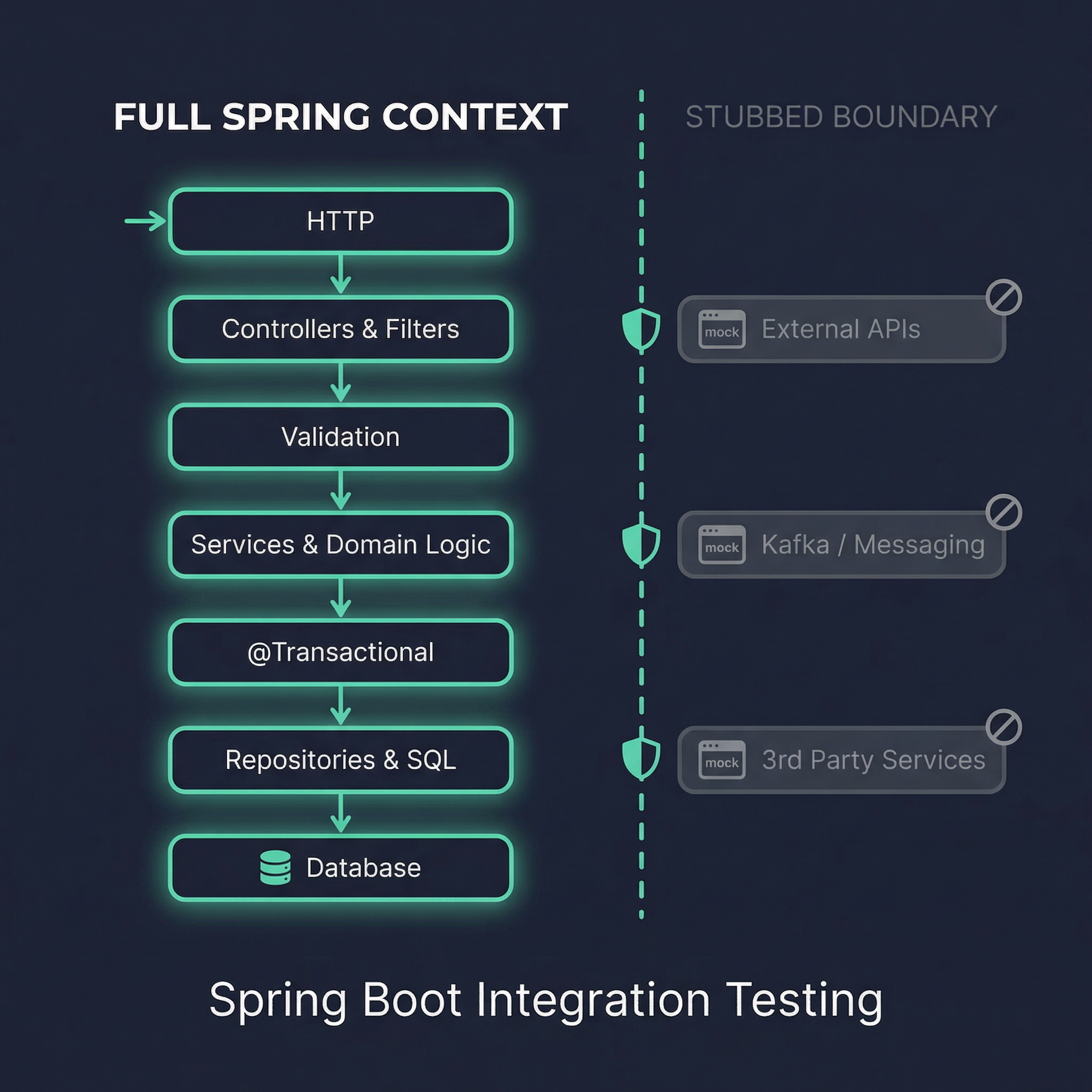
<p><strong>HTTP request -&gt; filters -&gt; validation -&gt; service logic -&gt; transaction boundaries -&gt; repositories -&gt; response serialization</strong></p>
<h3 class="anchor anchorTargetStickyNavbar_Vzrq" id="5-compare-before-and-after-behavior">5. Compare Before and After Behavior<a href="https://bitdive.io/blog/what-is-trace-based-testing/#5-compare-before-and-after-behavior" class="hash-link" aria-label="Direct link to 5. Compare Before and After Behavior" title="Direct link to 5. Compare Before and After Behavior" translate="no">​</a></h3>
<p>This is the proof step. BitDive can compare:</p>
<ul>
<li class="">response payloads</li>
<li class="">SQL count and shape</li>
<li class="">downstream calls and headers</li>
<li class="">error responses</li>
<li class="">call path changes</li>
<li class="">timings and side effects</li>
</ul>
<p>If behavior drifted in a meaningful way, the verification fails.</p>
<h2 class="anchor anchorTargetStickyNavbar_Vzrq" id="why-this-model-is-stronger-than-hand-written-mocks">Why This Model Is Stronger Than Hand-Written Mocks<a href="https://bitdive.io/blog/what-is-trace-based-testing/#why-this-model-is-stronger-than-hand-written-mocks" class="hash-link" aria-label="Direct link to Why This Model Is Stronger Than Hand-Written Mocks" title="Direct link to Why This Model Is Stronger Than Hand-Written Mocks" translate="no">​</a></h2>
<p>The value is not that the test looks shorter. The value is that the source of truth is better.</p>
<p>With a manual test, you often write:</p>
<ul>
<li class="">mock beans</li>
<li class="">WireMock stubs</li>
<li class="">fixture builders</li>
<li class="">setup code for infrastructure dependencies</li>
<li class="">assertions that overfit to technical noise</li>
</ul>
<p>With trace-based testing, the behavior already exists in recorded form.</p>
<p>A replay test can stay very small:</p>
<div class="language-java codeBlockContainer_Ckt0 theme-code-block" style="--prism-color:#F8F8F2;--prism-background-color:#282A36"><div class="codeBlockContent_QJqH"><pre tabindex="0" class="prism-code language-java codeBlock_bY9V thin-scrollbar" style="color:#F8F8F2;background-color:#282A36"><code class="codeBlockLines_e6Vv"><span class="token-line" style="color:#F8F8F2"><span class="token plain">class PolicyControllerReplayTest extends ReplayTestBase {</span><br></span><span class="token-line" style="color:#F8F8F2"><span class="token plain" style="display:inline-block"></span><br></span><span class="token-line" style="color:#F8F8F2"><span class="token plain">    @Override</span><br></span><span class="token-line" style="color:#F8F8F2"><span class="token plain">    protected List&lt;ReplayTestConfiguration&gt; getTestConfigurations() {</span><br></span><span class="token-line" style="color:#F8F8F2"><span class="token plain">        return ReplayTestUtils.fromRestApiWithJsonContentConfigFile(</span><br></span><span class="token-line" style="color:#F8F8F2"><span class="token plain">                Arrays.asList("0d46c175-4926-4fb6-ad2f-866acdc72996")</span><br></span><span class="token-line" style="color:#F8F8F2"><span class="token plain">        );</span><br></span><span class="token-line" style="color:#F8F8F2"><span class="token plain">    }</span><br></span><span class="token-line" style="color:#F8F8F2"><span class="token plain">}</span><br></span></code></pre></div></div>
<p>The important part is not tiny code. The important part is that the scenario ID points to a real execution rather than an invented test world.</p>
<h2 class="anchor anchorTargetStickyNavbar_Vzrq" id="what-trace-based-testing-catches-well">What Trace-Based Testing Catches Well<a href="https://bitdive.io/blog/what-is-trace-based-testing/#what-trace-based-testing-catches-well" class="hash-link" aria-label="Direct link to What Trace-Based Testing Catches Well" title="Direct link to What Trace-Based Testing Catches Well" translate="no">​</a></h2>
<p>Trace-based testing is strongest when the bug is subtle in code review but obvious at runtime.</p>
<h3 class="anchor anchorTargetStickyNavbar_Vzrq" id="api-and-serialization-drift">API and Serialization Drift<a href="https://bitdive.io/blog/what-is-trace-based-testing/#api-and-serialization-drift" class="hash-link" aria-label="Direct link to API and Serialization Drift" title="Direct link to API and Serialization Drift" translate="no">​</a></h3>
<p>A DTO refactor, date format change, or enum serialization shift can compile cleanly and still break consumers.</p>
<h3 class="anchor anchorTargetStickyNavbar_Vzrq" id="error-contract-regressions">Error Contract Regressions<a href="https://bitdive.io/blog/what-is-trace-based-testing/#error-contract-regressions" class="hash-link" aria-label="Direct link to Error Contract Regressions" title="Direct link to Error Contract Regressions" translate="no">​</a></h3>
<p>The service may still return <code>404</code>, but with a different body shape or headers than upstream systems expect.</p>
<h3 class="anchor anchorTargetStickyNavbar_Vzrq" id="n1-queries-and-sql-regressions">N+1 Queries and SQL Regressions<a href="https://bitdive.io/blog/what-is-trace-based-testing/#n1-queries-and-sql-regressions" class="hash-link" aria-label="Direct link to N+1 Queries and SQL Regressions" title="Direct link to N+1 Queries and SQL Regressions" translate="no">​</a></h3>
<p>The endpoint still returns the same JSON, but now runs 40 queries instead of 2.</p>
<h3 class="anchor anchorTargetStickyNavbar_Vzrq" id="unexpected-external-calls">Unexpected External Calls<a href="https://bitdive.io/blog/what-is-trace-based-testing/#unexpected-external-calls" class="hash-link" aria-label="Direct link to Unexpected External Calls" title="Direct link to Unexpected External Calls" translate="no">​</a></h3>
<p>An extra Feign request, Kafka publish, or downstream call may introduce cost or break integration guarantees.</p>
<h3 class="anchor anchorTargetStickyNavbar_Vzrq" id="full-spring-context-issues">Full Spring Context Issues<a href="https://bitdive.io/blog/what-is-trace-based-testing/#full-spring-context-issues" class="hash-link" aria-label="Direct link to Full Spring Context Issues" title="Direct link to Full Spring Context Issues" translate="no">​</a></h3>
<p>Some bugs appear only when real wiring is involved:</p>
<ul>
<li class="">transaction proxies</li>
<li class="">validation behavior</li>
<li class="">repository and schema mismatches</li>
<li class="">request filters</li>
<li class="">mapper behavior under real request flow</li>
</ul>
<p>This is why trace-based testing fits especially well with <a class="" href="https://bitdive.io/java-integration-tests/">Spring Boot integration testing</a>.</p>
<h2 class="anchor anchorTargetStickyNavbar_Vzrq" id="trace-based-testing-vs-unit-tests-vs-e2e">Trace-Based Testing vs Unit Tests vs E2E<a href="https://bitdive.io/blog/what-is-trace-based-testing/#trace-based-testing-vs-unit-tests-vs-e2e" class="hash-link" aria-label="Direct link to Trace-Based Testing vs Unit Tests vs E2E" title="Direct link to Trace-Based Testing vs Unit Tests vs E2E" translate="no">​</a></h2>
<table><thead><tr><th>Approach</th><th>Source of truth</th><th>Main strength</th><th>Main weakness</th></tr></thead><tbody><tr><td><a class="" href="https://bitdive.io/java-unit-tests/">Unit tests</a></td><td>hand-written expectations and mocks</td><td>fast for local logic</td><td>weak against runtime seams</td></tr><tr><td>E2E tests</td><td>live full-system execution</td><td>realistic</td><td>slow and expensive to scale</td></tr><tr><td>Trace-based testing</td><td>real captured runtime behavior</td><td>realistic and repeatable</td><td>requires capture and replay discipline</td></tr></tbody></table>
<p>This is not a reason to delete all your unit tests. Pure logic still benefits from ordinary unit coverage.</p>
<p>The point is different: trace-based testing covers the runtime surface that mock-heavy suites usually miss.</p>
<h2 class="anchor anchorTargetStickyNavbar_Vzrq" id="why-it-matters-for-ai-native-development">Why It Matters for AI-Native Development<a href="https://bitdive.io/blog/what-is-trace-based-testing/#why-it-matters-for-ai-native-development" class="hash-link" aria-label="Direct link to Why It Matters for AI-Native Development" title="Direct link to Why It Matters for AI-Native Development" translate="no">​</a></h2>
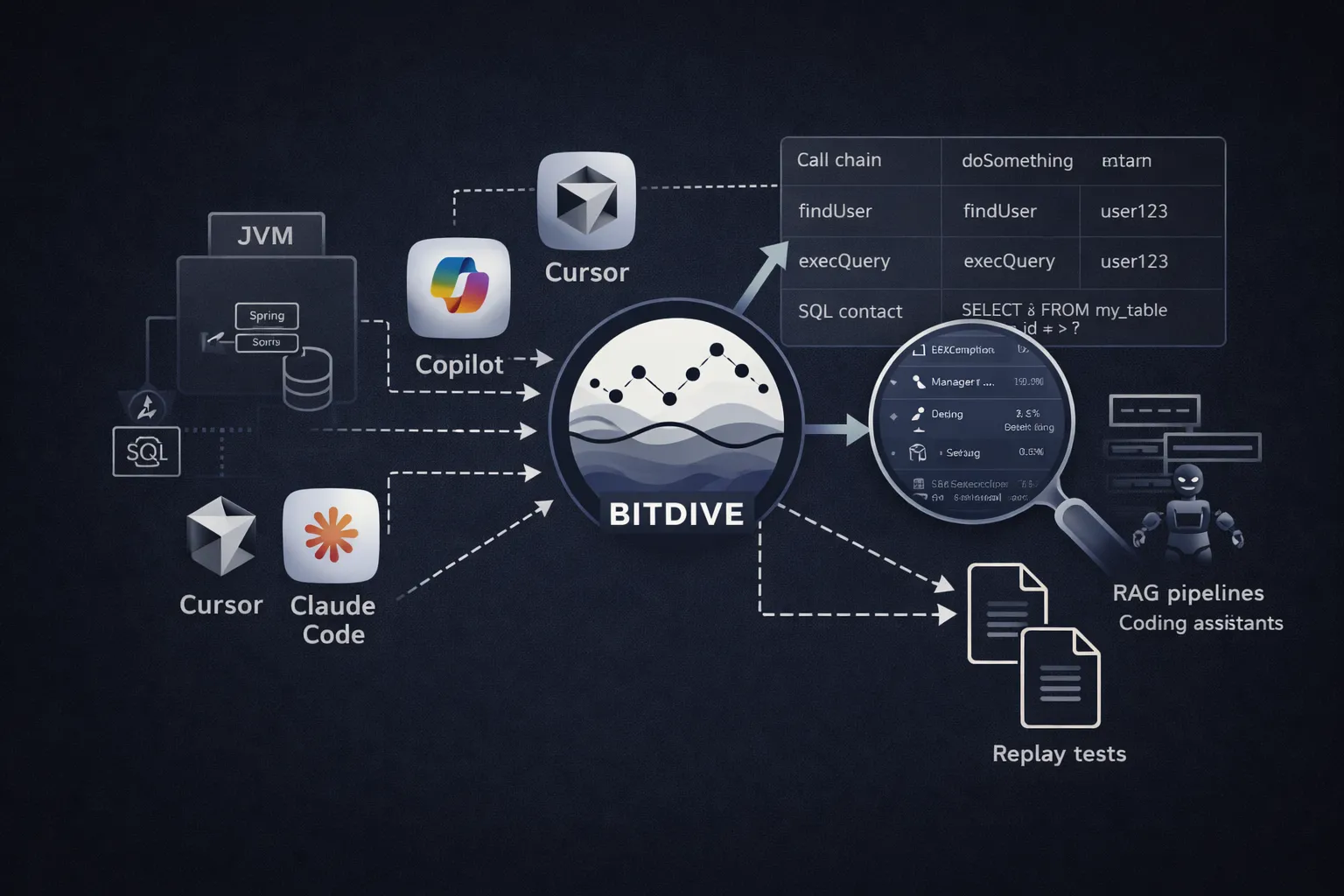
<p>BitDive uses trace-based testing as part of a wider deterministic verification workflow.</p>
<p>The first pillar is <strong>runtime context for AI agents</strong>. Through <a class="" href="https://bitdive.io/ai-runtime-context/">MCP</a>, an agent can inspect real payloads, SQL queries, call chains, and downstream operations before changing code.</p>
<p>The second pillar is <strong>replay-based regression memory</strong>. Once behavior is verified, the same scenario becomes deterministic protection in local development and CI.</p>
<p>That changes the standard from:</p>
<blockquote>
<p>"The patch looks plausible."</p>
</blockquote>
<p>to:</p>
<blockquote>
<p>"The patch was verified against the same runtime scenario and preserved the intended behavior."</p>
</blockquote>
<p>That is the practical difference between AI-assisted coding and AI-assisted engineering.</p>
<h2 class="anchor anchorTargetStickyNavbar_Vzrq" id="when-to-use-trace-based-testing-first">When to Use Trace-Based Testing First<a href="https://bitdive.io/blog/what-is-trace-based-testing/#when-to-use-trace-based-testing-first" class="hash-link" aria-label="Direct link to When to Use Trace-Based Testing First" title="Direct link to When to Use Trace-Based Testing First" translate="no">​</a></h2>
<p>This approach is especially valuable when:</p>
<ul>
<li class="">you are upgrading Spring Boot and need runtime proof that APIs did not drift</li>
<li class="">you are refactoring legacy code with poor existing tests</li>
<li class="">you need to turn a production bug into permanent regression protection</li>
<li class="">mocking the dependency graph is too expensive</li>
<li class="">AI is contributing code and you need stronger proof than lint plus unit tests</li>
<li class="">you care about SQL behavior, contract safety, and call flow, not just final status codes</li>
</ul>
<h2 class="anchor anchorTargetStickyNavbar_Vzrq" id="where-to-go-next-in-bitdive">Where to Go Next in BitDive<a href="https://bitdive.io/blog/what-is-trace-based-testing/#where-to-go-next-in-bitdive" class="hash-link" aria-label="Direct link to Where to Go Next in BitDive" title="Direct link to Where to Go Next in BitDive" translate="no">​</a></h2>
<p>If you want the product view, start here:</p>
<ul>
<li class=""><a class="" href="https://bitdive.io/trace-based-testing/">What Is Trace-Based Testing?</a> for the category overview</li>
<li class=""><a class="" href="https://bitdive.io/docs/testing/testing-overview/">Testing Overview</a></li>
<li class=""><a class="" href="https://bitdive.io/docs/testing/unit-tests/">Automated JUnit Tests from Real Traces</a></li>
<li class=""><a class="" href="https://bitdive.io/docs/testing/integration-tests/">Integration Testing with Deterministic Replay</a></li>
<li class=""><a class="" href="https://bitdive.io/docs/testing/api-verification/">Inter-Service API Verification</a></li>
<li class=""><a class="" href="https://bitdive.io/ai-runtime-context/">Runtime Verification for AI Agents</a></li>
</ul>
<div class="product-highlight dark"><div class="product-highlight-content"><h2>Turn Real Runtime Behavior into Regression Proof</h2><p>BitDive captures real executions, compares before and after traces, and turns verified scenarios into deterministic JUnit replay protection.</p><a href="https://bitdive.io/pricing" class="button button-secondary-filled with-icon icon-calendar">Try BitDive Free</a></div></div>
<hr>
<h2 class="anchor anchorTargetStickyNavbar_Vzrq" id="related-reading">Related Reading<a href="https://bitdive.io/blog/what-is-trace-based-testing/#related-reading" class="hash-link" aria-label="Direct link to Related Reading" title="Direct link to Related Reading" translate="no">​</a></h2>
<ul>
<li class=""><a class="" href="https://bitdive.io/blog/spring-boot-integration-testing-full-context/">Spring Boot Integration Testing: Full Context, Stubbed Boundaries</a> -- when replay-based integration tests beat mock-heavy suites</li>
<li class=""><a class="" href="https://bitdive.io/blog/ai-generated-code-breaks-apis/">Why AI Coding Agents Break APIs</a> -- why source-only reasoning fails at runtime</li>
<li class=""><a class="" href="https://bitdive.io/blog/fragile-generated-tests-trace-replay/">Stop Cluttering Your Codebase with Brittle Generated Tests</a> -- why replay data scales better than generated test code</li>
</ul>
<p><strong><a class="" href="https://bitdive.io/book-demo/">Book a Demo</a></strong> or <strong><a class="" href="https://bitdive.io/pricing/">Try BitDive Free</a></strong> if you want trace-based testing without building a custom replay platform yourself.</p>]]></content>
        <author>
            <name>Dmitry Turmyshev</name>
            <uri>https://www.linkedin.com/in/turmyshev/</uri>
        </author>
        <category label="Software Testing" term="Software Testing"/>
        <category label="Trace-Based Testing" term="Trace-Based Testing"/>
        <category label="Spring Boot" term="Spring Boot"/>
        <category label="Artificial Intelligence" term="Artificial Intelligence"/>
    </entry>
    <entry>
        <title type="html"><![CDATA[How to Detect and Fix N+1 Queries in Spring Boot Before Production]]></title>
        <id>https://bitdive.io/blog/n-plus-one-queries-spring-boot/</id>
        <link href="https://bitdive.io/blog/n-plus-one-queries-spring-boot/"/>
        <updated>2026-04-15T00:00:00.000Z</updated>
        <summary type="html"><![CDATA[Learn how to detect N+1 queries in Spring Boot using real SQL traces, fix them with @EntityGraph, fetch joins, or DTO projections, and verify the API contract did not change.]]></summary>
        <content type="html"><![CDATA[
<p><img decoding="async" loading="lazy" alt="How to Detect and Fix N+1 Queries in Spring Boot Before Production" src="https://bitdive.io/assets/images/hero-382a9ec6f73eb5b623da344336cbd335.webp" width="1024" height="465" class="img_ev3q"></p>
<p><strong>TL;DR:</strong> The hardest part of an N+1 bug is not fixing it. The hardest part is noticing it before production. A Spring Boot endpoint can return the correct JSON, pass unit tests, and still execute 243 SQL queries instead of 1. This post shows how to detect N+1 patterns from <a class="" href="https://bitdive.io/trace-based-testing/">real traces</a>, choose the right fix in Spring Data JPA, and verify that the optimization did not change the API output.</p>
<h2 class="anchor anchorTargetStickyNavbar_Vzrq" id="why-n1-queries-keep-reaching-production">Why N+1 Queries Keep Reaching Production<a href="https://bitdive.io/blog/n-plus-one-queries-spring-boot/#why-n1-queries-keep-reaching-production" class="hash-link" aria-label="Direct link to Why N+1 Queries Keep Reaching Production" title="Direct link to Why N+1 Queries Keep Reaching Production" translate="no">​</a></h2>
<p>N+1 problems survive longer than they should because they rarely break correctness first. They break cost, latency, and scale.</p>
<p>A typical flow looks safe in code review:</p>
<ol>
<li class="">load a list of parent entities</li>
<li class="">access a lazy collection or related entity inside a loop</li>
<li class="">serialize the result into a response</li>
</ol>
<p>The endpoint still returns <code>200 OK</code>. The data looks right. The unit tests stay green because repositories and external dependencies are mocked. But in production, the request does this:</p>
<ul>
<li class="">1 query to load the parent list</li>
<li class="">N more queries to load each child or nested relation</li>
</ul>
<p>At small volume, this looks like a non-event. Under real load, it becomes:</p>
<ul>
<li class="">slow endpoints</li>
<li class="">high database CPU</li>
<li class="">connection pool pressure</li>
<li class="">noisy latency spikes</li>
<li class="">unexpected cloud cost</li>
</ul>
<p>That is why N+1 is a runtime problem first. You need visibility into the actual SQL sequence, not just the Java code.</p>
<h2 class="anchor anchorTargetStickyNavbar_Vzrq" id="what-an-n1-query-looks-like-in-spring-boot">What an N+1 Query Looks Like in Spring Boot<a href="https://bitdive.io/blog/n-plus-one-queries-spring-boot/#what-an-n1-query-looks-like-in-spring-boot" class="hash-link" aria-label="Direct link to What an N+1 Query Looks Like in Spring Boot" title="Direct link to What an N+1 Query Looks Like in Spring Boot" translate="no">​</a></h2>
<p>The classic pattern appears in JPA/Hibernate-backed Spring Boot services.</p>
<p>Imagine a <code>Student</code> entity with a lazy association to <code>courses</code>:</p>
<div class="language-java codeBlockContainer_Ckt0 theme-code-block" style="--prism-color:#F8F8F2;--prism-background-color:#282A36"><div class="codeBlockContent_QJqH"><pre tabindex="0" class="prism-code language-java codeBlock_bY9V thin-scrollbar" style="color:#F8F8F2;background-color:#282A36"><code class="codeBlockLines_e6Vv"><span class="token-line" style="color:#F8F8F2"><span class="token plain">@Entity</span><br></span><span class="token-line" style="color:#F8F8F2"><span class="token plain">public class Student {</span><br></span><span class="token-line" style="color:#F8F8F2"><span class="token plain" style="display:inline-block"></span><br></span><span class="token-line" style="color:#F8F8F2"><span class="token plain">    @Id</span><br></span><span class="token-line" style="color:#F8F8F2"><span class="token plain">    private Long id;</span><br></span><span class="token-line" style="color:#F8F8F2"><span class="token plain" style="display:inline-block"></span><br></span><span class="token-line" style="color:#F8F8F2"><span class="token plain">    private String firstName;</span><br></span><span class="token-line" style="color:#F8F8F2"><span class="token plain">    private String lastName;</span><br></span><span class="token-line" style="color:#F8F8F2"><span class="token plain" style="display:inline-block"></span><br></span><span class="token-line" style="color:#F8F8F2"><span class="token plain">    @ManyToMany(fetch = FetchType.LAZY)</span><br></span><span class="token-line" style="color:#F8F8F2"><span class="token plain">    @JoinTable(</span><br></span><span class="token-line" style="color:#F8F8F2"><span class="token plain">        name = "enrollment",</span><br></span><span class="token-line" style="color:#F8F8F2"><span class="token plain">        joinColumns = @JoinColumn(name = "student_id"),</span><br></span><span class="token-line" style="color:#F8F8F2"><span class="token plain">        inverseJoinColumns = @JoinColumn(name = "course_id")</span><br></span><span class="token-line" style="color:#F8F8F2"><span class="token plain">    )</span><br></span><span class="token-line" style="color:#F8F8F2"><span class="token plain">    private List&lt;Course&gt; courses;</span><br></span><span class="token-line" style="color:#F8F8F2"><span class="token plain">}</span><br></span></code></pre></div></div>
<p>And a service like this:</p>
<div class="language-java codeBlockContainer_Ckt0 theme-code-block" style="--prism-color:#F8F8F2;--prism-background-color:#282A36"><div class="codeBlockContent_QJqH"><pre tabindex="0" class="prism-code language-java codeBlock_bY9V thin-scrollbar" style="color:#F8F8F2;background-color:#282A36"><code class="codeBlockLines_e6Vv"><span class="token-line" style="color:#F8F8F2"><span class="token plain">public List&lt;StudentDto&gt; getStudents() {</span><br></span><span class="token-line" style="color:#F8F8F2"><span class="token plain">    return studentRepository.findAll().stream()</span><br></span><span class="token-line" style="color:#F8F8F2"><span class="token plain">            .map(studentMapper::toDto)</span><br></span><span class="token-line" style="color:#F8F8F2"><span class="token plain">            .toList();</span><br></span><span class="token-line" style="color:#F8F8F2"><span class="token plain">}</span><br></span></code></pre></div></div>
<p>If <code>studentMapper::toDto</code> touches <code>student.getCourses()</code> and each course touches <code>course.getTeacher()</code>, Hibernate may execute:</p>
<ul>
<li class="">1 query for all students</li>
<li class="">1 query per student for courses</li>
<li class="">1 query per course set for teacher data</li>
</ul>
<p>The code looks harmless. The database says otherwise.</p>
<h2 class="anchor anchorTargetStickyNavbar_Vzrq" id="a-real-runtime-pattern">A Real Runtime Pattern<a href="https://bitdive.io/blog/n-plus-one-queries-spring-boot/#a-real-runtime-pattern" class="hash-link" aria-label="Direct link to A Real Runtime Pattern" title="Direct link to A Real Runtime Pattern" translate="no">​</a></h2>
<p>This is the kind of shape BitDive sees in traces:</p>
<div class="language-sql codeBlockContainer_Ckt0 theme-code-block" style="--prism-color:#F8F8F2;--prism-background-color:#282A36"><div class="codeBlockContent_QJqH"><pre tabindex="0" class="prism-code language-sql codeBlock_bY9V thin-scrollbar" style="color:#F8F8F2;background-color:#282A36"><code class="codeBlockLines_e6Vv"><span class="token-line" style="color:#F8F8F2"><span class="token keyword" style="color:rgb(189, 147, 249);font-style:italic">SELECT</span><span class="token plain"> </span><span class="token operator">*</span><span class="token plain"> </span><span class="token keyword" style="color:rgb(189, 147, 249);font-style:italic">FROM</span><span class="token plain"> student</span><span class="token punctuation" style="color:rgb(248, 248, 242)">;</span><span class="token plain"></span><br></span><span class="token-line" style="color:#F8F8F2"><span class="token plain" style="display:inline-block"></span><br></span><span class="token-line" style="color:#F8F8F2"><span class="token plain"></span><span class="token keyword" style="color:rgb(189, 147, 249);font-style:italic">SELECT</span><span class="token plain"> c</span><span class="token punctuation" style="color:rgb(248, 248, 242)">.</span><span class="token operator">*</span><span class="token punctuation" style="color:rgb(248, 248, 242)">,</span><span class="token plain"> t</span><span class="token punctuation" style="color:rgb(248, 248, 242)">.</span><span class="token operator">*</span><span class="token plain"></span><br></span><span class="token-line" style="color:#F8F8F2"><span class="token plain"></span><span class="token keyword" style="color:rgb(189, 147, 249);font-style:italic">FROM</span><span class="token plain"> enrollment e</span><br></span><span class="token-line" style="color:#F8F8F2"><span class="token plain"></span><span class="token keyword" style="color:rgb(189, 147, 249);font-style:italic">JOIN</span><span class="token plain"> course c </span><span class="token keyword" style="color:rgb(189, 147, 249);font-style:italic">ON</span><span class="token plain"> c</span><span class="token punctuation" style="color:rgb(248, 248, 242)">.</span><span class="token plain">id </span><span class="token operator">=</span><span class="token plain"> e</span><span class="token punctuation" style="color:rgb(248, 248, 242)">.</span><span class="token plain">course_id</span><br></span><span class="token-line" style="color:#F8F8F2"><span class="token plain"></span><span class="token keyword" style="color:rgb(189, 147, 249);font-style:italic">LEFT</span><span class="token plain"> </span><span class="token keyword" style="color:rgb(189, 147, 249);font-style:italic">JOIN</span><span class="token plain"> teacher t </span><span class="token keyword" style="color:rgb(189, 147, 249);font-style:italic">ON</span><span class="token plain"> t</span><span class="token punctuation" style="color:rgb(248, 248, 242)">.</span><span class="token plain">id </span><span class="token operator">=</span><span class="token plain"> c</span><span class="token punctuation" style="color:rgb(248, 248, 242)">.</span><span class="token plain">teacher_id</span><br></span><span class="token-line" style="color:#F8F8F2"><span class="token plain"></span><span class="token keyword" style="color:rgb(189, 147, 249);font-style:italic">WHERE</span><span class="token plain"> e</span><span class="token punctuation" style="color:rgb(248, 248, 242)">.</span><span class="token plain">student_id </span><span class="token operator">=</span><span class="token plain"> ?</span><span class="token punctuation" style="color:rgb(248, 248, 242)">;</span><span class="token plain"></span><br></span><span class="token-line" style="color:#F8F8F2"><span class="token plain" style="display:inline-block"></span><br></span><span class="token-line" style="color:#F8F8F2"><span class="token plain"></span><span class="token keyword" style="color:rgb(189, 147, 249);font-style:italic">SELECT</span><span class="token plain"> c</span><span class="token punctuation" style="color:rgb(248, 248, 242)">.</span><span class="token operator">*</span><span class="token punctuation" style="color:rgb(248, 248, 242)">,</span><span class="token plain"> t</span><span class="token punctuation" style="color:rgb(248, 248, 242)">.</span><span class="token operator">*</span><span class="token plain"></span><br></span><span class="token-line" style="color:#F8F8F2"><span class="token plain"></span><span class="token keyword" style="color:rgb(189, 147, 249);font-style:italic">FROM</span><span class="token plain"> enrollment e</span><br></span><span class="token-line" style="color:#F8F8F2"><span class="token plain"></span><span class="token keyword" style="color:rgb(189, 147, 249);font-style:italic">JOIN</span><span class="token plain"> course c </span><span class="token keyword" style="color:rgb(189, 147, 249);font-style:italic">ON</span><span class="token plain"> c</span><span class="token punctuation" style="color:rgb(248, 248, 242)">.</span><span class="token plain">id </span><span class="token operator">=</span><span class="token plain"> e</span><span class="token punctuation" style="color:rgb(248, 248, 242)">.</span><span class="token plain">course_id</span><br></span><span class="token-line" style="color:#F8F8F2"><span class="token plain"></span><span class="token keyword" style="color:rgb(189, 147, 249);font-style:italic">LEFT</span><span class="token plain"> </span><span class="token keyword" style="color:rgb(189, 147, 249);font-style:italic">JOIN</span><span class="token plain"> teacher t </span><span class="token keyword" style="color:rgb(189, 147, 249);font-style:italic">ON</span><span class="token plain"> t</span><span class="token punctuation" style="color:rgb(248, 248, 242)">.</span><span class="token plain">id </span><span class="token operator">=</span><span class="token plain"> c</span><span class="token punctuation" style="color:rgb(248, 248, 242)">.</span><span class="token plain">teacher_id</span><br></span><span class="token-line" style="color:#F8F8F2"><span class="token plain"></span><span class="token keyword" style="color:rgb(189, 147, 249);font-style:italic">WHERE</span><span class="token plain"> e</span><span class="token punctuation" style="color:rgb(248, 248, 242)">.</span><span class="token plain">student_id </span><span class="token operator">=</span><span class="token plain"> ?</span><span class="token punctuation" style="color:rgb(248, 248, 242)">;</span><span class="token plain"></span><br></span><span class="token-line" style="color:#F8F8F2"><span class="token plain" style="display:inline-block"></span><br></span><span class="token-line" style="color:#F8F8F2"><span class="token plain"></span><span class="token keyword" style="color:rgb(189, 147, 249);font-style:italic">SELECT</span><span class="token plain"> c</span><span class="token punctuation" style="color:rgb(248, 248, 242)">.</span><span class="token operator">*</span><span class="token punctuation" style="color:rgb(248, 248, 242)">,</span><span class="token plain"> t</span><span class="token punctuation" style="color:rgb(248, 248, 242)">.</span><span class="token operator">*</span><span class="token plain"></span><br></span><span class="token-line" style="color:#F8F8F2"><span class="token plain"></span><span class="token keyword" style="color:rgb(189, 147, 249);font-style:italic">FROM</span><span class="token plain"> enrollment e</span><br></span><span class="token-line" style="color:#F8F8F2"><span class="token plain"></span><span class="token keyword" style="color:rgb(189, 147, 249);font-style:italic">JOIN</span><span class="token plain"> course c </span><span class="token keyword" style="color:rgb(189, 147, 249);font-style:italic">ON</span><span class="token plain"> c</span><span class="token punctuation" style="color:rgb(248, 248, 242)">.</span><span class="token plain">id </span><span class="token operator">=</span><span class="token plain"> e</span><span class="token punctuation" style="color:rgb(248, 248, 242)">.</span><span class="token plain">course_id</span><br></span><span class="token-line" style="color:#F8F8F2"><span class="token plain"></span><span class="token keyword" style="color:rgb(189, 147, 249);font-style:italic">LEFT</span><span class="token plain"> </span><span class="token keyword" style="color:rgb(189, 147, 249);font-style:italic">JOIN</span><span class="token plain"> teacher t </span><span class="token keyword" style="color:rgb(189, 147, 249);font-style:italic">ON</span><span class="token plain"> t</span><span class="token punctuation" style="color:rgb(248, 248, 242)">.</span><span class="token plain">id </span><span class="token operator">=</span><span class="token plain"> c</span><span class="token punctuation" style="color:rgb(248, 248, 242)">.</span><span class="token plain">teacher_id</span><br></span><span class="token-line" style="color:#F8F8F2"><span class="token plain"></span><span class="token keyword" style="color:rgb(189, 147, 249);font-style:italic">WHERE</span><span class="token plain"> e</span><span class="token punctuation" style="color:rgb(248, 248, 242)">.</span><span class="token plain">student_id </span><span class="token operator">=</span><span class="token plain"> ?</span><span class="token punctuation" style="color:rgb(248, 248, 242)">;</span><br></span></code></pre></div></div>
<p>Same query shape, different bind parameter. Repeated dozens or hundreds of times inside one request. That is the signature.</p>
<h2 class="anchor anchorTargetStickyNavbar_Vzrq" id="how-to-detect-n1-queries-before-production">How to Detect N+1 Queries Before Production<a href="https://bitdive.io/blog/n-plus-one-queries-spring-boot/#how-to-detect-n1-queries-before-production" class="hash-link" aria-label="Direct link to How to Detect N+1 Queries Before Production" title="Direct link to How to Detect N+1 Queries Before Production" translate="no">​</a></h2>
<h3 class="anchor anchorTargetStickyNavbar_Vzrq" id="1-count-sql-queries-per-request-not-per-test-suite">1. Count SQL Queries Per Request, Not Per Test Suite<a href="https://bitdive.io/blog/n-plus-one-queries-spring-boot/#1-count-sql-queries-per-request-not-per-test-suite" class="hash-link" aria-label="Direct link to 1. Count SQL Queries Per Request, Not Per Test Suite" title="Direct link to 1. Count SQL Queries Per Request, Not Per Test Suite" translate="no">​</a></h3>
<p>The right unit of analysis is one business request.</p>
<p>If <code>GET /students</code> returns 50 students and runs:</p>
<ul>
<li class="">1 query for the root list</li>
<li class="">50 queries for child collections</li>
</ul>
<p>you already have an N+1 pattern, even if the response time still "looks fine" on a laptop.</p>
<h3 class="anchor anchorTargetStickyNavbar_Vzrq" id="2-look-for-repeated-query-shapes-with-different-ids">2. Look for Repeated Query Shapes with Different IDs<a href="https://bitdive.io/blog/n-plus-one-queries-spring-boot/#2-look-for-repeated-query-shapes-with-different-ids" class="hash-link" aria-label="Direct link to 2. Look for Repeated Query Shapes with Different IDs" title="Direct link to 2. Look for Repeated Query Shapes with Different IDs" translate="no">​</a></h3>
<p>The giveaway is repetition:</p>
<ul>
<li class="">same <code>SELECT</code></li>
<li class="">same joins</li>
<li class="">same projection</li>
<li class="">only the <code>WHERE ... = ?</code> bind value changes</li>
</ul>
<p>This is why raw logs are not enough. Grepping logs is slow and noisy. You want one request trace with the SQL sequence grouped in order.</p>
<h3 class="anchor anchorTargetStickyNavbar_Vzrq" id="3-compare-query-count-to-the-result-cardinality">3. Compare Query Count to the Result Cardinality<a href="https://bitdive.io/blog/n-plus-one-queries-spring-boot/#3-compare-query-count-to-the-result-cardinality" class="hash-link" aria-label="Direct link to 3. Compare Query Count to the Result Cardinality" title="Direct link to 3. Compare Query Count to the Result Cardinality" translate="no">​</a></h3>
<p>If one endpoint returns:</p>
<ul>
<li class="">1 order and runs 2 queries, that may be normal</li>
<li class="">100 students and runs 243 queries, that is not normal</li>
</ul>
<p>The important ratio is not only "slow or fast." It is "how many queries did this request need to produce one response?"</p>
<h3 class="anchor anchorTargetStickyNavbar_Vzrq" id="4-compare-before-and-after-not-just-before">4. Compare Before and After, Not Just Before<a href="https://bitdive.io/blog/n-plus-one-queries-spring-boot/#4-compare-before-and-after-not-just-before" class="hash-link" aria-label="Direct link to 4. Compare Before and After, Not Just Before" title="Direct link to 4. Compare Before and After, Not Just Before" translate="no">​</a></h3>
<p>Most teams detect N+1 only after the regression has already shipped. A safer pattern is:</p>
<ol>
<li class="">capture the current request trace</li>
<li class="">apply the optimization</li>
<li class="">capture the same request again</li>
<li class="">compare SQL count, SQL shape, timings, and response payload</li>
</ol>
<p>That way you prove both sides:</p>
<ul>
<li class="">performance improved</li>
<li class="">business behavior stayed the same</li>
</ul>
<h2 class="anchor anchorTargetStickyNavbar_Vzrq" id="why-unit-tests-usually-miss-n1">Why Unit Tests Usually Miss N+1<a href="https://bitdive.io/blog/n-plus-one-queries-spring-boot/#why-unit-tests-usually-miss-n1" class="hash-link" aria-label="Direct link to Why Unit Tests Usually Miss N+1" title="Direct link to Why Unit Tests Usually Miss N+1" translate="no">​</a></h2>
<p>A mock-heavy unit test cannot see:</p>
<ul>
<li class="">real SQL count</li>
<li class="">lazy loading behavior</li>
<li class="">serialization side effects</li>
<li class="">transaction boundaries</li>
<li class="">mapper access to nested associations</li>
</ul>
<p>It only sees the objects you fed into the mock.</p>
<p>This is why N+1 bugs often appear after an innocent request like:</p>
<ul>
<li class="">"add courses to the response"</li>
<li class="">"include teacher name in the DTO"</li>
<li class="">"return full details instead of IDs"</li>
</ul>
<p>The Java change is small. The SQL explosion is invisible unless you capture the runtime path.</p>
<h2 class="anchor anchorTargetStickyNavbar_Vzrq" id="the-4-most-useful-fixes-in-spring-boot">The 4 Most Useful Fixes in Spring Boot<a href="https://bitdive.io/blog/n-plus-one-queries-spring-boot/#the-4-most-useful-fixes-in-spring-boot" class="hash-link" aria-label="Direct link to The 4 Most Useful Fixes in Spring Boot" title="Direct link to The 4 Most Useful Fixes in Spring Boot" translate="no">​</a></h2>
<p>There is no single universal fix. The right choice depends on the endpoint shape.</p>
<h3 class="anchor anchorTargetStickyNavbar_Vzrq" id="1-entitygraph-for-repository-level-fetch-plans">1. <code>@EntityGraph</code> for Repository-Level Fetch Plans<a href="https://bitdive.io/blog/n-plus-one-queries-spring-boot/#1-entitygraph-for-repository-level-fetch-plans" class="hash-link" aria-label="Direct link to 1-entitygraph-for-repository-level-fetch-plans" title="Direct link to 1-entitygraph-for-repository-level-fetch-plans" translate="no">​</a></h3>
<p>If one repository method needs a richer graph than the default mapping, <code>@EntityGraph</code> is often the cleanest fix.</p>
<div class="language-java codeBlockContainer_Ckt0 theme-code-block" style="--prism-color:#F8F8F2;--prism-background-color:#282A36"><div class="codeBlockContent_QJqH"><pre tabindex="0" class="prism-code language-java codeBlock_bY9V thin-scrollbar" style="color:#F8F8F2;background-color:#282A36"><code class="codeBlockLines_e6Vv"><span class="token-line" style="color:#F8F8F2"><span class="token plain">public interface StudentRepository extends JpaRepository&lt;Student, Long&gt; {</span><br></span><span class="token-line" style="color:#F8F8F2"><span class="token plain" style="display:inline-block"></span><br></span><span class="token-line" style="color:#F8F8F2"><span class="token plain">    @EntityGraph(attributePaths = {"courses", "courses.teacher"})</span><br></span><span class="token-line" style="color:#F8F8F2"><span class="token plain">    @Query("SELECT DISTINCT s FROM Student s ORDER BY s.lastName ASC, s.firstName ASC")</span><br></span><span class="token-line" style="color:#F8F8F2"><span class="token plain">    List&lt;Student&gt; findAllWithCoursesAndTeachersEntityGraph();</span><br></span><span class="token-line" style="color:#F8F8F2"><span class="token plain">}</span><br></span></code></pre></div></div>
<p>Then the service becomes:</p>
<div class="language-java codeBlockContainer_Ckt0 theme-code-block" style="--prism-color:#F8F8F2;--prism-background-color:#282A36"><div class="codeBlockContent_QJqH"><pre tabindex="0" class="prism-code language-java codeBlock_bY9V thin-scrollbar" style="color:#F8F8F2;background-color:#282A36"><code class="codeBlockLines_e6Vv"><span class="token-line" style="color:#F8F8F2"><span class="token plain">public List&lt;Student&gt; findAll() {</span><br></span><span class="token-line" style="color:#F8F8F2"><span class="token plain">    return studentRepository.findAllWithCoursesAndTeachersEntityGraph();</span><br></span><span class="token-line" style="color:#F8F8F2"><span class="token plain">}</span><br></span></code></pre></div></div>
<p>Use this when:</p>
<ul>
<li class="">one endpoint needs the richer graph</li>
<li class="">the fetch plan is request-specific</li>
<li class="">you want the intention close to the repository method</li>
</ul>
<h3 class="anchor anchorTargetStickyNavbar_Vzrq" id="2-join-fetch-for-explicit-query-control">2. <code>JOIN FETCH</code> for Explicit Query Control<a href="https://bitdive.io/blog/n-plus-one-queries-spring-boot/#2-join-fetch-for-explicit-query-control" class="hash-link" aria-label="Direct link to 2-join-fetch-for-explicit-query-control" title="Direct link to 2-join-fetch-for-explicit-query-control" translate="no">​</a></h3>
<p>If the query is highly specific and you want exact control in JPQL, a fetch join is straightforward.</p>
<div class="language-java codeBlockContainer_Ckt0 theme-code-block" style="--prism-color:#F8F8F2;--prism-background-color:#282A36"><div class="codeBlockContent_QJqH"><pre tabindex="0" class="prism-code language-java codeBlock_bY9V thin-scrollbar" style="color:#F8F8F2;background-color:#282A36"><code class="codeBlockLines_e6Vv"><span class="token-line" style="color:#F8F8F2"><span class="token plain">@Query("""</span><br></span><span class="token-line" style="color:#F8F8F2"><span class="token plain">    select distinct s</span><br></span><span class="token-line" style="color:#F8F8F2"><span class="token plain">    from Student s</span><br></span><span class="token-line" style="color:#F8F8F2"><span class="token plain">    left join fetch s.courses c</span><br></span><span class="token-line" style="color:#F8F8F2"><span class="token plain">    left join fetch c.teacher</span><br></span><span class="token-line" style="color:#F8F8F2"><span class="token plain">    order by s.lastName, s.firstName</span><br></span><span class="token-line" style="color:#F8F8F2"><span class="token plain">""")</span><br></span><span class="token-line" style="color:#F8F8F2"><span class="token plain">List&lt;Student&gt; findAllWithCoursesAndTeachers();</span><br></span></code></pre></div></div>
<p>Use this when:</p>
<ul>
<li class="">the endpoint is read-heavy</li>
<li class="">the fetch shape is fixed</li>
<li class="">you want the join strategy visible in the query itself</li>
</ul>
<p>Be careful with very wide graphs. One big join can trade N+1 for row explosion.</p>
<h3 class="anchor anchorTargetStickyNavbar_Vzrq" id="3-dto-projections-for-read-models">3. DTO Projections for Read Models<a href="https://bitdive.io/blog/n-plus-one-queries-spring-boot/#3-dto-projections-for-read-models" class="hash-link" aria-label="Direct link to 3. DTO Projections for Read Models" title="Direct link to 3. DTO Projections for Read Models" translate="no">​</a></h3>
<p>If the endpoint is purely read-oriented and does not need managed entities, a projection is often better than loading a rich entity graph and serializing it.</p>
<p>Use a DTO projection when:</p>
<ul>
<li class="">you control the exact response shape</li>
<li class="">you only need a subset of columns</li>
<li class="">the endpoint is query-driven, not domain-behavior-driven</li>
</ul>
<p>This can be the cleanest fix for list endpoints and reporting APIs.</p>
<h3 class="anchor anchorTargetStickyNavbar_Vzrq" id="4-batch-fetching-for-some-association-patterns">4. Batch Fetching for Some Association Patterns<a href="https://bitdive.io/blog/n-plus-one-queries-spring-boot/#4-batch-fetching-for-some-association-patterns" class="hash-link" aria-label="Direct link to 4. Batch Fetching for Some Association Patterns" title="Direct link to 4. Batch Fetching for Some Association Patterns" translate="no">​</a></h3>
<p>In some cases, batch fetching can reduce the number of secondary selects without forcing one huge join. This is useful when one giant fetch join would create too many duplicate rows.</p>
<p>Use it carefully. Batch fetching can improve the pattern, but it does not make the query plan obvious to reviewers. You still need trace-level evidence that the request improved.</p>
<h2 class="anchor anchorTargetStickyNavbar_Vzrq" id="what-not-to-do">What Not to Do<a href="https://bitdive.io/blog/n-plus-one-queries-spring-boot/#what-not-to-do" class="hash-link" aria-label="Direct link to What Not to Do" title="Direct link to What Not to Do" translate="no">​</a></h2>
<h3 class="anchor anchorTargetStickyNavbar_Vzrq" id="do-not-default-everything-to-fetchtypeeager">Do Not Default Everything to <code>FetchType.EAGER</code><a href="https://bitdive.io/blog/n-plus-one-queries-spring-boot/#do-not-default-everything-to-fetchtypeeager" class="hash-link" aria-label="Direct link to do-not-default-everything-to-fetchtypeeager" title="Direct link to do-not-default-everything-to-fetchtypeeager" translate="no">​</a></h3>
<p><code>EAGER</code> is not a real N+1 strategy. It is a blunt mapping decision. It can:</p>
<ul>
<li class="">hide performance problems in one path</li>
<li class="">create oversized object graphs in another</li>
<li class="">trigger unnecessary joins everywhere</li>
</ul>
<p>Fix the request shape, not the whole domain model by default.</p>
<h3 class="anchor anchorTargetStickyNavbar_Vzrq" id="do-not-trust-a-faster-response-alone">Do Not Trust a Faster Response Alone<a href="https://bitdive.io/blog/n-plus-one-queries-spring-boot/#do-not-trust-a-faster-response-alone" class="hash-link" aria-label="Direct link to Do Not Trust a Faster Response Alone" title="Direct link to Do Not Trust a Faster Response Alone" translate="no">​</a></h3>
<p>If one request went from 240 queries to 4, that is good. But you still need to verify:</p>
<ul>
<li class="">did the response body change?</li>
<li class="">did nested fields disappear?</li>
<li class="">did ordering change?</li>
<li class="">did headers or error handling drift?</li>
</ul>
<p>Performance optimization that silently changes the API contract is still a regression.</p>
<h2 class="anchor anchorTargetStickyNavbar_Vzrq" id="a-safer-n1-workflow-with-bitdive">A Safer N+1 Workflow with BitDive<a href="https://bitdive.io/blog/n-plus-one-queries-spring-boot/#a-safer-n1-workflow-with-bitdive" class="hash-link" aria-label="Direct link to A Safer N+1 Workflow with BitDive" title="Direct link to A Safer N+1 Workflow with BitDive" translate="no">​</a></h2>
<p>The most reliable workflow is:</p>
<h3 class="anchor anchorTargetStickyNavbar_Vzrq" id="step-1-capture-the-baseline-request">Step 1: Capture the Baseline Request<a href="https://bitdive.io/blog/n-plus-one-queries-spring-boot/#step-1-capture-the-baseline-request" class="hash-link" aria-label="Direct link to Step 1: Capture the Baseline Request" title="Direct link to Step 1: Capture the Baseline Request" translate="no">​</a></h3>
<p>Trigger the real endpoint with BitDive attached and inspect:</p>
<ul>
<li class="">SQL sequence</li>
<li class="">query count</li>
<li class="">timings</li>
<li class="">response body</li>
</ul>
<h3 class="anchor anchorTargetStickyNavbar_Vzrq" id="step-2-identify-the-repeated-query-pattern">Step 2: Identify the Repeated Query Pattern<a href="https://bitdive.io/blog/n-plus-one-queries-spring-boot/#step-2-identify-the-repeated-query-pattern" class="hash-link" aria-label="Direct link to Step 2: Identify the Repeated Query Pattern" title="Direct link to Step 2: Identify the Repeated Query Pattern" translate="no">​</a></h3>
<p>BitDive shows the full execution tree and SQL sequence for one request, so you can see exactly where the repeated selects begin.</p>
<p>For a concrete walkthrough, see <a class="" href="https://bitdive.io/docs/cursor-analyze-services-with-bitdive/">Cursor AI &amp; BitDive: Diagnosing N+1 Queries with Runtime Context</a>.</p>
<h3 class="anchor anchorTargetStickyNavbar_Vzrq" id="step-3-apply-the-smallest-reasonable-fix">Step 3: Apply the Smallest Reasonable Fix<a href="https://bitdive.io/blog/n-plus-one-queries-spring-boot/#step-3-apply-the-smallest-reasonable-fix" class="hash-link" aria-label="Direct link to Step 3: Apply the Smallest Reasonable Fix" title="Direct link to Step 3: Apply the Smallest Reasonable Fix" translate="no">​</a></h3>
<p>Typical fixes:</p>
<ul>
<li class="">add <code>@EntityGraph</code></li>
<li class="">replace <code>findAll()</code> with a fetch-specific repository method</li>
<li class="">switch the endpoint to a DTO projection</li>
<li class="">adjust the association access path</li>
</ul>
<h3 class="anchor anchorTargetStickyNavbar_Vzrq" id="step-4-capture-the-same-request-again">Step 4: Capture the Same Request Again<a href="https://bitdive.io/blog/n-plus-one-queries-spring-boot/#step-4-capture-the-same-request-again" class="hash-link" aria-label="Direct link to Step 4: Capture the Same Request Again" title="Direct link to Step 4: Capture the Same Request Again" translate="no">​</a></h3>
<p>Run the same endpoint after the change and capture a second trace.</p>
<h3 class="anchor anchorTargetStickyNavbar_Vzrq" id="step-5-compare-before-and-after">Step 5: Compare Before and After<a href="https://bitdive.io/blog/n-plus-one-queries-spring-boot/#step-5-compare-before-and-after" class="hash-link" aria-label="Direct link to Step 5: Compare Before and After" title="Direct link to Step 5: Compare Before and After" translate="no">​</a></h3>
<p>This is the proof step. Compare:</p>
<ul>
<li class="">SQL count</li>
<li class="">SQL shape</li>
<li class="">response payload</li>
<li class="">method return values</li>
<li class="">downstream behavior</li>
</ul>
<p>For example:</p>
<table><thead><tr><th>Metric</th><th>Before</th><th>After</th></tr></thead><tbody><tr><td>Response time</td><td>94ms</td><td>13ms</td></tr><tr><td>SQL queries</td><td>243</td><td>1</td></tr><tr><td>Response body</td><td>identical</td><td>identical</td></tr></tbody></table>
<p>That is a safe optimization. Faster and behaviorally stable.</p>
<h3 class="anchor anchorTargetStickyNavbar_Vzrq" id="step-6-preserve-it-as-regression-memory">Step 6: Preserve It as Regression Memory<a href="https://bitdive.io/blog/n-plus-one-queries-spring-boot/#step-6-preserve-it-as-regression-memory" class="hash-link" aria-label="Direct link to Step 6: Preserve It as Regression Memory" title="Direct link to Step 6: Preserve It as Regression Memory" translate="no">​</a></h3>
<p>Once the optimized request is verified, turn that execution into replay-based protection so the N+1 pattern does not come back six weeks later.</p>
<p>That is where <a class="" href="https://bitdive.io/trace-based-testing/">trace-based testing</a> becomes part of performance engineering, not just functional testing.</p>
<h2 class="anchor anchorTargetStickyNavbar_Vzrq" id="why-this-matters-for-ai-assisted-development">Why This Matters for AI-Assisted Development<a href="https://bitdive.io/blog/n-plus-one-queries-spring-boot/#why-this-matters-for-ai-assisted-development" class="hash-link" aria-label="Direct link to Why This Matters for AI-Assisted Development" title="Direct link to Why This Matters for AI-Assisted Development" translate="no">​</a></h2>
<p>N+1 is a perfect example of where AI needs runtime context.</p>
<p>An agent reading source code can see:</p>
<ul>
<li class=""><code>studentRepository.findAll()</code></li>
<li class=""><code>student.getCourses()</code></li>
<li class="">a mapper calling nested getters</li>
</ul>
<p>What it cannot see from static code alone is:</p>
<ul>
<li class="">the actual SQL sequence</li>
<li class="">how many times the query repeats</li>
<li class="">whether the "fix" changed the API output</li>
</ul>
<p>That is why BitDive's <a class="" href="https://bitdive.io/ai-runtime-context/">runtime context for AI agents</a> matters. The agent can inspect the trace, apply a targeted fix, then compare before and after traces to verify it improved the query plan without breaking the response.</p>
<div class="product-highlight dark"><div class="product-highlight-content"><h2>Find N+1 Queries from Real Runtime Traces</h2><p>BitDive captures SQL activity, method calls, and response payloads for one real request. Detect repeated query patterns, apply a focused fix, and verify that performance improved without changing the API contract.</p><a href="https://bitdive.io/java-code-level-observability/" class="button button-secondary-filled with-icon icon-calendar">Explore code-level observability</a></div></div>
<h2 class="anchor anchorTargetStickyNavbar_Vzrq" id="related-reading">Related Reading<a href="https://bitdive.io/blog/n-plus-one-queries-spring-boot/#related-reading" class="hash-link" aria-label="Direct link to Related Reading" title="Direct link to Related Reading" translate="no">​</a></h2>
<ul>
<li class=""><a class="" href="https://bitdive.io/docs/cursor-analyze-services-with-bitdive/">Interactive Demo: Fixing N+1 Queries with Cursor</a></li>
<li class=""><a class="" href="https://bitdive.io/ai-runtime-context/">Runtime Context for AI Agents</a></li>
<li class=""><a class="" href="https://bitdive.io/trace-based-testing/">What Is Trace-Based Testing?</a></li>
<li class=""><a class="" href="https://bitdive.io/blog/spring-boot-integration-testing-full-context/">Spring Boot Integration Testing: Full Context, Stubbed Boundaries, Zero Flakiness</a></li>
</ul>]]></content>
        <author>
            <name>Evgenii Frolikov</name>
            <uri>https://www.linkedin.com/in/evgeniy-frolikov-java-developer/</uri>
        </author>
        <category label="Spring Boot" term="Spring Boot"/>
        <category label="Performance" term="Performance"/>
        <category label="Trace-Based Testing" term="Trace-Based Testing"/>
        <category label="Java" term="Java"/>
    </entry>
    <entry>
        <title type="html"><![CDATA[Stop Cluttering Your Codebase with Brittle Generated Tests]]></title>
        <id>https://bitdive.io/blog/fragile-generated-tests-trace-replay/</id>
        <link href="https://bitdive.io/blog/fragile-generated-tests-trace-replay/"/>
        <updated>2026-03-26T00:00:00.000Z</updated>
        <summary type="html"><![CDATA[Industry tools that generate hundreds of .java test files create noisy PRs and fragile CI. Learn why storing traces as data and replaying them dynamically is the only scalable way to verify real behavior.]]></summary>
        <content type="html"><![CDATA[
<p><img decoding="async" loading="lazy" alt="Trace-based dynamic test replay vs. generated test code" src="https://bitdive.io/assets/images/hero-3196803a834e593fd969e896cc052885.png" width="1536" height="622" class="img_ev3q"></p>
<p><strong>TL;DR:</strong> In the industry, there is a weird habit: if a tool can generate tests, it is considered automatically useful. If you have 300 new <code>.java</code> files in your repo after recording a scenario, the team assumes they have "more quality." They are wrong. Automated test generation often turns into a source of engineering pain, cluttering repositories and burying real regressions in noise. There is a more mature path: capture real execution traces, store them as data, and replay them dynamically.</p>
<h2 class="anchor anchorTargetStickyNavbar_Vzrq" id="the-hidden-cost-of-generated-test-code">The Hidden Cost of Generated Test Code<a href="https://bitdive.io/blog/fragile-generated-tests-trace-replay/#the-hidden-cost-of-generated-test-code" class="hash-link" aria-label="Direct link to The Hidden Cost of Generated Test Code" title="Direct link to The Hidden Cost of Generated Test Code" translate="no">​</a></h2>
<p>The problem is not that tests are created automatically. The problem is <strong>what</strong> exactly is created.</p>
<p>If an instrument produces static <code>.java</code> files that:</p>
<ul>
<li class="">Fail because of a timestamp change</li>
<li class="">Fail due to an extra field in a JSON response</li>
<li class="">Fail because of a shift in JSON field order</li>
<li class="">Fail after an internal method rename</li>
<li class="">Fail after any refactoring that doesn't change business logic</li>
</ul>
<p>...then it is not a regression testing strategy. It is just a generator of fragile noise.</p>
<h3 class="anchor anchorTargetStickyNavbar_Vzrq" id="the-fragility-cascade">The Fragility Cascade<a href="https://bitdive.io/blog/fragile-generated-tests-trace-replay/#the-fragility-cascade" class="hash-link" aria-label="Direct link to The Fragility Cascade" title="Direct link to The Fragility Cascade" translate="no">​</a></h3>
<p>When your repository becomes a dumping ground for side artifacts that no one wrote and no one wants to read, your engineering velocity dies.</p>
<div class="mermaid-container"><div class="mermaid-caption">Figure 1: The cascade of fragility when tests are treated as code artifacts.</div></div>
<ol>
<li class=""><strong>Existing codebase:</strong> You have your application's source code and logic.</li>
<li class=""><strong>Auto-derive logic:</strong> A tool or AI agent parses code structure or record local execution.</li>
<li class=""><strong>Generate 100s of .java files:</strong> The system produces massive amounts of boilerplate code (mocks, setup, assertions) to "freeze" the state.</li>
<li class=""><strong>Commit to repository:</strong> Pull requests drown in garbage.</li>
<li class=""><strong>Noisy PRs:</strong> Every minor change triggers a avalanche of test updates.</li>
<li class=""><strong>Fragile CI failures:</strong> CI turns red for technical fluctuations, not business bugs.</li>
<li class=""><strong>Team fears change:</strong> Refactoring is avoided because the test maintenance is too expensive.</li>
</ol>
<h2 class="anchor anchorTargetStickyNavbar_Vzrq" id="why-generated-tests-break-every-sneeze">Why Generated Tests Break "Every Sneeze"<a href="https://bitdive.io/blog/fragile-generated-tests-trace-replay/#why-generated-tests-break-every-sneeze" class="hash-link" aria-label="Direct link to Why Generated Tests Break &quot;Every Sneeze&quot;" title="Direct link to Why Generated Tests Break &quot;Every Sneeze&quot;" translate="no">​</a></h2>
<p>Generated tests fixate on the wrong things. Instead of verifying business invariants, key results, or significant contracts, they verify:</p>
<ul>
<li class="">Dynamic UUIDs</li>
<li class="">Timestamps</li>
<li class="">Technical headers</li>
<li class="">Serialized form (field order)</li>
<li class="">Service hostnames</li>
</ul>
<h3 class="anchor anchorTargetStickyNavbar_Vzrq" id="the-bad-path-example">The "Bad Path" Example<a href="https://bitdive.io/blog/fragile-generated-tests-trace-replay/#the-bad-path-example" class="hash-link" aria-label="Direct link to The &quot;Bad Path&quot; Example" title="Direct link to The &quot;Bad Path&quot; Example" translate="no">​</a></h3>
<p>Here is a typical anti-pattern: a statically generated test that looks "powerful" but is actually a brittle trap.</p>
<div class="language-java codeBlockContainer_Ckt0 theme-code-block" style="--prism-color:#F8F8F2;--prism-background-color:#282A36"><div class="codeBlockContent_QJqH"><pre tabindex="0" class="prism-code language-java codeBlock_bY9V thin-scrollbar" style="color:#F8F8F2;background-color:#282A36"><code class="codeBlockLines_e6Vv"><span class="token-line" style="color:#F8F8F2"><span class="token plain">@Test</span><br></span><span class="token-line" style="color:#F8F8F2"><span class="token plain">void shouldReplayCreateContract_2026_03_19_15_42_11() throws Exception {</span><br></span><span class="token-line" style="color:#F8F8F2"><span class="token plain">    ContractRequest request = new ContractRequest();</span><br></span><span class="token-line" style="color:#F8F8F2"><span class="token plain">    request.setClientId("12345");</span><br></span><span class="token-line" style="color:#F8F8F2"><span class="token plain">    request.setProductCode("IPOTEKA");</span><br></span><span class="token-line" style="color:#F8F8F2"><span class="token plain">    // Brittle timestamp!</span><br></span><span class="token-line" style="color:#F8F8F2"><span class="token plain">    request.setRequestedAt(OffsetDateTime.parse("2026-03-19T15:42:11.123+03:00"));</span><br></span><span class="token-line" style="color:#F8F8F2"><span class="token plain" style="display:inline-block"></span><br></span><span class="token-line" style="color:#F8F8F2"><span class="token plain">    ContractResponse actual = contractService.createContract(request);</span><br></span><span class="token-line" style="color:#F8F8F2"><span class="token plain" style="display:inline-block"></span><br></span><span class="token-line" style="color:#F8F8F2"><span class="token plain">    assertEquals("OK", actual.getStatus());</span><br></span><span class="token-line" style="color:#F8F8F2"><span class="token plain">    // Brittle UUID!</span><br></span><span class="token-line" style="color:#F8F8F2"><span class="token plain">    assertEquals("c7d89e8e-5d7f-4f7a-a2a2-873638f47f44", actual.getRequestId());</span><br></span><span class="token-line" style="color:#F8F8F2"><span class="token plain">    assertEquals("2026-03-19T15:42:11.456+03:00", actual.getCreatedAt().toString());</span><br></span><span class="token-line" style="color:#F8F8F2"><span class="token plain">    // Brittle JSON structure comparison!</span><br></span><span class="token-line" style="color:#F8F8F2"><span class="token plain">    assertEquals("""</span><br></span><span class="token-line" style="color:#F8F8F2"><span class="token plain">        {</span><br></span><span class="token-line" style="color:#F8F8F2"><span class="token plain">          "status":"OK",</span><br></span><span class="token-line" style="color:#F8F8F2"><span class="token plain">          "requestId":"c7d89e8e-5d7f-4f7a-a2a2-873638f47f44",</span><br></span><span class="token-line" style="color:#F8F8F2"><span class="token plain">          "createdAt":"2026-03-19T15:42:11.456+03:00",</span><br></span><span class="token-line" style="color:#F8F8F2"><span class="token plain">          "technicalInfo":{</span><br></span><span class="token-line" style="color:#F8F8F2"><span class="token plain">            "host":"node-17",</span><br></span><span class="token-line" style="color:#F8F8F2"><span class="token plain">            "thread":"http-nio-8080-exec-5"</span><br></span><span class="token-line" style="color:#F8F8F2"><span class="token plain">          }</span><br></span><span class="token-line" style="color:#F8F8F2"><span class="token plain">        }</span><br></span><span class="token-line" style="color:#F8F8F2"><span class="token plain">        """, objectMapper.writeValueAsString(actual));</span><br></span><span class="token-line" style="color:#F8F8F2"><span class="token plain">}</span><br></span></code></pre></div></div>
<p>This test catches every technical shiver but misses the signal. The smallest DTO refactoring makes this test red without any business logic failure.</p>
<h2 class="anchor anchorTargetStickyNavbar_Vzrq" id="the-false-alarm-trap">The False Alarm Trap<a href="https://bitdive.io/blog/fragile-generated-tests-trace-replay/#the-false-alarm-trap" class="hash-link" aria-label="Direct link to The False Alarm Trap" title="Direct link to The False Alarm Trap" translate="no">​</a></h2>
<p>This structural coupling trains developers to ignore the CI.</p>
<div class="mermaid-container"><div class="mermaid-caption">Figure 2: The signal-to-noise ratio problem in automated test generation.</div></div>
<p>When you refactor:</p>
<ul>
<li class=""><strong>Did logic change? No.</strong> Generated tests fail anyway. This is a <strong>false alarm</strong>.</li>
<li class=""><strong>Did logic change? Yes.</strong> There is a real bug.</li>
</ul>
<p>But because the developer already sees 30+ failures from the false alarms, the real regression is drowned in the noise. The team ends up "fixing" tests by bulk-updating mocks without checking the logic.</p>
<h2 class="anchor anchorTargetStickyNavbar_Vzrq" id="bitdive-a-replay-platform-not-a-code-generator">BitDive: A Replay Platform, Not a Code Generator<a href="https://bitdive.io/blog/fragile-generated-tests-trace-replay/#bitdive-a-replay-platform-not-a-code-generator" class="hash-link" aria-label="Direct link to BitDive: A Replay Platform, Not a Code Generator" title="Direct link to BitDive: A Replay Platform, Not a Code Generator" translate="no">​</a></h2>
<p>BitDive offers a more mature model. We don't flood your project with static test files. Instead, we treat scenarios as <strong>data</strong> and use a centralized <strong>replay engine</strong> to verify behavior.</p>
<div class="mermaid-container"><div class="mermaid-caption">Figure 3: The clean BitDive verified scenario flow.</div></div>
<h3 class="anchor anchorTargetStickyNavbar_Vzrq" id="the-architecture-tests-as-data">The Architecture: Tests as Data<a href="https://bitdive.io/blog/fragile-generated-tests-trace-replay/#the-architecture-tests-as-data" class="hash-link" aria-label="Direct link to The Architecture: Tests as Data" title="Direct link to The Architecture: Tests as Data" translate="no">​</a></h3>
<p>The core shift is simple: stop committing test code. Commit the <strong>test scenario</strong> as a data snapshot.</p>
<div class="mermaid-container"><div class="mermaid-caption">Figure 4: BitDive architecture—separating capture (data) from replay (verification).</div></div>
<h3 class="anchor anchorTargetStickyNavbar_Vzrq" id="implementation-the-good-path">Implementation: The "Good Path"<a href="https://bitdive.io/blog/fragile-generated-tests-trace-replay/#implementation-the-good-path" class="hash-link" aria-label="Direct link to Implementation: The &quot;Good Path&quot;" title="Direct link to Implementation: The &quot;Good Path&quot;" translate="no">​</a></h3>
<p>In your repository, you keep one clean runner that loads all scenarios dynamically using JUnit 5 <code>DynamicNode</code>.</p>
<div class="language-java codeBlockContainer_Ckt0 theme-code-block" style="--prism-color:#F8F8F2;--prism-background-color:#282A36"><div class="codeBlockContent_QJqH"><pre tabindex="0" class="prism-code language-java codeBlock_bY9V thin-scrollbar" style="color:#F8F8F2;background-color:#282A36"><code class="codeBlockLines_e6Vv"><span class="token-line" style="color:#F8F8F2"><span class="token plain">import org.junit.jupiter.api.DynamicNode;</span><br></span><span class="token-line" style="color:#F8F8F2"><span class="token plain">import org.junit.jupiter.api.DynamicTest;</span><br></span><span class="token-line" style="color:#F8F8F2"><span class="token plain">import org.junit.jupiter.api.TestFactory;</span><br></span><span class="token-line" style="color:#F8F8F2"><span class="token plain" style="display:inline-block"></span><br></span><span class="token-line" style="color:#F8F8F2"><span class="token plain">class BitDiveReplayTest extends ReplayTestBase {</span><br></span><span class="token-line" style="color:#F8F8F2"><span class="token plain" style="display:inline-block"></span><br></span><span class="token-line" style="color:#F8F8F2"><span class="token plain">    @TestFactory</span><br></span><span class="token-line" style="color:#F8F8F2"><span class="token plain">    List&lt;DynamicNode&gt; replayRecordedScenarios() {</span><br></span><span class="token-line" style="color:#F8F8F2"><span class="token plain">        return traceRepository.loadAll().stream()</span><br></span><span class="token-line" style="color:#F8F8F2"><span class="token plain">                .map(trace -&gt; DynamicTest.dynamicTest(</span><br></span><span class="token-line" style="color:#F8F8F2"><span class="token plain">                        trace.testDisplayName(),</span><br></span><span class="token-line" style="color:#F8F8F2"><span class="token plain">                        () -&gt; {</span><br></span><span class="token-line" style="color:#F8F8F2"><span class="token plain">                            ReplayResult actual = replayEngine.replay(trace);</span><br></span><span class="token-line" style="color:#F8F8F2"><span class="token plain">                            replayAssertions.assertMatches(trace.expectedSnapshot(), actual);</span><br></span><span class="token-line" style="color:#F8F8F2"><span class="token plain">                        }</span><br></span><span class="token-line" style="color:#F8F8F2"><span class="token plain">                ))</span><br></span><span class="token-line" style="color:#F8F8F2"><span class="token plain">                .collect(Collectors.toList());</span><br></span><span class="token-line" style="color:#F8F8F2"><span class="token plain">    }</span><br></span><span class="token-line" style="color:#F8F8F2"><span class="token plain">}</span><br></span></code></pre></div></div>
<p>This doesn't clutter your <code>src/test/java</code>. Adding new scenarios just means adding new trace data files to your resources.</p>
<h2 class="anchor anchorTargetStickyNavbar_Vzrq" id="comparing-the-approaches">Comparing the Approaches<a href="https://bitdive.io/blog/fragile-generated-tests-trace-replay/#comparing-the-approaches" class="hash-link" aria-label="Direct link to Comparing the Approaches" title="Direct link to Comparing the Approaches" translate="no">​</a></h2>
<table><thead><tr><th>Metric</th><th>Generated .java Tests</th><th>BitDive Trace Replay</th></tr></thead><tbody><tr><td>Repository Impact</td><td>Massive (1000s of files)</td><td>Minimal (Data files + 1 runner)</td></tr><tr><td>Maintenance</td><td>High (breaks on refactoring)</td><td>Low (centralized normalization)</td></tr><tr><td>Review Effort</td><td>Exhausting noisy PRs</td><td>Meaningful logic changes</td></tr><tr><td>Trust in CI</td><td>Low (false positives hide bugs)</td><td>High (contract-level verification)</td></tr><tr><td>Scalability</td><td>Linear growth of boilerplace</td><td>Logarithmic growth of data</td></tr></tbody></table>
<h2 class="anchor anchorTargetStickyNavbar_Vzrq" id="why-replay-wins-at-scale">Why Replay Wins at Scale<a href="https://bitdive.io/blog/fragile-generated-tests-trace-replay/#why-replay-wins-at-scale" class="hash-link" aria-label="Direct link to Why Replay Wins at Scale" title="Direct link to Why Replay Wins at Scale" translate="no">​</a></h2>
<p>Traditional generated tests have a "stupid" growth model: <strong>more scenarios = more files</strong>.
More files lead to heavier reviews, which leads to lower trust and "formal" approvals.</p>
<p>BitDive's replay approach scales differently:</p>
<ul>
<li class=""><strong>More scenarios</strong> = more trace snapshots.</li>
<li class=""><strong>Replay engine</strong> remains the same.</li>
<li class=""><strong>Normalization rules</strong> are centralized (e.g., ignore all UUIDs in one place).</li>
<li class=""><strong>Scale is handled by data</strong>, not code maintenance.</li>
</ul>
<div class="product-highlight dark"><div class="product-highlight-content"><h2>Stop the Code Clutter</h2><p>BitDive captures real behavior and replays it as deterministic tests. No generated garbage. No fragile mocks. Just verified behavior that stays green through refactoring.</p><a href="https://bitdive.io/pricing" class="button button-secondary-filled with-icon icon-calendar">Get Started for Free</a></div></div>
<hr>
<h2 class="anchor anchorTargetStickyNavbar_Vzrq" id="related-reading">Related Reading<a href="https://bitdive.io/blog/fragile-generated-tests-trace-replay/#related-reading" class="hash-link" aria-label="Direct link to Related Reading" title="Direct link to Related Reading" translate="no">​</a></h2>
<ul>
<li class=""><a class="" href="https://bitdive.io/blog/spring-boot-integration-testing-full-context/">Spring Boot Integration Testing: Full Context</a> -- How to boot real ApplicationContext for stable verification.</li>
<li class=""><a class="" href="https://bitdive.io/blog/unit-tests-zero-code-automation/">Trace-Based Java Testing: Unit Tests without Mocks</a> -- Deep dive into deterministic verification.</li>
<li class=""><a class="" href="https://bitdive.io/docs/testing/testing-overview/">Trace-Based Testing Overview</a> -- The technical foundation of BitDive.</li>
</ul>
<p><strong><a class="" href="https://bitdive.io/pricing/">Try BitDive Free</a></strong></p>]]></content>
        <author>
            <name>Evgenii Frolikov</name>
            <uri>https://www.linkedin.com/in/evgeniy-frolikov-java-developer/</uri>
        </author>
        <category label="Software Testing" term="Software Testing"/>
        <category label="Trace-Based Testing" term="Trace-Based Testing"/>
        <category label="Spring Boot" term="Spring Boot"/>
        <category label="Integration Tests" term="Integration Tests"/>
    </entry>
    <entry>
        <title type="html"><![CDATA[Why AI Coding Agents Break APIs (And How BitDive Restores Their Vision via MCP)]]></title>
        <id>https://bitdive.io/blog/ai-generated-code-breaks-apis/</id>
        <link href="https://bitdive.io/blog/ai-generated-code-breaks-apis/"/>
        <updated>2026-03-11T00:00:00.000Z</updated>
        <summary type="html"><![CDATA[AI coding agents like Cursor and Copilot write code blazingly fast but are completely blind to runtime behavior. Here are 5 ways they silently break your API contracts, and how giving them runtime context and trace comparison via BitDive and MCP solves this.]]></summary>
        <content type="html"><![CDATA[
<p><img decoding="async" loading="lazy" alt="Why AI Coding Agents Break APIs" src="https://bitdive.io/assets/images/hero-d701bf7d6963233f65b03ab535aa6b99.png" width="640" height="290" class="img_ev3q"></p>
<p><strong>TL;DR:</strong> AI coding agents are incredibly powerful at reading and writing source code, but when it comes to understanding what code <em>actually does at runtime</em>, they are blind. They can read `repository.findAll()` in the source code, but they cannot see the 40-query N+1 explosion it causes in production. This post explores how AI routinely breaks APIs and how connecting agents to runtime context and before/after trace comparison through BitDive and the Model Context Protocol (MCP) dramatically improves their reliability.</p>
<h2 class="anchor anchorTargetStickyNavbar_Vzrq" id="the-ai-runtime-blindness-problem">The AI Runtime Blindness Problem<a href="https://bitdive.io/blog/ai-generated-code-breaks-apis/#the-ai-runtime-blindness-problem" class="hash-link" aria-label="Direct link to The AI Runtime Blindness Problem" title="Direct link to The AI Runtime Blindness Problem" translate="no">​</a></h2>
<p>Modern AI coding agents (like Cursor, GitHub Copilot, and Cline) have revolutionized developer velocity. They have near-perfect recall of syntax, framework paradigms, and project structure.</p>
<p>However, they suffer from a fundamental limitation: <strong>Runtime Blindness</strong>.</p>
<p>A static code file does not tell the whole story. Spring Boot auto-configurations, Jackson serialization rules, database connection pool exhaustion, and intermittent network timeouts are all invisible to a Language Model that is simply reading a `.java` file. Consequently, when an AI refactors code, it makes assumptions about the runtime state that are often perilously wrong.</p>
<h2 class="anchor anchorTargetStickyNavbar_Vzrq" id="5-ways-ai-agents-silently-break-apis">5 Ways AI Agents Silently Break APIs<a href="https://bitdive.io/blog/ai-generated-code-breaks-apis/#5-ways-ai-agents-silently-break-apis" class="hash-link" aria-label="Direct link to 5 Ways AI Agents Silently Break APIs" title="Direct link to 5 Ways AI Agents Silently Break APIs" translate="no">​</a></h2>
<h3 class="anchor anchorTargetStickyNavbar_Vzrq" id="1-the-n1-query-explosion">1. The N+1 Query Explosion<a href="https://bitdive.io/blog/ai-generated-code-breaks-apis/#1-the-n1-query-explosion" class="hash-link" aria-label="Direct link to 1. The N+1 Query Explosion" title="Direct link to 1. The N+1 Query Explosion" translate="no">​</a></h3>
<p>You ask the AI to "add the student's enrolled courses to the response payload." The AI happily loops over a list of students and calls `courseRepo.findByStudentId(id)` for each one.
The code is syntactically perfect. The unit tests pass. Yet, in production, an endpoint that used to fire one query now fires 51, bringing the database to a crawl. The AI could not foresee the performance degradation because it lacks visibility into the database execution layer.</p>
<h3 class="anchor anchorTargetStickyNavbar_Vzrq" id="2-accidental-json-serialization-shifts">2. Accidental JSON Serialization Shifts<a href="https://bitdive.io/blog/ai-generated-code-breaks-apis/#2-accidental-json-serialization-shifts" class="hash-link" aria-label="Direct link to 2. Accidental JSON Serialization Shifts" title="Direct link to 2. Accidental JSON Serialization Shifts" translate="no">​</a></h3>
<p>You ask the AI to refactor an old messy DTO into a clean Java Record. The AI does a fantastic job with the boilerplate. But you didn't notice that the AI forgot to carry over a `@JsonFormat(pattern = "yyyy-MM-dd")` annotation, or that a boolean getter was renamed from `isEligible()` to `getEligible()`.
The Java code compiles, but upstream services trying to parse your JSON response suddenly crash. Your API contract has silently shifted.</p>
<h3 class="anchor anchorTargetStickyNavbar_Vzrq" id="3-swallowed-exceptions">3. Swallowed Exceptions<a href="https://bitdive.io/blog/ai-generated-code-breaks-apis/#3-swallowed-exceptions" class="hash-link" aria-label="Direct link to 3. Swallowed Exceptions" title="Direct link to 3. Swallowed Exceptions" translate="no">​</a></h3>
<p>When instructed to "handle errors from the external integration," an AI will frequently wrap a Feign Client call in a `try/catch` block that simply prints a stack trace and returns a default `null` object.
The application no longer crashes (which satisfies the AI's immediate goal), but the business logic downstream now operates on null or corrupted data.</p>
<h3 class="anchor anchorTargetStickyNavbar_Vzrq" id="4-erasing-vital-http-headers">4. Erasing Vital HTTP Headers<a href="https://bitdive.io/blog/ai-generated-code-breaks-apis/#4-erasing-vital-http-headers" class="hash-link" aria-label="Direct link to 4. Erasing Vital HTTP Headers" title="Direct link to 4. Erasing Vital HTTP Headers" translate="no">​</a></h3>
<p>During a major code cleanup, an AI might streamline your REST template configuration. In doing so, it drops the implicit propagation of an `X-Correlation-ID` or a custom `Authorization` token that wasn't explicitly mentioned in the file it was focusing on. The downstream service starts returning `401 Unauthorized`.</p>
<h3 class="anchor anchorTargetStickyNavbar_Vzrq" id="5-sequential-execution-bottlenecks">5. Sequential Execution Bottlenecks<a href="https://bitdive.io/blog/ai-generated-code-breaks-apis/#5-sequential-execution-bottlenecks" class="hash-link" aria-label="Direct link to 5. Sequential Execution Bottlenecks" title="Direct link to 5. Sequential Execution Bottlenecks" translate="no">​</a></h3>
<p>When an AI writes logic to fetch data from three different microscopic services, it defaults to sequential loops: fetch A, wait, fetch B, wait, fetch C. Without runtime context, the AI has no idea that service C takes 800ms to respond, destroying your application's 200ms SLA.</p>
<h2 class="anchor anchorTargetStickyNavbar_Vzrq" id="giving-ai-its-vision-back-the-bitdive-solution">Giving AI its Vision Back: The BitDive Solution<a href="https://bitdive.io/blog/ai-generated-code-breaks-apis/#giving-ai-its-vision-back-the-bitdive-solution" class="hash-link" aria-label="Direct link to Giving AI its Vision Back: The BitDive Solution" title="Direct link to Giving AI its Vision Back: The BitDive Solution" translate="no">​</a></h2>
<p>The only way to stop AI from breaking runtime contracts is to feed it runtime context from real traces. This is exactly what the <a class="" href="https://bitdive.io/ai-runtime-context/">BitDive MCP Server</a> is built for.</p>
<p>By connecting an AI agent to the BitDive APM and tracing platform via the Model Context Protocol (MCP) standard, the agent can investigate the consequences of its own code.</p>
<h3 class="anchor anchorTargetStickyNavbar_Vzrq" id="the-understand-before-changing-workflow">The "Understand Before Changing" Workflow<a href="https://bitdive.io/blog/ai-generated-code-breaks-apis/#the-understand-before-changing-workflow" class="hash-link" aria-label="Direct link to The &quot;Understand Before Changing&quot; Workflow" title="Direct link to The &quot;Understand Before Changing&quot; Workflow" translate="no">​</a></h3>
<p>Before the AI touches the code, it uses its tools to fetch a trace of the target method:
```
Agent -&gt; get_last_calls -&gt; find_trace_summary
```
Instead of just reading `repository.findAll()`, the AI now reads the <em>actual</em> SQL queries executed, the REST calls made, and the exact JSON returned. It understands what the code DOES, not just what it SAYS.</p>
<h3 class="anchor anchorTargetStickyNavbar_Vzrq" id="the-verify-after-changing-workflow">The "Verify After Changing" Workflow<a href="https://bitdive.io/blog/ai-generated-code-breaks-apis/#the-verify-after-changing-workflow" class="hash-link" aria-label="Direct link to The &quot;Verify After Changing&quot; Workflow" title="Direct link to The &quot;Verify After Changing&quot; Workflow" translate="no">​</a></h3>
<p>After modifying the code, the developer triggers the endpoint, and the AI runs a comparison:
```
Agent -&gt; compare_traces(before_call_id, after_call_id)
```
The MCP server returns a calculated diff:</p>
<ul>
<li class=""><strong>New SQL queries:</strong> 45 (Alert: N+1 detected)</li>
<li class=""><strong>Response payload:</strong> Field `eligible` renamed to `isEligible`</li>
<li class=""><strong>Performance:</strong> +850ms latency</li>
</ul>
<p>The AI immediately sees its own mistake and fixes the N+1 query and JSON serialization <em>before</em> creating a Pull Request.</p>
<h2 class="anchor anchorTargetStickyNavbar_Vzrq" id="token-efficient-runtime-summaries">Token-Efficient Runtime Summaries<a href="https://bitdive.io/blog/ai-generated-code-breaks-apis/#token-efficient-runtime-summaries" class="hash-link" aria-label="Direct link to Token-Efficient Runtime Summaries" title="Direct link to Token-Efficient Runtime Summaries" translate="no">​</a></h2>
<p>The challenge with feeding traces to Large Language Models is the context window. A raw production trace can easily exceed 2.5MB of JSON.</p>
<p>The magic of the <strong>BitDive MCP Server</strong> is <strong>server-side summarization</strong>. An intelligent middleware strips out the time-series arrays, internal rule evaluation data, and purely administrative fields. It condenses megabytes of JSON into a 1.5KB summary that highlights only what the AI needs for decision-making: call counts, average times, HTTP 4xx/5xx breakdowns, and exact SQL payloads.</p>
<div class="product-highlight dark"><div class="product-highlight-content"><h2>Empower Your AI Agents with BitDive</h2><p>BitDive's MCP Server connects Cursor, Copilot, and Cline to live application traces. Give your AI agents the runtime context they need to self-verify code changes, prevent N+1 queries, and preserve verified behavior with trace-based testing.</p><a href="https://bitdive.io/docs/mcp-bitdive-integration/" class="button button-secondary-filled with-icon icon-calendar">Read the MCP Integration Guide</a></div></div>
<h2 class="anchor anchorTargetStickyNavbar_Vzrq" id="conclusion">Conclusion<a href="https://bitdive.io/blog/ai-generated-code-breaks-apis/#conclusion" class="hash-link" aria-label="Direct link to Conclusion" title="Direct link to Conclusion" translate="no">​</a></h2>
<p>AI coding agents are brilliant typists, but they need an architect to guide them. By integrating APM and observability data directly into their decision loop via MCP, we upgrade them from blind code-generators to context-aware engineers capable of <strong>deterministic verification</strong>.</p>
<h2 class="anchor anchorTargetStickyNavbar_Vzrq" id="related-reading">Related Reading<a href="https://bitdive.io/blog/ai-generated-code-breaks-apis/#related-reading" class="hash-link" aria-label="Direct link to Related Reading" title="Direct link to Related Reading" translate="no">​</a></h2>
<ul>
<li class=""><a class="" href="https://bitdive.io/docs/cursor-analyze-services-with-bitdive/">Interactive Demo: Fixing N+1 Queries with Cursor</a></li>
<li class=""><a class="" href="https://bitdive.io/blog/n-plus-one-queries-spring-boot/">Detecting and Fixing N+1 Queries in Spring Boot Before Production</a></li>
<li class=""><a class="" href="https://bitdive.io/docs/mcp-bitdive-integration/">Model Context Protocol (MCP) Integration</a></li>
<li class=""><a class="" href="https://bitdive.io/blog/jackson-configuration-breaks-microservices/">5 Jackson Configuration Changes That Silently Break Microservices</a>
ervices/)</li>
</ul>]]></content>
        <author>
            <name>Evgenii Frolikov</name>
            <uri>https://www.linkedin.com/in/evgeniy-frolikov-java-developer/</uri>
        </author>
        <category label="AI Coding" term="AI Coding"/>
        <category label="Trace-Based Testing" term="Trace-Based Testing"/>
        <category label="Software Testing" term="Software Testing"/>
        <category label="Microservices" term="Microservices"/>
    </entry>
    <entry>
        <title type="html"><![CDATA[How to Upgrade Spring Boot Without Breaking Your APIs]]></title>
        <id>https://bitdive.io/blog/spring-boot-upgrade-api-safety/</id>
        <link href="https://bitdive.io/blog/spring-boot-upgrade-api-safety/"/>
        <updated>2026-03-09T00:00:00.000Z</updated>
        <summary type="html"><![CDATA[A practical checklist for Spring Boot version upgrades. Seven categories of silent breaking changes that affect API behavior: Jackson defaults, security filters, actuator endpoints, error handling, and more.]]></summary>
        <content type="html"><![CDATA[
<p><img decoding="async" loading="lazy" alt="How to Upgrade Spring Boot Without Breaking Your APIs" src="https://bitdive.io/assets/images/hero-3891894bcdf90e57780b6a424e81c1b6.png" width="640" height="290" class="img_ev3q"></p>
<p><strong>TL;DR:</strong> Bumping the Spring Boot version in <code>pom.xml</code> takes 10 seconds. Finding out that the upgrade silently changed your JSON serialization, broke your security filters, or altered your error responses takes days. This post covers seven categories of silent breaking changes that Spring Boot upgrades introduce, and a practical workflow to catch them before production.</p>
<h2 class="anchor anchorTargetStickyNavbar_Vzrq" id="why-spring-boot-upgrades-are-deceptively-risky">Why Spring Boot Upgrades Are Deceptively Risky<a href="https://bitdive.io/blog/spring-boot-upgrade-api-safety/#why-spring-boot-upgrades-are-deceptively-risky" class="hash-link" aria-label="Direct link to Why Spring Boot Upgrades Are Deceptively Risky" title="Direct link to Why Spring Boot Upgrades Are Deceptively Risky" translate="no">​</a></h2>
<p>Spring Boot upgrades feel safe. The changelog says "bug fixes and dependency updates." The compiler reports zero errors. The unit tests pass. The integration tests are green.</p>
<p>Then production starts behaving differently.</p>
<p>The problem is that Spring Boot is an opinionated framework. It makes hundreds of auto-configuration decisions based on the dependencies on your classpath: which <code>ObjectMapper</code> features are enabled, which security filters are active, how errors are formatted, which HTTP message converters are registered. When you upgrade Spring Boot, these decisions can change.</p>
<p>These changes are not bugs. They are intentional improvements. But they are invisible to your test suite because your tests verify business logic, not framework configuration side effects.</p>
<h2 class="anchor anchorTargetStickyNavbar_Vzrq" id="seven-categories-of-silent-breaking-changes">Seven Categories of Silent Breaking Changes<a href="https://bitdive.io/blog/spring-boot-upgrade-api-safety/#seven-categories-of-silent-breaking-changes" class="hash-link" aria-label="Direct link to Seven Categories of Silent Breaking Changes" title="Direct link to Seven Categories of Silent Breaking Changes" translate="no">​</a></h2>
<h3 class="anchor anchorTargetStickyNavbar_Vzrq" id="1-jackson-serialization-defaults">1. Jackson Serialization Defaults<a href="https://bitdive.io/blog/spring-boot-upgrade-api-safety/#1-jackson-serialization-defaults" class="hash-link" aria-label="Direct link to 1. Jackson Serialization Defaults" title="Direct link to 1. Jackson Serialization Defaults" translate="no">​</a></h3>
<p>Spring Boot auto-configures <code>ObjectMapper</code> with a set of modules and features. A version bump can change:</p>
<ul>
<li class=""><strong>Date format.</strong> <code>JavaTimeModule</code> behavior changes between Jackson minor versions. <code>LocalDateTime</code> can flip between ISO string and Unix timestamp.</li>
<li class=""><strong>Enum serialization.</strong> Default can switch between name and ordinal depending on <code>jackson-databind</code> version.</li>
<li class=""><strong>Null handling.</strong> <code>Include.NON_NULL</code> vs <code>Include.ALWAYS</code> can change if a dependency's <code>Jackson2ObjectMapperBuilderCustomizer</code> is added or removed.</li>
<li class=""><strong>Module registration order.</strong> New modules on the classpath (e.g., <code>jackson-datatype-jdk8</code>) alter <code>Optional</code> serialization.</li>
</ul>
<p><strong>What breaks:</strong> Every outgoing HTTP request and response that uses JSON serialization. The Java objects are unchanged. The actual bytes over the wire are different.</p>
<p><strong>How to detect:</strong> Compare the serialized JSON payloads of your API endpoints before and after the upgrade using <a class="" href="https://bitdive.io/trace-based-testing/">trace-based testing</a>. See our <a class="" href="https://bitdive.io/blog/jackson-configuration-breaks-microservices/">deep dive into Jackson configuration changes</a>.</p>
<h3 class="anchor anchorTargetStickyNavbar_Vzrq" id="2-spring-security-filter-chain">2. Spring Security Filter Chain<a href="https://bitdive.io/blog/spring-boot-upgrade-api-safety/#2-spring-security-filter-chain" class="hash-link" aria-label="Direct link to 2. Spring Security Filter Chain" title="Direct link to 2. Spring Security Filter Chain" translate="no">​</a></h3>
<p>Spring Security changes its defaults between minor versions more aggressively than most teams expect:</p>
<ul>
<li class=""><strong>CSRF protection.</strong> New versions may enable CSRF for endpoints that previously had it disabled.</li>
<li class=""><strong>Session management.</strong> Default session creation policy can change from <code>IF_REQUIRED</code> to <code>STATELESS</code> or vice versa.</li>
<li class=""><strong>Authorization rules.</strong> The migration from <code>WebSecurityConfigurerAdapter</code> (removed in Spring Security 6.0) to the <code>SecurityFilterChain</code> bean model can subtly change rule evaluation order.</li>
<li class=""><strong>Default headers.</strong> <code>X-Content-Type-Options</code>, <code>X-Frame-Options</code>, <code>Cache-Control</code> headers may be added or changed.</li>
</ul>
<p><strong>What breaks:</strong> Requests that used to succeed start returning <code>403 Forbidden</code> or <code>401 Unauthorized</code>. Or previously protected endpoints become unprotected.</p>
<p><strong>How to detect:</strong> Trigger authenticated and unauthenticated requests to every protected endpoint. Compare response status codes and security-related headers before and after.</p>
<h3 class="anchor anchorTargetStickyNavbar_Vzrq" id="3-error-response-format">3. Error Response Format<a href="https://bitdive.io/blog/spring-boot-upgrade-api-safety/#3-error-response-format" class="hash-link" aria-label="Direct link to 3. Error Response Format" title="Direct link to 3. Error Response Format" translate="no">​</a></h3>
<p>Spring Boot's <code>DefaultErrorAttributes</code> and <code>BasicErrorController</code> evolve between versions:</p>
<ul>
<li class=""><strong>Field names.</strong> The <code>timestamp</code> format, the presence of <code>trace</code>, the structure of <code>errors</code> array can all change.</li>
<li class=""><strong>Status mapping.</strong> Which exceptions map to which HTTP status codes can change when <code>ResponseStatusException</code> handling is updated.</li>
<li class=""><strong>Content negotiation.</strong> Error responses might return JSON in one version and HTML in another, depending on the <code>Accept</code> header handling.</li>
</ul>
<p><strong>What breaks:</strong> Upstream services that parse error responses. Frontend applications that display error messages. Monitoring systems that parse error payloads. See our <a class="" href="https://bitdive.io/blog/error-contract-microservices/">deep dive into error contract regressions</a>.</p>
<p><strong>How to detect:</strong> Trigger error scenarios (invalid input, non-existent resources, unauthorized access) and compare the error response format before and after.</p>
<h3 class="anchor anchorTargetStickyNavbar_Vzrq" id="4-actuator-endpoint-changes">4. Actuator Endpoint Changes<a href="https://bitdive.io/blog/spring-boot-upgrade-api-safety/#4-actuator-endpoint-changes" class="hash-link" aria-label="Direct link to 4. Actuator Endpoint Changes" title="Direct link to 4. Actuator Endpoint Changes" translate="no">​</a></h3>
<p>Spring Boot Actuator endpoints change frequently between versions:</p>
<ul>
<li class=""><strong>Endpoint paths.</strong> The default base path and individual endpoint paths can change.</li>
<li class=""><strong>Response format.</strong> Health check response structure, metrics format, and info endpoint content can all change.</li>
<li class=""><strong>Exposure defaults.</strong> Which endpoints are exposed over HTTP vs JMX changes between versions.</li>
<li class=""><strong>Security defaults.</strong> Actuator endpoint security configuration can change, especially after Spring Security upgrades.</li>
</ul>
<p><strong>What breaks:</strong> Monitoring dashboards, health check probes in Kubernetes (<code>livenessProbe</code> / <code>readinessProbe</code>), CI/CD pipeline health checks, and alerting rules that parse actuator responses.</p>
<p><strong>How to detect:</strong> Call all actuator endpoints you use in production (especially <code>/actuator/health</code>) and compare response format and accessibility before and after.</p>
<h3 class="anchor anchorTargetStickyNavbar_Vzrq" id="5-http-message-converter-order">5. HTTP Message Converter Order<a href="https://bitdive.io/blog/spring-boot-upgrade-api-safety/#5-http-message-converter-order" class="hash-link" aria-label="Direct link to 5. HTTP Message Converter Order" title="Direct link to 5. HTTP Message Converter Order" translate="no">​</a></h3>
<p>Spring Boot registers HTTP message converters in a specific order. The order determines which converter handles a request based on <code>Content-Type</code> and <code>Accept</code> headers:</p>
<ul>
<li class=""><strong>XML vs JSON priority.</strong> Adding or removing <code>jackson-dataformat-xml</code> from the classpath can change the default response format.</li>
<li class=""><strong>Form data handling.</strong> <code>FormHttpMessageConverter</code> behavior can change, affecting <code>multipart/form-data</code> processing.</li>
<li class=""><strong>String converter.</strong> <code>StringHttpMessageConverter</code> charset defaults can change (UTF-8 vs ISO-8859-1).</li>
</ul>
<p><strong>What breaks:</strong> API responses that suddenly return XML instead of JSON (or vice versa). File upload endpoints that stop parsing multipart requests. Character encoding issues in non-ASCII text.</p>
<p><strong>How to detect:</strong> Send requests with explicit <code>Accept</code> headers and without them. Compare response <code>Content-Type</code> and body encoding before and after.</p>
<h3 class="anchor anchorTargetStickyNavbar_Vzrq" id="6-database-and-jpa-behavior">6. Database and JPA Behavior<a href="https://bitdive.io/blog/spring-boot-upgrade-api-safety/#6-database-and-jpa-behavior" class="hash-link" aria-label="Direct link to 6. Database and JPA Behavior" title="Direct link to 6. Database and JPA Behavior" translate="no">​</a></h3>
<p>Spring Boot manages Hibernate and Spring Data JPA versions:</p>
<ul>
<li class=""><strong>Hibernate dialect.</strong> Auto-detected dialect can change between Hibernate versions, altering SQL production.</li>
<li class=""><strong>DDL auto.</strong> Default <code>spring.jpa.hibernate.ddl-auto</code> behavior can change.</li>
<li class=""><strong>Naming strategy.</strong> Physical and implicit naming strategies can change, causing column name mismatches.</li>
<li class=""><strong>Lazy loading defaults.</strong> Proxy initialization behavior can change, introducing <code>LazyInitializationException</code> in previously working code.</li>
<li class=""><strong>Query creation.</strong> HQL/JPQL to SQL translation can change, producing different queries with different performance characteristics.</li>
</ul>
<p><strong>What breaks:</strong> SQL queries that suddenly fail or return different results. Performance regressions from changed query plans. Column name mismatches after naming strategy changes.</p>
<p><strong>How to detect:</strong> Capture and compare the actual SQL queries executed for key business scenarios. Compare query count, query text, and execution time before and after.</p>
<h3 class="anchor anchorTargetStickyNavbar_Vzrq" id="7-embedded-server-and-http-handling">7. Embedded Server and HTTP Handling<a href="https://bitdive.io/blog/spring-boot-upgrade-api-safety/#7-embedded-server-and-http-handling" class="hash-link" aria-label="Direct link to 7. Embedded Server and HTTP Handling" title="Direct link to 7. Embedded Server and HTTP Handling" translate="no">​</a></h3>
<p>Tomcat, Jetty, or Undertow versions bundled with Spring Boot change behavior:</p>
<ul>
<li class=""><strong>Header handling.</strong> Maximum header size, header name case sensitivity, and duplicate header handling can change.</li>
<li class=""><strong>Request size limits.</strong> Default <code>max-http-form-post-size</code> and multipart limits can change.</li>
<li class=""><strong>Connection timeouts.</strong> Default idle timeout, connection timeout, and keep-alive behavior can change.</li>
<li class=""><strong>URL encoding.</strong> Path parameter encoding and special character handling can change.</li>
</ul>
<p><strong>What breaks:</strong> Large file uploads that suddenly fail. Requests with many headers (e.g., JWT tokens) that are rejected. Long-running requests that time out. URLs with special characters that stop working.</p>
<p><strong>How to detect:</strong> Test with edge cases: large payloads, long headers, special characters in URLs, slow responses.</p>
<h2 class="anchor anchorTargetStickyNavbar_Vzrq" id="the-upgrade-verification-workflow">The Upgrade Verification Workflow<a href="https://bitdive.io/blog/spring-boot-upgrade-api-safety/#the-upgrade-verification-workflow" class="hash-link" aria-label="Direct link to The Upgrade Verification Workflow" title="Direct link to The Upgrade Verification Workflow" translate="no">​</a></h2>
<p>A safe Spring Boot upgrade follows this workflow:</p>
<h3 class="anchor anchorTargetStickyNavbar_Vzrq" id="step-1-capture-baseline-traces">Step 1: Capture Baseline Traces<a href="https://bitdive.io/blog/spring-boot-upgrade-api-safety/#step-1-capture-baseline-traces" class="hash-link" aria-label="Direct link to Step 1: Capture Baseline Traces" title="Direct link to Step 1: Capture Baseline Traces" translate="no">​</a></h3>
<p>Before changing the version, run your key business scenarios with BitDive agent attached. Capture traces that cover:</p>
<ul>
<li class="">Happy path for all critical API endpoints</li>
<li class="">Error scenarios (invalid input, not found, unauthorized)</li>
<li class="">Authenticated and unauthenticated requests</li>
<li class="">Actuator endpoints used by your infrastructure</li>
</ul>
<p>Each trace captures the full HTTP exchange: request headers, request body, response status, response headers, response body, and all downstream calls with their payloads.</p>
<h3 class="anchor anchorTargetStickyNavbar_Vzrq" id="step-2-bump-the-version">Step 2: Bump the Version<a href="https://bitdive.io/blog/spring-boot-upgrade-api-safety/#step-2-bump-the-version" class="hash-link" aria-label="Direct link to Step 2: Bump the Version" title="Direct link to Step 2: Bump the Version" translate="no">​</a></h3>
<p>Update <code>spring-boot-starter-parent</code> (or <code>spring-boot-dependencies</code> BOM) in your <code>pom.xml</code>:</p>
<div class="language-xml codeBlockContainer_Ckt0 theme-code-block" style="--prism-color:#F8F8F2;--prism-background-color:#282A36"><div class="codeBlockContent_QJqH"><pre tabindex="0" class="prism-code language-xml codeBlock_bY9V thin-scrollbar" style="color:#F8F8F2;background-color:#282A36"><code class="codeBlockLines_e6Vv"><span class="token-line" style="color:#F8F8F2"><span class="token tag punctuation" style="color:rgb(248, 248, 242)">&lt;</span><span class="token tag" style="color:rgb(255, 121, 198)">parent</span><span class="token tag punctuation" style="color:rgb(248, 248, 242)">&gt;</span><span class="token plain"></span><br></span><span class="token-line" style="color:#F8F8F2"><span class="token plain">    </span><span class="token tag punctuation" style="color:rgb(248, 248, 242)">&lt;</span><span class="token tag" style="color:rgb(255, 121, 198)">groupId</span><span class="token tag punctuation" style="color:rgb(248, 248, 242)">&gt;</span><span class="token plain">org.springframework.boot</span><span class="token tag punctuation" style="color:rgb(248, 248, 242)">&lt;/</span><span class="token tag" style="color:rgb(255, 121, 198)">groupId</span><span class="token tag punctuation" style="color:rgb(248, 248, 242)">&gt;</span><span class="token plain"></span><br></span><span class="token-line" style="color:#F8F8F2"><span class="token plain">    </span><span class="token tag punctuation" style="color:rgb(248, 248, 242)">&lt;</span><span class="token tag" style="color:rgb(255, 121, 198)">artifactId</span><span class="token tag punctuation" style="color:rgb(248, 248, 242)">&gt;</span><span class="token plain">spring-boot-starter-parent</span><span class="token tag punctuation" style="color:rgb(248, 248, 242)">&lt;/</span><span class="token tag" style="color:rgb(255, 121, 198)">artifactId</span><span class="token tag punctuation" style="color:rgb(248, 248, 242)">&gt;</span><span class="token plain"></span><br></span><span class="token-line" style="color:#F8F8F2"><span class="token plain">    </span><span class="token tag punctuation" style="color:rgb(248, 248, 242)">&lt;</span><span class="token tag" style="color:rgb(255, 121, 198)">version</span><span class="token tag punctuation" style="color:rgb(248, 248, 242)">&gt;</span><span class="token plain">3.2.0</span><span class="token tag punctuation" style="color:rgb(248, 248, 242)">&lt;/</span><span class="token tag" style="color:rgb(255, 121, 198)">version</span><span class="token tag punctuation" style="color:rgb(248, 248, 242)">&gt;</span><span class="token plain">  </span><span class="token comment" style="color:rgb(98, 114, 164)">&lt;!-- was 3.1.5 --&gt;</span><span class="token plain"></span><br></span><span class="token-line" style="color:#F8F8F2"><span class="token plain"></span><span class="token tag punctuation" style="color:rgb(248, 248, 242)">&lt;/</span><span class="token tag" style="color:rgb(255, 121, 198)">parent</span><span class="token tag punctuation" style="color:rgb(248, 248, 242)">&gt;</span><br></span></code></pre></div></div>
<p>Run <code>mvn dependency:tree</code> and review the transitive dependency changes. Pay special attention to:</p>
<ul>
<li class=""><code>jackson-databind</code> version</li>
<li class=""><code>spring-security-*</code> versions</li>
<li class=""><code>hibernate-core</code> version</li>
<li class="">Embedded server version (Tomcat, Jetty, Undertow)</li>
</ul>
<h3 class="anchor anchorTargetStickyNavbar_Vzrq" id="step-3-compile-and-run-existing-tests">Step 3: Compile and Run Existing Tests<a href="https://bitdive.io/blog/spring-boot-upgrade-api-safety/#step-3-compile-and-run-existing-tests" class="hash-link" aria-label="Direct link to Step 3: Compile and Run Existing Tests" title="Direct link to Step 3: Compile and Run Existing Tests" translate="no">​</a></h3>
<p>Fix any compilation errors. Run the existing test suite. Fix any test failures.</p>
<p>This step catches the obvious breaks. The danger is assuming that "tests pass = upgrade is safe."</p>
<h3 class="anchor anchorTargetStickyNavbar_Vzrq" id="step-4-capture-new-traces">Step 4: Capture New Traces<a href="https://bitdive.io/blog/spring-boot-upgrade-api-safety/#step-4-capture-new-traces" class="hash-link" aria-label="Direct link to Step 4: Capture New Traces" title="Direct link to Step 4: Capture New Traces" translate="no">​</a></h3>
<p>Restart the service with the new version and BitDive agent. Trigger the same scenarios from Step 1. Capture new traces.</p>
<h3 class="anchor anchorTargetStickyNavbar_Vzrq" id="step-5-compare-traces">Step 5: Compare Traces<a href="https://bitdive.io/blog/spring-boot-upgrade-api-safety/#step-5-compare-traces" class="hash-link" aria-label="Direct link to Step 5: Compare Traces" title="Direct link to Step 5: Compare Traces" translate="no">​</a></h3>
<p>Diff the baseline and new traces across every layer:</p>
<table><thead><tr><th>What to compare</th><th>Why</th></tr></thead><tbody><tr><td>Response body JSON</td><td>Jackson serialization changes</td></tr><tr><td>Response headers</td><td>Security header changes, Content-Type changes</td></tr><tr><td>Error response format</td><td>DefaultErrorAttributes changes</td></tr><tr><td>Downstream request payloads</td><td>Serialization of outgoing calls</td></tr><tr><td>SQL queries</td><td>Hibernate/JPA query production changes</td></tr><tr><td>Actuator response format</td><td>Health check and metrics changes</td></tr><tr><td>Response status codes</td><td>Security filter and error mapping changes</td></tr></tbody></table>
<h3 class="anchor anchorTargetStickyNavbar_Vzrq" id="step-6-classify-differences">Step 6: Classify Differences<a href="https://bitdive.io/blog/spring-boot-upgrade-api-safety/#step-6-classify-differences" class="hash-link" aria-label="Direct link to Step 6: Classify Differences" title="Direct link to Step 6: Classify Differences" translate="no">​</a></h3>
<p>Not every diff is a problem:</p>
<p><strong>Expected (normal upgrade behavior):</strong></p>
<ul>
<li class="">New security headers added by Spring Security</li>
<li class="">Actuator response includes new fields</li>
<li class="">Minor SQL query syntax changes with same semantics</li>
</ul>
<p><strong>Critical (likely regression):</strong></p>
<ul>
<li class="">JSON field serialization format changed</li>
<li class="">Response status code changed</li>
<li class="">Error response body structure changed</li>
<li class="">Security filter blocks previously allowed requests</li>
<li class="">Downstream API payload changed</li>
<li class="">SQL query count increased (N+1 introduced)</li>
</ul>
<p>For a real example of layer-by-layer trace comparison, see the <a class="" href="https://bitdive.io/docs/cursor-analyze-services-with-bitdive/">Interactive Demo with Cursor</a> (<a href="https://www.youtube.com/watch?v=Ku2IU3xt_UI" target="_blank" rel="noopener noreferrer" class="">video</a>).</p>
<h2 class="anchor anchorTargetStickyNavbar_Vzrq" id="a-practical-checklist">A Practical Checklist<a href="https://bitdive.io/blog/spring-boot-upgrade-api-safety/#a-practical-checklist" class="hash-link" aria-label="Direct link to A Practical Checklist" title="Direct link to A Practical Checklist" translate="no">​</a></h2>
<p>Use this checklist for every Spring Boot version upgrade:</p>
<ul class="contains-task-list containsTaskList_mC6p">
<li class="task-list-item"><input type="checkbox" disabled=""> <!-- -->Compare <code>mvn dependency:tree</code> before and after</li>
<li class="task-list-item"><input type="checkbox" disabled=""> <!-- -->Verify Jackson serialization output (dates, enums, nulls, BigDecimal)</li>
<li class="task-list-item"><input type="checkbox" disabled=""> <!-- -->Test authenticated + unauthenticated access to protected endpoints</li>
<li class="task-list-item"><input type="checkbox" disabled=""> <!-- -->Trigger error scenarios and compare error response format</li>
<li class="task-list-item"><input type="checkbox" disabled=""> <!-- -->Verify actuator endpoint responses (especially <code>/health</code>)</li>
<li class="task-list-item"><input type="checkbox" disabled=""> <!-- -->Check response <code>Content-Type</code> headers (JSON vs XML vs HTML)</li>
<li class="task-list-item"><input type="checkbox" disabled=""> <!-- -->Verify downstream API call payloads are unchanged</li>
<li class="task-list-item"><input type="checkbox" disabled=""> <!-- -->Compare SQL query count and query text for key scenarios</li>
<li class="task-list-item"><input type="checkbox" disabled=""> <!-- -->Test file uploads and multipart requests</li>
<li class="task-list-item"><input type="checkbox" disabled=""> <!-- -->Check request size limits and header size limits</li>
</ul>
<div class="product-highlight dark"><div class="product-highlight-content"><h2>Verify Spring Boot Upgrades with Real Traces</h2><p>BitDive captures HTTP exchanges and SQL queries from real API calls. Compare traces before and after a framework upgrade to catch serialization changes, security filter regressions, and error format drift.</p><a href="https://bitdive.io/pricing" class="button button-secondary-filled with-icon icon-calendar">Try BitDive Free</a></div></div>
<h2 class="anchor anchorTargetStickyNavbar_Vzrq" id="faq">FAQ<a href="https://bitdive.io/blog/spring-boot-upgrade-api-safety/#faq" class="hash-link" aria-label="Direct link to FAQ" title="Direct link to FAQ" translate="no">​</a></h2>
<h3 class="anchor anchorTargetStickyNavbar_Vzrq" id="how-often-should-i-upgrade-spring-boot">How often should I upgrade Spring Boot?<a href="https://bitdive.io/blog/spring-boot-upgrade-api-safety/#how-often-should-i-upgrade-spring-boot" class="hash-link" aria-label="Direct link to How often should I upgrade Spring Boot?" title="Direct link to How often should I upgrade Spring Boot?" translate="no">​</a></h3>
<p>Stay within the latest patch version of your current minor release (e.g., 3.1.x). Upgrade to the next minor release (3.1 → 3.2) within 3-6 months. Each minor release is supported for about 12 months. Delaying upgrades beyond the support window means missing security patches.</p>
<h3 class="anchor anchorTargetStickyNavbar_Vzrq" id="is-the-spring-boot-migration-guide-enough">Is the Spring Boot migration guide enough?<a href="https://bitdive.io/blog/spring-boot-upgrade-api-safety/#is-the-spring-boot-migration-guide-enough" class="hash-link" aria-label="Direct link to Is the Spring Boot migration guide enough?" title="Direct link to Is the Spring Boot migration guide enough?" translate="no">​</a></h3>
<p>The official migration guide covers intentional API changes. It does not cover transitive dependency behavior changes (Jackson, Hibernate, Tomcat), auto-configuration side effects, or the interaction between multiple changed defaults. The guide is necessary reading but not sufficient for production safety.</p>
<h3 class="anchor anchorTargetStickyNavbar_Vzrq" id="can-i-automate-this-workflow-in-cicd">Can I automate this workflow in CI/CD?<a href="https://bitdive.io/blog/spring-boot-upgrade-api-safety/#can-i-automate-this-workflow-in-cicd" class="hash-link" aria-label="Direct link to Can I automate this workflow in CI/CD?" title="Direct link to Can I automate this workflow in CI/CD?" translate="no">​</a></h3>
<p>Yes. Capture baseline traces as part of your release pipeline. After a version bump PR, run the same scenarios and compare automatically. BitDive's trace comparison shows a clear diff report. If any critical-layer diff is detected, the pipeline can flag the PR for manual review.</p>
<div class="blog-insight"><p><span class="blog-insight-label">Related</span>
<a class="" href="https://bitdive.io/blog/jackson-configuration-breaks-microservices/">5 Jackson Configuration Changes That Silently Break Your Microservices</a></p></div>
<div class="blog-insight"><p><span class="blog-insight-label">Related</span>
<a class="" href="https://bitdive.io/blog/error-contract-microservices/">Your Error Contract Is a Ticking Time Bomb</a></p></div>
<div class="blog-insight"><p><span class="blog-insight-label">Guide</span>
<a class="" href="https://bitdive.io/docs/testing/api-verification/">Inter-Service API Verification</a></p></div>
<hr>
<h2 class="anchor anchorTargetStickyNavbar_Vzrq" id="related-reading">Related Reading<a href="https://bitdive.io/blog/spring-boot-upgrade-api-safety/#related-reading" class="hash-link" aria-label="Direct link to Related Reading" title="Direct link to Related Reading" translate="no">​</a></h2>
<ul>
<li class=""><a class="" href="https://bitdive.io/blog/api-contract-regression-microservices/">Detecting Inter-Service API Regression</a> -- The broader problem of silent API drift</li>
<li class=""><a class="" href="https://bitdive.io/blog/spring-boot-integration-testing-full-context/">Spring Boot Integration Testing</a> -- Full-chain testing with deterministic replay</li>
<li class=""><a class="" href="https://bitdive.io/docs/testing/testing-spring-boot/">Testing Spring Boot Applications with BitDive</a> -- Strategy guide for Spring Boot</li>
<li class=""><a class="" href="https://bitdive.io/docs/glossary/#runtime-api-contract">Glossary: Runtime API Contract</a> -- What constitutes the real API contract</li>
</ul>
<p><strong><a class="" href="https://bitdive.io/pricing/">Try BitDive Free</a></strong></p>]]></content>
        <author>
            <name>Evgenii Frolikov</name>
            <uri>https://www.linkedin.com/in/evgeniy-frolikov-java-developer/</uri>
        </author>
        <category label="Spring Boot" term="Spring Boot"/>
        <category label="Software Testing" term="Software Testing"/>
        <category label="Trace-Based Testing" term="Trace-Based Testing"/>
        <category label="API Testing" term="API Testing"/>
    </entry>
    <entry>
        <title type="html"><![CDATA[Your Error Contract Is a Ticking Time Bomb: Why Microservices Break at 3 AM]]></title>
        <id>https://bitdive.io/blog/error-contract-microservices/</id>
        <link href="https://bitdive.io/blog/error-contract-microservices/"/>
        <updated>2026-03-05T00:00:00.000Z</updated>
        <summary type="html"><![CDATA[Most microservices test only the happy path. When a downstream service changes its error format, the upstream enters uncontrolled behavior. Here is why error contract stability matters and how to verify it.]]></summary>
        <content type="html"><![CDATA[
<p><img decoding="async" loading="lazy" alt="Your Error Contract Is a Ticking Time Bomb" src="https://bitdive.io/assets/images/hero-c354cc63260c8608855dfbb57fd3ee99.png" width="640" height="256" class="img_ev3q"></p>
<p><strong>TL;DR:</strong> Your integration test hits the happy path: <code>200 OK</code>, correct response body, all good. But what happens when the downstream returns a <code>404</code>? A <code>500</code>? A <code>503 with retry-after</code>? If your service parses the error response body, and the body format changes silently, you will find out at 3 AM when the retry storm starts. Error contracts are just as important as success contracts, and almost nobody tests them.</p>
<h2 class="anchor anchorTargetStickyNavbar_Vzrq" id="the-incident-pattern">The Incident Pattern<a href="https://bitdive.io/blog/error-contract-microservices/#the-incident-pattern" class="hash-link" aria-label="Direct link to The Incident Pattern" title="Direct link to The Incident Pattern" translate="no">​</a></h2>
<p>Here is a story that plays out every few weeks in microservices teams:</p>
<ol>
<li class="">
<p><strong>Monday.</strong> The payments team updates their error handling. Instead of returning <code>{"code": "INSUFFICIENT_FUNDS", "message": "..."}</code>, the service now returns <code>{"error": "insufficient_funds", "description": "..."}</code>. The change looks clean. Their tests pass.</p>
</li>
<li class="">
<p><strong>Tuesday.</strong> The orders service deploys a routine update. No changes to payment integration code.</p>
</li>
<li class="">
<p><strong>Wednesday, 3 AM.</strong> Monitoring alerts fire. The orders service is stuck in a retry loop. Every payment failure causes an <code>HttpMessageNotReadableException</code> because the orders service expects <code>code</code> but receives <code>error</code>. The error handler catches the exception, logs "payment service unavailable", and retries. Infinitely.</p>
</li>
<li class="">
<p><strong>Root cause.</strong> The orders service has 47 happy-path integration tests for the payment flow. Zero tests for the error response format.</p>
</li>
</ol>
<p>This is not a hypothetical. This is the most common pattern behind 3 AM incidents in microservices architectures.</p>
<h2 class="anchor anchorTargetStickyNavbar_Vzrq" id="why-error-paths-are-undertested">Why Error Paths Are Undertested<a href="https://bitdive.io/blog/error-contract-microservices/#why-error-paths-are-undertested" class="hash-link" aria-label="Direct link to Why Error Paths Are Undertested" title="Direct link to Why Error Paths Are Undertested" translate="no">​</a></h2>
<p>Engineering teams have a structural bias toward happy-path testing:</p>
<p><strong>Happy path is easy to test.</strong> You send a valid request, you get a valid response, you assert on the fields. The test is short and clear.</p>
<p><strong>Error path requires simulation.</strong> To test a <code>404</code> from the downstream, you need to set up the mock to return an error. To test a <code>503 with retry-after</code>, you need to configure the mock with specific headers. To test a timeout, you need to simulate network delay. Each scenario is more work than the happy path.</p>
<p><strong>Error paths are "edge cases" in developers' minds.</strong> The happy path is the "normal" behavior. Errors are exceptions. The mental model says: "if the happy path works, errors will be handled by the catch block." But the catch block has assumptions about the error format that nobody verified.</p>
<p><strong>Contract tests skip errors.</strong> Pact and Spring Cloud Contract focus on defining expected behavior. Negative scenarios require explicit examples, which teams often postpone. The contract says "when I send a valid request, I get this response." It rarely says "when the resource does not exist, I get this exact error body."</p>
<p>The result: a service with 95% test coverage on the happy path and 0% coverage on the error response format.</p>
<h2 class="anchor anchorTargetStickyNavbar_Vzrq" id="five-error-contract-regressions-that-break-production">Five Error Contract Regressions That Break Production<a href="https://bitdive.io/blog/error-contract-microservices/#five-error-contract-regressions-that-break-production" class="hash-link" aria-label="Direct link to Five Error Contract Regressions That Break Production" title="Direct link to Five Error Contract Regressions That Break Production" translate="no">​</a></h2>
<h3 class="anchor anchorTargetStickyNavbar_Vzrq" id="1-structured-json-becomes-plain-text">1. Structured JSON Becomes Plain Text<a href="https://bitdive.io/blog/error-contract-microservices/#1-structured-json-becomes-plain-text" class="hash-link" aria-label="Direct link to 1. Structured JSON Becomes Plain Text" title="Direct link to 1. Structured JSON Becomes Plain Text" translate="no">​</a></h3>
<p><strong>Before:</strong></p>
<div class="language-json codeBlockContainer_Ckt0 theme-code-block" style="--prism-color:#F8F8F2;--prism-background-color:#282A36"><div class="codeBlockContent_QJqH"><pre tabindex="0" class="prism-code language-json codeBlock_bY9V thin-scrollbar" style="color:#F8F8F2;background-color:#282A36"><code class="codeBlockLines_e6Vv"><span class="token-line" style="color:#F8F8F2"><span class="token plain">HTTP/</span><span class="token number">1.1</span><span class="token plain"> </span><span class="token number">404</span><span class="token plain"> Not Found</span><br></span><span class="token-line" style="color:#F8F8F2"><span class="token plain">Content-Type</span><span class="token operator">:</span><span class="token plain"> application/json</span><br></span><span class="token-line" style="color:#F8F8F2"><span class="token plain" style="display:inline-block"></span><br></span><span class="token-line" style="color:#F8F8F2"><span class="token plain"></span><span class="token punctuation" style="color:rgb(248, 248, 242)">{</span><span class="token plain"></span><br></span><span class="token-line" style="color:#F8F8F2"><span class="token plain">  </span><span class="token property">"code"</span><span class="token operator">:</span><span class="token plain"> </span><span class="token string" style="color:rgb(255, 121, 198)">"CUSTOMER_NOT_FOUND"</span><span class="token punctuation" style="color:rgb(248, 248, 242)">,</span><span class="token plain"></span><br></span><span class="token-line" style="color:#F8F8F2"><span class="token plain">  </span><span class="token property">"message"</span><span class="token operator">:</span><span class="token plain"> </span><span class="token string" style="color:rgb(255, 121, 198)">"Customer 42 not found"</span><span class="token punctuation" style="color:rgb(248, 248, 242)">,</span><span class="token plain"></span><br></span><span class="token-line" style="color:#F8F8F2"><span class="token plain">  </span><span class="token property">"correlationId"</span><span class="token operator">:</span><span class="token plain"> </span><span class="token string" style="color:rgb(255, 121, 198)">"abc-123"</span><span class="token plain"></span><br></span><span class="token-line" style="color:#F8F8F2"><span class="token plain"></span><span class="token punctuation" style="color:rgb(248, 248, 242)">}</span><br></span></code></pre></div></div>
<p><strong>After:</strong></p>
<div class="language-text codeBlockContainer_Ckt0 theme-code-block" style="--prism-color:#F8F8F2;--prism-background-color:#282A36"><div class="codeBlockContent_QJqH"><pre tabindex="0" class="prism-code language-text codeBlock_bY9V thin-scrollbar" style="color:#F8F8F2;background-color:#282A36"><code class="codeBlockLines_e6Vv"><span class="token-line" style="color:#F8F8F2"><span class="token plain">HTTP/1.1 404 Not Found</span><br></span><span class="token-line" style="color:#F8F8F2"><span class="token plain">Content-Type: text/html</span><br></span><span class="token-line" style="color:#F8F8F2"><span class="token plain" style="display:inline-block"></span><br></span><span class="token-line" style="color:#F8F8F2"><span class="token plain">&lt;html&gt;&lt;body&gt;&lt;h1&gt;404 Not Found&lt;/h1&gt;&lt;/body&gt;&lt;/html&gt;</span><br></span></code></pre></div></div>
<p><strong>What breaks:</strong> The upstream calls <code>objectMapper.readValue(response.body(), ErrorResponse.class)</code>. It receives HTML. <code>HttpMessageNotReadableException</code>. The error handler does not expect a parsing failure at this point and throws an unhandled exception, which returns <code>500</code> to the caller, which retries.</p>
<p><strong>Why it happens:</strong> A reverse proxy, gateway, or Spring Boot error page configuration intercepted the response before the application's <code>@ExceptionHandler</code> could format it. This is common after infrastructure changes: gateway updates, Spring Security reconfiguration, Kubernetes ingress changes.</p>
<h3 class="anchor anchorTargetStickyNavbar_Vzrq" id="2-error-field-names-change">2. Error Field Names Change<a href="https://bitdive.io/blog/error-contract-microservices/#2-error-field-names-change" class="hash-link" aria-label="Direct link to 2. Error Field Names Change" title="Direct link to 2. Error Field Names Change" translate="no">​</a></h3>
<p><strong>Before:</strong></p>
<div class="language-json codeBlockContainer_Ckt0 theme-code-block" style="--prism-color:#F8F8F2;--prism-background-color:#282A36"><div class="codeBlockContent_QJqH"><pre tabindex="0" class="prism-code language-json codeBlock_bY9V thin-scrollbar" style="color:#F8F8F2;background-color:#282A36"><code class="codeBlockLines_e6Vv"><span class="token-line" style="color:#F8F8F2"><span class="token punctuation" style="color:rgb(248, 248, 242)">{</span><span class="token plain"></span><br></span><span class="token-line" style="color:#F8F8F2"><span class="token plain">  </span><span class="token property">"code"</span><span class="token operator">:</span><span class="token plain"> </span><span class="token string" style="color:rgb(255, 121, 198)">"INSUFFICIENT_FUNDS"</span><span class="token punctuation" style="color:rgb(248, 248, 242)">,</span><span class="token plain"></span><br></span><span class="token-line" style="color:#F8F8F2"><span class="token plain">  </span><span class="token property">"message"</span><span class="token operator">:</span><span class="token plain"> </span><span class="token string" style="color:rgb(255, 121, 198)">"Account balance too low"</span><span class="token plain"></span><br></span><span class="token-line" style="color:#F8F8F2"><span class="token plain"></span><span class="token punctuation" style="color:rgb(248, 248, 242)">}</span><br></span></code></pre></div></div>
<p><strong>After:</strong></p>
<div class="language-json codeBlockContainer_Ckt0 theme-code-block" style="--prism-color:#F8F8F2;--prism-background-color:#282A36"><div class="codeBlockContent_QJqH"><pre tabindex="0" class="prism-code language-json codeBlock_bY9V thin-scrollbar" style="color:#F8F8F2;background-color:#282A36"><code class="codeBlockLines_e6Vv"><span class="token-line" style="color:#F8F8F2"><span class="token punctuation" style="color:rgb(248, 248, 242)">{</span><span class="token plain"></span><br></span><span class="token-line" style="color:#F8F8F2"><span class="token plain">  </span><span class="token property">"error"</span><span class="token operator">:</span><span class="token plain"> </span><span class="token string" style="color:rgb(255, 121, 198)">"insufficient_funds"</span><span class="token punctuation" style="color:rgb(248, 248, 242)">,</span><span class="token plain"></span><br></span><span class="token-line" style="color:#F8F8F2"><span class="token plain">  </span><span class="token property">"description"</span><span class="token operator">:</span><span class="token plain"> </span><span class="token string" style="color:rgb(255, 121, 198)">"Account balance too low"</span><span class="token plain"></span><br></span><span class="token-line" style="color:#F8F8F2"><span class="token plain"></span><span class="token punctuation" style="color:rgb(248, 248, 242)">}</span><br></span></code></pre></div></div>
<p><strong>What breaks:</strong> The upstream reads <code>errorResponse.getCode()</code> to decide whether to retry. The <code>code</code> field is <code>null</code> (Jackson ignores unknown fields by default). The retry logic checks <code>if (code == null) retry()</code> because it assumes a null code means a transient error. Infinite retry loop.</p>
<p><strong>Why it happens:</strong> The downstream team adopted a new error response standard (RFC 7807, a shared library convention, or just a code style preference). They updated all their error handlers. Their tests pass because they test the new format. Nobody told the upstream team.</p>
<h3 class="anchor anchorTargetStickyNavbar_Vzrq" id="3-status-code-changes-silently">3. Status Code Changes Silently<a href="https://bitdive.io/blog/error-contract-microservices/#3-status-code-changes-silently" class="hash-link" aria-label="Direct link to 3. Status Code Changes Silently" title="Direct link to 3. Status Code Changes Silently" translate="no">​</a></h3>
<p><strong>Before:</strong></p>
<div class="language-text codeBlockContainer_Ckt0 theme-code-block" style="--prism-color:#F8F8F2;--prism-background-color:#282A36"><div class="codeBlockContent_QJqH"><pre tabindex="0" class="prism-code language-text codeBlock_bY9V thin-scrollbar" style="color:#F8F8F2;background-color:#282A36"><code class="codeBlockLines_e6Vv"><span class="token-line" style="color:#F8F8F2"><span class="token plain">HTTP/1.1 404 Not Found</span><br></span><span class="token-line" style="color:#F8F8F2"><span class="token plain">{"code": "NOT_FOUND", "message": "..."}</span><br></span></code></pre></div></div>
<p><strong>After:</strong></p>
<div class="language-text codeBlockContainer_Ckt0 theme-code-block" style="--prism-color:#F8F8F2;--prism-background-color:#282A36"><div class="codeBlockContent_QJqH"><pre tabindex="0" class="prism-code language-text codeBlock_bY9V thin-scrollbar" style="color:#F8F8F2;background-color:#282A36"><code class="codeBlockLines_e6Vv"><span class="token-line" style="color:#F8F8F2"><span class="token plain">HTTP/1.1 400 Bad Request</span><br></span><span class="token-line" style="color:#F8F8F2"><span class="token plain">{"code": "VALIDATION_ERROR", "message": "..."}</span><br></span></code></pre></div></div>
<p><strong>What breaks:</strong> The upstream has retry logic based on status codes:</p>
<div class="language-java codeBlockContainer_Ckt0 theme-code-block" style="--prism-color:#F8F8F2;--prism-background-color:#282A36"><div class="codeBlockContent_QJqH"><pre tabindex="0" class="prism-code language-java codeBlock_bY9V thin-scrollbar" style="color:#F8F8F2;background-color:#282A36"><code class="codeBlockLines_e6Vv"><span class="token-line" style="color:#F8F8F2"><span class="token plain">if (status &gt;= 500) {</span><br></span><span class="token-line" style="color:#F8F8F2"><span class="token plain">    retry();  // transient error</span><br></span><span class="token-line" style="color:#F8F8F2"><span class="token plain">} else if (status == 404) {</span><br></span><span class="token-line" style="color:#F8F8F2"><span class="token plain">    return Optional.empty();  // resource not found, handle gracefully</span><br></span><span class="token-line" style="color:#F8F8F2"><span class="token plain">} else {</span><br></span><span class="token-line" style="color:#F8F8F2"><span class="token plain">    throw new PaymentException("Unexpected error");</span><br></span><span class="token-line" style="color:#F8F8F2"><span class="token plain">}</span><br></span></code></pre></div></div>
<p>A <code>404</code> was handled gracefully. A <code>400</code> hits the <code>else</code> branch and throws. The caller receives a <code>500</code>. The user sees "Something went wrong."</p>
<p><strong>Why it happens:</strong> The downstream refactored validation logic. What used to be "resource not found" is now "invalid request" because the ID format validation runs before the lookup. The behavior is technically correct from the downstream's perspective.</p>
<h3 class="anchor anchorTargetStickyNavbar_Vzrq" id="4-error-body-becomes-empty">4. Error Body Becomes Empty<a href="https://bitdive.io/blog/error-contract-microservices/#4-error-body-becomes-empty" class="hash-link" aria-label="Direct link to 4. Error Body Becomes Empty" title="Direct link to 4. Error Body Becomes Empty" translate="no">​</a></h3>
<p><strong>Before:</strong></p>
<div class="language-json codeBlockContainer_Ckt0 theme-code-block" style="--prism-color:#F8F8F2;--prism-background-color:#282A36"><div class="codeBlockContent_QJqH"><pre tabindex="0" class="prism-code language-json codeBlock_bY9V thin-scrollbar" style="color:#F8F8F2;background-color:#282A36"><code class="codeBlockLines_e6Vv"><span class="token-line" style="color:#F8F8F2"><span class="token plain">HTTP/</span><span class="token number">1.1</span><span class="token plain"> </span><span class="token number">422</span><span class="token plain"> Unprocessable Entity</span><br></span><span class="token-line" style="color:#F8F8F2"><span class="token plain"></span><span class="token punctuation" style="color:rgb(248, 248, 242)">{</span><span class="token plain"></span><br></span><span class="token-line" style="color:#F8F8F2"><span class="token plain">  </span><span class="token property">"code"</span><span class="token operator">:</span><span class="token plain"> </span><span class="token string" style="color:rgb(255, 121, 198)">"VALIDATION_FAILED"</span><span class="token punctuation" style="color:rgb(248, 248, 242)">,</span><span class="token plain"></span><br></span><span class="token-line" style="color:#F8F8F2"><span class="token plain">  </span><span class="token property">"violations"</span><span class="token operator">:</span><span class="token plain"> </span><span class="token punctuation" style="color:rgb(248, 248, 242)">[</span><span class="token plain"></span><br></span><span class="token-line" style="color:#F8F8F2"><span class="token plain">    </span><span class="token punctuation" style="color:rgb(248, 248, 242)">{</span><span class="token property">"field"</span><span class="token operator">:</span><span class="token plain"> </span><span class="token string" style="color:rgb(255, 121, 198)">"amount"</span><span class="token punctuation" style="color:rgb(248, 248, 242)">,</span><span class="token plain"> </span><span class="token property">"reason"</span><span class="token operator">:</span><span class="token plain"> </span><span class="token string" style="color:rgb(255, 121, 198)">"must be positive"</span><span class="token punctuation" style="color:rgb(248, 248, 242)">}</span><span class="token punctuation" style="color:rgb(248, 248, 242)">,</span><span class="token plain"></span><br></span><span class="token-line" style="color:#F8F8F2"><span class="token plain">    </span><span class="token punctuation" style="color:rgb(248, 248, 242)">{</span><span class="token property">"field"</span><span class="token operator">:</span><span class="token plain"> </span><span class="token string" style="color:rgb(255, 121, 198)">"currency"</span><span class="token punctuation" style="color:rgb(248, 248, 242)">,</span><span class="token plain"> </span><span class="token property">"reason"</span><span class="token operator">:</span><span class="token plain"> </span><span class="token string" style="color:rgb(255, 121, 198)">"unsupported"</span><span class="token punctuation" style="color:rgb(248, 248, 242)">}</span><span class="token plain"></span><br></span><span class="token-line" style="color:#F8F8F2"><span class="token plain">  </span><span class="token punctuation" style="color:rgb(248, 248, 242)">]</span><span class="token plain"></span><br></span><span class="token-line" style="color:#F8F8F2"><span class="token plain"></span><span class="token punctuation" style="color:rgb(248, 248, 242)">}</span><br></span></code></pre></div></div>
<p><strong>After:</strong></p>
<div class="language-text codeBlockContainer_Ckt0 theme-code-block" style="--prism-color:#F8F8F2;--prism-background-color:#282A36"><div class="codeBlockContent_QJqH"><pre tabindex="0" class="prism-code language-text codeBlock_bY9V thin-scrollbar" style="color:#F8F8F2;background-color:#282A36"><code class="codeBlockLines_e6Vv"><span class="token-line" style="color:#F8F8F2"><span class="token plain">HTTP/1.1 422 Unprocessable Entity</span><br></span><span class="token-line" style="color:#F8F8F2"><span class="token plain">(empty body)</span><br></span></code></pre></div></div>
<p><strong>What breaks:</strong> The upstream parses <code>violations</code> to build a user-facing error message. <code>NullPointerException</code> because <code>response.body()</code> returns an empty string, and <code>objectMapper.readValue("", ErrorResponse.class)</code> throws <code>MismatchedInputException</code>.</p>
<p><strong>Why it happens:</strong> The downstream added <code>@Valid</code> on a controller parameter, and Spring's default <code>MethodArgumentNotValidException</code> handler returns <code>422</code> with an empty body (or with Spring Boot's default error format, which has different field names than the custom error handler).</p>
<h3 class="anchor anchorTargetStickyNavbar_Vzrq" id="5-retryable-becomes-non-retryable-or-vice-versa">5. Retryable Becomes Non-Retryable (or Vice Versa)<a href="https://bitdive.io/blog/error-contract-microservices/#5-retryable-becomes-non-retryable-or-vice-versa" class="hash-link" aria-label="Direct link to 5. Retryable Becomes Non-Retryable (or Vice Versa)" title="Direct link to 5. Retryable Becomes Non-Retryable (or Vice Versa)" translate="no">​</a></h3>
<p><strong>Before:</strong></p>
<div class="language-json codeBlockContainer_Ckt0 theme-code-block" style="--prism-color:#F8F8F2;--prism-background-color:#282A36"><div class="codeBlockContent_QJqH"><pre tabindex="0" class="prism-code language-json codeBlock_bY9V thin-scrollbar" style="color:#F8F8F2;background-color:#282A36"><code class="codeBlockLines_e6Vv"><span class="token-line" style="color:#F8F8F2"><span class="token plain">HTTP/</span><span class="token number">1.1</span><span class="token plain"> </span><span class="token number">503</span><span class="token plain"> Service Unavailable</span><br></span><span class="token-line" style="color:#F8F8F2"><span class="token plain">Retry-After</span><span class="token operator">:</span><span class="token plain"> </span><span class="token number">30</span><span class="token plain"></span><br></span><span class="token-line" style="color:#F8F8F2"><span class="token plain" style="display:inline-block"></span><br></span><span class="token-line" style="color:#F8F8F2"><span class="token plain"></span><span class="token punctuation" style="color:rgb(248, 248, 242)">{</span><span class="token property">"code"</span><span class="token operator">:</span><span class="token plain"> </span><span class="token string" style="color:rgb(255, 121, 198)">"TEMPORARILY_UNAVAILABLE"</span><span class="token punctuation" style="color:rgb(248, 248, 242)">,</span><span class="token plain"> </span><span class="token property">"retryable"</span><span class="token operator">:</span><span class="token plain"> </span><span class="token boolean">true</span><span class="token punctuation" style="color:rgb(248, 248, 242)">}</span><br></span></code></pre></div></div>
<p><strong>After:</strong></p>
<div class="language-json codeBlockContainer_Ckt0 theme-code-block" style="--prism-color:#F8F8F2;--prism-background-color:#282A36"><div class="codeBlockContent_QJqH"><pre tabindex="0" class="prism-code language-json codeBlock_bY9V thin-scrollbar" style="color:#F8F8F2;background-color:#282A36"><code class="codeBlockLines_e6Vv"><span class="token-line" style="color:#F8F8F2"><span class="token plain">HTTP/</span><span class="token number">1.1</span><span class="token plain"> </span><span class="token number">500</span><span class="token plain"> Internal Server Error</span><br></span><span class="token-line" style="color:#F8F8F2"><span class="token plain" style="display:inline-block"></span><br></span><span class="token-line" style="color:#F8F8F2"><span class="token plain"></span><span class="token punctuation" style="color:rgb(248, 248, 242)">{</span><span class="token property">"code"</span><span class="token operator">:</span><span class="token plain"> </span><span class="token string" style="color:rgb(255, 121, 198)">"INTERNAL_ERROR"</span><span class="token punctuation" style="color:rgb(248, 248, 242)">}</span><br></span></code></pre></div></div>
<p><strong>What breaks:</strong> The upstream checks <code>retryable: true</code> before retrying. After the change, the field is absent. The upstream treats the error as non-retryable and immediately returns a failure to the user. What was a 30-second delay is now an instant failure.</p>
<p><strong>The reverse is worse:</strong> A non-retryable error (e.g., <code>INSUFFICIENT_FUNDS</code>) becomes retryable. The upstream retries the payment 5 times. The customer is charged 5 times.</p>
<p><strong>Why it happens:</strong> The downstream team simplified their error model. They removed the <code>retryable</code> field because "the status code should be enough." Technically correct. Practically, every upstream client was relying on that field.</p>
<h2 class="anchor anchorTargetStickyNavbar_Vzrq" id="the-pattern-error-contracts-are-invisible-dependencies">The Pattern: Error Contracts Are Invisible Dependencies<a href="https://bitdive.io/blog/error-contract-microservices/#the-pattern-error-contracts-are-invisible-dependencies" class="hash-link" aria-label="Direct link to The Pattern: Error Contracts Are Invisible Dependencies" title="Direct link to The Pattern: Error Contracts Are Invisible Dependencies" translate="no">​</a></h2>
<p>All five cases share the same root cause:</p>
<ol>
<li class="">
<p><strong>The error response format is an implicit contract.</strong> It is not documented in OpenAPI (or documented but not enforced). It is not covered by Pact examples. It is not tested in integration tests.</p>
</li>
<li class="">
<p><strong>The upstream builds logic on the error format.</strong> Retry policies, user-facing messages, fallback behavior, circuit breaker triggers, and logging all depend on specific fields in the error response.</p>
</li>
<li class="">
<p><strong>The downstream changes the format without notifying consumers.</strong> Because the error format is implicit, the change looks like an internal cleanup. No breaking change flag. No API version bump.</p>
</li>
<li class="">
<p><strong>The failure is delayed and amplified.</strong> The upstream does not crash immediately. It enters degraded behavior: wrong retry logic, misleading error messages, infinite loops, silent data corruption.</p>
</li>
</ol>
<h2 class="anchor anchorTargetStickyNavbar_Vzrq" id="how-to-verify-error-contract-stability">How to Verify Error Contract Stability<a href="https://bitdive.io/blog/error-contract-microservices/#how-to-verify-error-contract-stability" class="hash-link" aria-label="Direct link to How to Verify Error Contract Stability" title="Direct link to How to Verify Error Contract Stability" translate="no">​</a></h2>
<h3 class="anchor anchorTargetStickyNavbar_Vzrq" id="option-1-explicit-error-path-integration-tests">Option 1: Explicit error-path integration tests<a href="https://bitdive.io/blog/error-contract-microservices/#option-1-explicit-error-path-integration-tests" class="hash-link" aria-label="Direct link to Option 1: Explicit error-path integration tests" title="Direct link to Option 1: Explicit error-path integration tests" translate="no">​</a></h3>
<p>Write tests that mock downstream errors and verify how the upstream handles them:</p>
<div class="language-java codeBlockContainer_Ckt0 theme-code-block" style="--prism-color:#F8F8F2;--prism-background-color:#282A36"><div class="codeBlockContent_QJqH"><pre tabindex="0" class="prism-code language-java codeBlock_bY9V thin-scrollbar" style="color:#F8F8F2;background-color:#282A36"><code class="codeBlockLines_e6Vv"><span class="token-line" style="color:#F8F8F2"><span class="token plain">@Test</span><br></span><span class="token-line" style="color:#F8F8F2"><span class="token plain">void payment_404_returns_empty_optional() {</span><br></span><span class="token-line" style="color:#F8F8F2"><span class="token plain">    when(paymentClient.charge(any()))</span><br></span><span class="token-line" style="color:#F8F8F2"><span class="token plain">            .thenThrow(new FeignException.NotFound(</span><br></span><span class="token-line" style="color:#F8F8F2"><span class="token plain">                "Not Found",</span><br></span><span class="token-line" style="color:#F8F8F2"><span class="token plain">                Request.create(GET, "/api/payments", Map.of(), null, UTF_8),</span><br></span><span class="token-line" style="color:#F8F8F2"><span class="token plain">                "{\"code\":\"NOT_FOUND\",\"message\":\"...\"}".getBytes(),</span><br></span><span class="token-line" style="color:#F8F8F2"><span class="token plain">                Map.of()</span><br></span><span class="token-line" style="color:#F8F8F2"><span class="token plain">            ));</span><br></span><span class="token-line" style="color:#F8F8F2"><span class="token plain" style="display:inline-block"></span><br></span><span class="token-line" style="color:#F8F8F2"><span class="token plain">    Optional&lt;PaymentResult&gt; result = orderService.processPayment("order-123");</span><br></span><span class="token-line" style="color:#F8F8F2"><span class="token plain">    </span><br></span><span class="token-line" style="color:#F8F8F2"><span class="token plain">    assertThat(result).isEmpty();</span><br></span><span class="token-line" style="color:#F8F8F2"><span class="token plain">}</span><br></span><span class="token-line" style="color:#F8F8F2"><span class="token plain" style="display:inline-block"></span><br></span><span class="token-line" style="color:#F8F8F2"><span class="token plain">@Test</span><br></span><span class="token-line" style="color:#F8F8F2"><span class="token plain">void payment_500_with_html_does_not_cause_retry_storm() {</span><br></span><span class="token-line" style="color:#F8F8F2"><span class="token plain">    when(paymentClient.charge(any()))</span><br></span><span class="token-line" style="color:#F8F8F2"><span class="token plain">            .thenThrow(new FeignException.InternalServerError(</span><br></span><span class="token-line" style="color:#F8F8F2"><span class="token plain">                "Error",</span><br></span><span class="token-line" style="color:#F8F8F2"><span class="token plain">                Request.create(GET, "/api/payments", Map.of(), null, UTF_8),</span><br></span><span class="token-line" style="color:#F8F8F2"><span class="token plain">                "&lt;html&gt;Internal Server Error&lt;/html&gt;".getBytes(),</span><br></span><span class="token-line" style="color:#F8F8F2"><span class="token plain">                Map.of()</span><br></span><span class="token-line" style="color:#F8F8F2"><span class="token plain">            ));</span><br></span><span class="token-line" style="color:#F8F8F2"><span class="token plain" style="display:inline-block"></span><br></span><span class="token-line" style="color:#F8F8F2"><span class="token plain">    assertThatThrownBy(() -&gt; orderService.processPayment("order-123"))</span><br></span><span class="token-line" style="color:#F8F8F2"><span class="token plain">            .isInstanceOf(PaymentUnavailableException.class);</span><br></span><span class="token-line" style="color:#F8F8F2"><span class="token plain">    </span><br></span><span class="token-line" style="color:#F8F8F2"><span class="token plain">    verify(paymentClient, times(1)).charge(any());  // no retry</span><br></span><span class="token-line" style="color:#F8F8F2"><span class="token plain">}</span><br></span></code></pre></div></div>
<p>This works but requires writing a test for every error scenario. In a system with 10 downstream services and 5 error scenarios each, that is 50 tests to write and maintain.</p>
<h3 class="anchor anchorTargetStickyNavbar_Vzrq" id="option-2-defensive-error-parsing">Option 2: Defensive error parsing<a href="https://bitdive.io/blog/error-contract-microservices/#option-2-defensive-error-parsing" class="hash-link" aria-label="Direct link to Option 2: Defensive error parsing" title="Direct link to Option 2: Defensive error parsing" translate="no">​</a></h3>
<p>Build error handlers that never assume the response body format:</p>
<div class="language-java codeBlockContainer_Ckt0 theme-code-block" style="--prism-color:#F8F8F2;--prism-background-color:#282A36"><div class="codeBlockContent_QJqH"><pre tabindex="0" class="prism-code language-java codeBlock_bY9V thin-scrollbar" style="color:#F8F8F2;background-color:#282A36"><code class="codeBlockLines_e6Vv"><span class="token-line" style="color:#F8F8F2"><span class="token plain">private ErrorResponse parseErrorSafely(Response response) {</span><br></span><span class="token-line" style="color:#F8F8F2"><span class="token plain">    try {</span><br></span><span class="token-line" style="color:#F8F8F2"><span class="token plain">        if (response.body() == null || response.body().length() == 0) {</span><br></span><span class="token-line" style="color:#F8F8F2"><span class="token plain">            return ErrorResponse.unknown(response.status());</span><br></span><span class="token-line" style="color:#F8F8F2"><span class="token plain">        }</span><br></span><span class="token-line" style="color:#F8F8F2"><span class="token plain">        String contentType = response.headers()</span><br></span><span class="token-line" style="color:#F8F8F2"><span class="token plain">                .getOrDefault("Content-Type", List.of("")).get(0);</span><br></span><span class="token-line" style="color:#F8F8F2"><span class="token plain">        if (!contentType.contains("application/json")) {</span><br></span><span class="token-line" style="color:#F8F8F2"><span class="token plain">            return ErrorResponse.nonJson(response.status(), contentType);</span><br></span><span class="token-line" style="color:#F8F8F2"><span class="token plain">        }</span><br></span><span class="token-line" style="color:#F8F8F2"><span class="token plain">        return objectMapper.readValue(response.body(), ErrorResponse.class);</span><br></span><span class="token-line" style="color:#F8F8F2"><span class="token plain">    } catch (Exception e) {</span><br></span><span class="token-line" style="color:#F8F8F2"><span class="token plain">        return ErrorResponse.unparseable(response.status(), e.getMessage());</span><br></span><span class="token-line" style="color:#F8F8F2"><span class="token plain">    }</span><br></span><span class="token-line" style="color:#F8F8F2"><span class="token plain">}</span><br></span></code></pre></div></div>
<p>This handles the parsing problem but does not detect when the error contract changes. The service continues running, but the business behavior silently changes.</p>
<h3 class="anchor anchorTargetStickyNavbar_Vzrq" id="option-3-beforeafter-trace-comparison">Option 3: Before/after trace comparison<a href="https://bitdive.io/blog/error-contract-microservices/#option-3-beforeafter-trace-comparison" class="hash-link" aria-label="Direct link to Option 3: Before/after trace comparison" title="Direct link to Option 3: Before/after trace comparison" translate="no">​</a></h3>
<p>Trace both the happy path and the error path. BitDive captures the full HTTP exchange including error responses. After a code change, trigger the same error scenario (e.g., by sending a request with a non-existent customer ID) and compare the two traces.</p>
<p>The diff shows exactly what changed in the error response: status code, content-type header, body format, field names, and whether the <code>retryable</code> flag disappeared.</p>
<p>See a real before/after trace comparison in the <a class="" href="https://bitdive.io/docs/cursor-analyze-services-with-bitdive/">Interactive Demo with Cursor</a> (<a href="https://www.youtube.com/watch?v=Ku2IU3xt_UI" target="_blank" rel="noopener noreferrer" class="">video</a>).</p>
<div class="product-highlight dark"><div class="product-highlight-content"><h2>Catch Error Contract Regressions from Real Traces</h2><p>BitDive captures real HTTP exchanges including error responses. Compare error behavior before and after code changes: status codes, error bodies, retry headers. Caught from actual API calls, not theoretical schemas.</p><a href="https://bitdive.io/pricing" class="button button-secondary-filled with-icon icon-calendar">Try BitDive Free</a></div></div>
<h2 class="anchor anchorTargetStickyNavbar_Vzrq" id="faq">FAQ<a href="https://bitdive.io/blog/error-contract-microservices/#faq" class="hash-link" aria-label="Direct link to FAQ" title="Direct link to FAQ" translate="no">​</a></h2>
<h3 class="anchor anchorTargetStickyNavbar_Vzrq" id="should-i-test-every-possible-error-from-every-downstream">Should I test every possible error from every downstream?<a href="https://bitdive.io/blog/error-contract-microservices/#should-i-test-every-possible-error-from-every-downstream" class="hash-link" aria-label="Direct link to Should I test every possible error from every downstream?" title="Direct link to Should I test every possible error from every downstream?" translate="no">​</a></h3>
<p>Focus on error scenarios that drive behavior: retries, fallbacks, user-facing messages, and circuit breakers. If your code branches on the error response content, that branch needs a test. If it simply logs and re-throws, the risk is lower.</p>
<h3 class="anchor anchorTargetStickyNavbar_Vzrq" id="is-rfc-7807-problem-details-the-solution">Is RFC 7807 (Problem Details) the solution?<a href="https://bitdive.io/blog/error-contract-microservices/#is-rfc-7807-problem-details-the-solution" class="hash-link" aria-label="Direct link to Is RFC 7807 (Problem Details) the solution?" title="Direct link to Is RFC 7807 (Problem Details) the solution?" translate="no">​</a></h3>
<p>RFC 7807 standardizes error format, which helps. But standardizing the format does not prevent changes to the content. A service can return RFC 7807-compliant errors and still change the <code>type</code> URI, the <code>status</code> code, or the <code>detail</code> text in ways that break upstream parsing logic. The format is a good foundation. Runtime verification is still needed.</p>
<h3 class="anchor anchorTargetStickyNavbar_Vzrq" id="how-do-i-get-the-downstream-to-return-an-error-for-testing">How do I get the downstream to return an error for testing?<a href="https://bitdive.io/blog/error-contract-microservices/#how-do-i-get-the-downstream-to-return-an-error-for-testing" class="hash-link" aria-label="Direct link to How do I get the downstream to return an error for testing?" title="Direct link to How do I get the downstream to return an error for testing?" translate="no">​</a></h3>
<p>Use a non-existent resource ID, an invalid payload, or a revoked auth token. In staging environments, many services have test endpoints or feature flags that simulate errors. The goal is to capture a trace of the error path so you have a baseline to compare against after changes.</p>
<div class="blog-insight"><p><span class="blog-insight-label">Related</span>
<a class="" href="https://bitdive.io/blog/api-contract-regression-microservices/">Your Service Passes All Tests But Breaks Production</a></p></div>
<div class="blog-insight"><p><span class="blog-insight-label">Deep Dive</span>
<a class="" href="https://bitdive.io/blog/jackson-configuration-breaks-microservices/">5 Jackson Configuration Changes That Silently Break Your Microservices</a></p></div>
<div class="blog-insight"><p><span class="blog-insight-label">Guide</span>
<a class="" href="https://bitdive.io/docs/testing/api-verification/">Inter-Service API Verification</a></p></div>
<hr>
<h2 class="anchor anchorTargetStickyNavbar_Vzrq" id="related-reading">Related Reading<a href="https://bitdive.io/blog/error-contract-microservices/#related-reading" class="hash-link" aria-label="Direct link to Related Reading" title="Direct link to Related Reading" translate="no">​</a></h2>
<ul>
<li class=""><a class="" href="https://bitdive.io/blog/api-contract-regression-microservices/">Detecting Inter-Service API Regression</a> -- The broader problem of silent API drift</li>
<li class=""><a class="" href="https://bitdive.io/blog/spring-boot-integration-testing-full-context/">Spring Boot Integration Testing</a> -- Full-chain testing with trace replay</li>
<li class=""><a class="" href="https://bitdive.io/docs/comparisons/bitdive-vs-contract-testing/">BitDive vs. Contract Testing (Pact)</a> -- Runtime traces vs. static contracts</li>
<li class=""><a class="" href="https://bitdive.io/docs/glossary/#api-regression">Glossary: API Regression</a> -- Definition and related terms</li>
</ul>
<p><strong><a class="" href="https://bitdive.io/pricing/">Try BitDive Free</a></strong></p>]]></content>
        <author>
            <name>Evgenii Frolikov</name>
            <uri>https://www.linkedin.com/in/evgeniy-frolikov-java-developer/</uri>
        </author>
        <category label="Software Testing" term="Software Testing"/>
        <category label="Trace-Based Testing" term="Trace-Based Testing"/>
        <category label="Spring Boot" term="Spring Boot"/>
        <category label="API Testing" term="API Testing"/>
    </entry>
    <entry>
        <title type="html"><![CDATA[5 Jackson Configuration Changes That Silently Break Your Microservices]]></title>
        <id>https://bitdive.io/blog/jackson-configuration-breaks-microservices/</id>
        <link href="https://bitdive.io/blog/jackson-configuration-breaks-microservices/"/>
        <updated>2026-03-03T00:00:00.000Z</updated>
        <summary type="html"><![CDATA[Five ObjectMapper and Jackson configuration changes that alter your API payloads without touching business logic. Each one passes unit tests and breaks downstream services.]]></summary>
        <content type="html"><![CDATA[
<p><img decoding="async" loading="lazy" alt="5 Jackson Configuration Changes That Silently Break Your Microservices" src="https://bitdive.io/assets/images/hero-ff4019c7c92af6d788054d0aac01d5b4.png" width="640" height="290" class="img_ev3q"></p>
<p><strong>TL;DR:</strong> Your service compiles. Your unit tests pass. Your integration tests are green. But a single line in your <code>ObjectMapper</code> configuration just changed what every outgoing HTTP request looks like. The downstream service cannot parse the payload anymore, and you will find out in production. Here are five Jackson configuration changes that cause this, with exact before/after JSON for each.</p>
<h2 class="anchor anchorTargetStickyNavbar_Vzrq" id="why-jackson-is-the-most-dangerous-dependency-in-your-stack">Why Jackson Is the Most Dangerous Dependency in Your Stack<a href="https://bitdive.io/blog/jackson-configuration-breaks-microservices/#why-jackson-is-the-most-dangerous-dependency-in-your-stack" class="hash-link" aria-label="Direct link to Why Jackson Is the Most Dangerous Dependency in Your Stack" title="Direct link to Why Jackson Is the Most Dangerous Dependency in Your Stack" translate="no">​</a></h2>
<p>Jackson is everywhere. If you run Spring Boot, Jackson serializes every <code>@RestController</code> response, every Feign client request, every Kafka message with a JSON payload, and every Redis value stored as JSON.</p>
<p>This makes <code>ObjectMapper</code> configuration one of the most impactful settings in a microservice. A single property change can alter the serialized output of every outgoing HTTP call in the service. And because the change happens at the serialization layer, it is invisible to:</p>
<ul>
<li class=""><strong>Unit tests</strong> that mock the HTTP client (never see the serialized bytes)</li>
<li class=""><strong>Contract tests</strong> that check field presence but not exact format</li>
<li class=""><strong>The compiler</strong> (the Java objects are unchanged)</li>
<li class=""><strong>The developer</strong> (the diff shows a one-line config change, not a payload break)</li>
</ul>
<p>The result: the most common cause of "it worked yesterday" in microservices is not a logic bug. It is a serialization change.</p>
<h2 class="anchor anchorTargetStickyNavbar_Vzrq" id="1-write_dates_as_timestamps-turns-iso-strings-into-numbers">1. <code>WRITE_DATES_AS_TIMESTAMPS</code> Turns ISO Strings Into Numbers<a href="https://bitdive.io/blog/jackson-configuration-breaks-microservices/#1-write_dates_as_timestamps-turns-iso-strings-into-numbers" class="hash-link" aria-label="Direct link to 1-write_dates_as_timestamps-turns-iso-strings-into-numbers" title="Direct link to 1-write_dates_as_timestamps-turns-iso-strings-into-numbers" translate="no">​</a></h2>
<p>This is the single most common Jackson-related production incident in Spring Boot applications.</p>
<p><strong>The config change:</strong></p>
<div class="language-java codeBlockContainer_Ckt0 theme-code-block" style="--prism-color:#F8F8F2;--prism-background-color:#282A36"><div class="codeBlockContent_QJqH"><pre tabindex="0" class="prism-code language-java codeBlock_bY9V thin-scrollbar" style="color:#F8F8F2;background-color:#282A36"><code class="codeBlockLines_e6Vv"><span class="token-line" style="color:#F8F8F2"><span class="token plain">objectMapper.configure(</span><br></span><span class="token-line" style="color:#F8F8F2"><span class="token plain">    SerializationFeature.WRITE_DATES_AS_TIMESTAMPS, true</span><br></span><span class="token-line" style="color:#F8F8F2"><span class="token plain">);</span><br></span></code></pre></div></div>
<p>Or equivalently in <code>application.yml</code>:</p>
<div class="language-yaml codeBlockContainer_Ckt0 theme-code-block" style="--prism-color:#F8F8F2;--prism-background-color:#282A36"><div class="codeBlockContent_QJqH"><pre tabindex="0" class="prism-code language-yaml codeBlock_bY9V thin-scrollbar" style="color:#F8F8F2;background-color:#282A36"><code class="codeBlockLines_e6Vv"><span class="token-line" style="color:#F8F8F2"><span class="token key atrule">spring</span><span class="token punctuation" style="color:rgb(248, 248, 242)">:</span><span class="token plain"></span><br></span><span class="token-line" style="color:#F8F8F2"><span class="token plain">  </span><span class="token key atrule">jackson</span><span class="token punctuation" style="color:rgb(248, 248, 242)">:</span><span class="token plain"></span><br></span><span class="token-line" style="color:#F8F8F2"><span class="token plain">    </span><span class="token key atrule">serialization</span><span class="token punctuation" style="color:rgb(248, 248, 242)">:</span><span class="token plain"></span><br></span><span class="token-line" style="color:#F8F8F2"><span class="token plain">      </span><span class="token key atrule">write-dates-as-timestamps</span><span class="token punctuation" style="color:rgb(248, 248, 242)">:</span><span class="token plain"> </span><span class="token boolean important">true</span><br></span></code></pre></div></div>
<p><strong>Before:</strong></p>
<div class="language-json codeBlockContainer_Ckt0 theme-code-block" style="--prism-color:#F8F8F2;--prism-background-color:#282A36"><div class="codeBlockContent_QJqH"><pre tabindex="0" class="prism-code language-json codeBlock_bY9V thin-scrollbar" style="color:#F8F8F2;background-color:#282A36"><code class="codeBlockLines_e6Vv"><span class="token-line" style="color:#F8F8F2"><span class="token punctuation" style="color:rgb(248, 248, 242)">{</span><span class="token plain"></span><br></span><span class="token-line" style="color:#F8F8F2"><span class="token plain">  </span><span class="token property">"createdAt"</span><span class="token operator">:</span><span class="token plain"> </span><span class="token string" style="color:rgb(255, 121, 198)">"2026-02-28T14:30:00.000Z"</span><span class="token punctuation" style="color:rgb(248, 248, 242)">,</span><span class="token plain"></span><br></span><span class="token-line" style="color:#F8F8F2"><span class="token plain">  </span><span class="token property">"expiresAt"</span><span class="token operator">:</span><span class="token plain"> </span><span class="token string" style="color:rgb(255, 121, 198)">"2026-03-28T14:30:00.000Z"</span><span class="token plain"></span><br></span><span class="token-line" style="color:#F8F8F2"><span class="token plain"></span><span class="token punctuation" style="color:rgb(248, 248, 242)">}</span><br></span></code></pre></div></div>
<p><strong>After:</strong></p>
<div class="language-json codeBlockContainer_Ckt0 theme-code-block" style="--prism-color:#F8F8F2;--prism-background-color:#282A36"><div class="codeBlockContent_QJqH"><pre tabindex="0" class="prism-code language-json codeBlock_bY9V thin-scrollbar" style="color:#F8F8F2;background-color:#282A36"><code class="codeBlockLines_e6Vv"><span class="token-line" style="color:#F8F8F2"><span class="token punctuation" style="color:rgb(248, 248, 242)">{</span><span class="token plain"></span><br></span><span class="token-line" style="color:#F8F8F2"><span class="token plain">  </span><span class="token property">"createdAt"</span><span class="token operator">:</span><span class="token plain"> </span><span class="token number">1772316600000</span><span class="token punctuation" style="color:rgb(248, 248, 242)">,</span><span class="token plain"></span><br></span><span class="token-line" style="color:#F8F8F2"><span class="token plain">  </span><span class="token property">"expiresAt"</span><span class="token operator">:</span><span class="token plain"> </span><span class="token number">1774908600000</span><span class="token plain"></span><br></span><span class="token-line" style="color:#F8F8F2"><span class="token plain"></span><span class="token punctuation" style="color:rgb(248, 248, 242)">}</span><br></span></code></pre></div></div>
<p>The downstream service expects an ISO-8601 string. It receives a Unix timestamp as a number. <code>DateTimeParseException</code> in production.</p>
<p><strong>Why tests miss it:</strong> Unit tests that mock the HTTP client never see the serialized JSON. They work with Java <code>Instant</code> or <code>LocalDateTime</code> objects, which are unchanged. The contract test checks that <code>createdAt</code> exists and is not null. It does not check the format.</p>
<p><strong>How common is this?</strong> Extremely. Spring Boot's default depends on whether <code>JavaTimeModule</code> is registered and which version of <code>jackson-datatype-jsr310</code> is on the classpath. A Spring Boot minor version bump can flip this behavior.</p>
<h2 class="anchor anchorTargetStickyNavbar_Vzrq" id="2-includenon_null-makes-fields-disappear">2. <code>Include.NON_NULL</code> Makes Fields Disappear<a href="https://bitdive.io/blog/jackson-configuration-breaks-microservices/#2-includenon_null-makes-fields-disappear" class="hash-link" aria-label="Direct link to 2-includenon_null-makes-fields-disappear" title="Direct link to 2-includenon_null-makes-fields-disappear" translate="no">​</a></h2>
<p><strong>The config change:</strong></p>
<div class="language-java codeBlockContainer_Ckt0 theme-code-block" style="--prism-color:#F8F8F2;--prism-background-color:#282A36"><div class="codeBlockContent_QJqH"><pre tabindex="0" class="prism-code language-java codeBlock_bY9V thin-scrollbar" style="color:#F8F8F2;background-color:#282A36"><code class="codeBlockLines_e6Vv"><span class="token-line" style="color:#F8F8F2"><span class="token plain">objectMapper.setSerializationInclusion(JsonInclude.Include.NON_NULL);</span><br></span></code></pre></div></div>
<p><strong>Before</strong> (field present with <code>null</code> value):</p>
<div class="language-json codeBlockContainer_Ckt0 theme-code-block" style="--prism-color:#F8F8F2;--prism-background-color:#282A36"><div class="codeBlockContent_QJqH"><pre tabindex="0" class="prism-code language-json codeBlock_bY9V thin-scrollbar" style="color:#F8F8F2;background-color:#282A36"><code class="codeBlockLines_e6Vv"><span class="token-line" style="color:#F8F8F2"><span class="token punctuation" style="color:rgb(248, 248, 242)">{</span><span class="token plain"></span><br></span><span class="token-line" style="color:#F8F8F2"><span class="token plain">  </span><span class="token property">"customerId"</span><span class="token operator">:</span><span class="token plain"> </span><span class="token string" style="color:rgb(255, 121, 198)">"42"</span><span class="token punctuation" style="color:rgb(248, 248, 242)">,</span><span class="token plain"></span><br></span><span class="token-line" style="color:#F8F8F2"><span class="token plain">  </span><span class="token property">"loyaltyTier"</span><span class="token operator">:</span><span class="token plain"> </span><span class="token string" style="color:rgb(255, 121, 198)">"GOLD"</span><span class="token punctuation" style="color:rgb(248, 248, 242)">,</span><span class="token plain"></span><br></span><span class="token-line" style="color:#F8F8F2"><span class="token plain">  </span><span class="token property">"referralCode"</span><span class="token operator">:</span><span class="token plain"> </span><span class="token null keyword" style="color:rgb(189, 147, 249);font-style:italic">null</span><span class="token plain"></span><br></span><span class="token-line" style="color:#F8F8F2"><span class="token plain"></span><span class="token punctuation" style="color:rgb(248, 248, 242)">}</span><br></span></code></pre></div></div>
<p><strong>After</strong> (field completely absent):</p>
<div class="language-json codeBlockContainer_Ckt0 theme-code-block" style="--prism-color:#F8F8F2;--prism-background-color:#282A36"><div class="codeBlockContent_QJqH"><pre tabindex="0" class="prism-code language-json codeBlock_bY9V thin-scrollbar" style="color:#F8F8F2;background-color:#282A36"><code class="codeBlockLines_e6Vv"><span class="token-line" style="color:#F8F8F2"><span class="token punctuation" style="color:rgb(248, 248, 242)">{</span><span class="token plain"></span><br></span><span class="token-line" style="color:#F8F8F2"><span class="token plain">  </span><span class="token property">"customerId"</span><span class="token operator">:</span><span class="token plain"> </span><span class="token string" style="color:rgb(255, 121, 198)">"42"</span><span class="token punctuation" style="color:rgb(248, 248, 242)">,</span><span class="token plain"></span><br></span><span class="token-line" style="color:#F8F8F2"><span class="token plain">  </span><span class="token property">"loyaltyTier"</span><span class="token operator">:</span><span class="token plain"> </span><span class="token string" style="color:rgb(255, 121, 198)">"GOLD"</span><span class="token plain"></span><br></span><span class="token-line" style="color:#F8F8F2"><span class="token plain"></span><span class="token punctuation" style="color:rgb(248, 248, 242)">}</span><br></span></code></pre></div></div>
<p>The downstream service processes the payload. When <code>referralCode</code> is <code>null</code>, it clears the existing referral. When <code>referralCode</code> is absent, it keeps the old value. These are different business outcomes.</p>
<p><strong>Why tests miss it:</strong> The Java object has <code>referralCode = null</code> in both cases. Any test that asserts on the Java object sees the same result. Only the serialized JSON is different.</p>
<p><strong>The trap:</strong> This is often introduced as a "clean up" or "reduce payload size" optimization. The pull request looks harmless: one line, no logic change, no test failures.</p>
<h2 class="anchor anchorTargetStickyNavbar_Vzrq" id="3-enum-serialization-strategy-changes-strings-to-integers">3. Enum Serialization Strategy Changes Strings to Integers<a href="https://bitdive.io/blog/jackson-configuration-breaks-microservices/#3-enum-serialization-strategy-changes-strings-to-integers" class="hash-link" aria-label="Direct link to 3. Enum Serialization Strategy Changes Strings to Integers" title="Direct link to 3. Enum Serialization Strategy Changes Strings to Integers" translate="no">​</a></h2>
<p><strong>The config change:</strong></p>
<div class="language-java codeBlockContainer_Ckt0 theme-code-block" style="--prism-color:#F8F8F2;--prism-background-color:#282A36"><div class="codeBlockContent_QJqH"><pre tabindex="0" class="prism-code language-java codeBlock_bY9V thin-scrollbar" style="color:#F8F8F2;background-color:#282A36"><code class="codeBlockLines_e6Vv"><span class="token-line" style="color:#F8F8F2"><span class="token plain">objectMapper.configure(</span><br></span><span class="token-line" style="color:#F8F8F2"><span class="token plain">    SerializationFeature.WRITE_ENUMS_USING_INDEX, true</span><br></span><span class="token-line" style="color:#F8F8F2"><span class="token plain">);</span><br></span></code></pre></div></div>
<p>Or by adding <code>@JsonValue</code> on an enum method, or switching from <code>@JsonFormat(shape = STRING)</code> to default.</p>
<p><strong>Before:</strong></p>
<div class="language-json codeBlockContainer_Ckt0 theme-code-block" style="--prism-color:#F8F8F2;--prism-background-color:#282A36"><div class="codeBlockContent_QJqH"><pre tabindex="0" class="prism-code language-json codeBlock_bY9V thin-scrollbar" style="color:#F8F8F2;background-color:#282A36"><code class="codeBlockLines_e6Vv"><span class="token-line" style="color:#F8F8F2"><span class="token punctuation" style="color:rgb(248, 248, 242)">{</span><span class="token plain"></span><br></span><span class="token-line" style="color:#F8F8F2"><span class="token plain">  </span><span class="token property">"orderId"</span><span class="token operator">:</span><span class="token plain"> </span><span class="token string" style="color:rgb(255, 121, 198)">"ORD-789"</span><span class="token punctuation" style="color:rgb(248, 248, 242)">,</span><span class="token plain"></span><br></span><span class="token-line" style="color:#F8F8F2"><span class="token plain">  </span><span class="token property">"status"</span><span class="token operator">:</span><span class="token plain"> </span><span class="token string" style="color:rgb(255, 121, 198)">"PROCESSING"</span><span class="token punctuation" style="color:rgb(248, 248, 242)">,</span><span class="token plain"></span><br></span><span class="token-line" style="color:#F8F8F2"><span class="token plain">  </span><span class="token property">"priority"</span><span class="token operator">:</span><span class="token plain"> </span><span class="token string" style="color:rgb(255, 121, 198)">"HIGH"</span><span class="token plain"></span><br></span><span class="token-line" style="color:#F8F8F2"><span class="token plain"></span><span class="token punctuation" style="color:rgb(248, 248, 242)">}</span><br></span></code></pre></div></div>
<p><strong>After:</strong></p>
<div class="language-json codeBlockContainer_Ckt0 theme-code-block" style="--prism-color:#F8F8F2;--prism-background-color:#282A36"><div class="codeBlockContent_QJqH"><pre tabindex="0" class="prism-code language-json codeBlock_bY9V thin-scrollbar" style="color:#F8F8F2;background-color:#282A36"><code class="codeBlockLines_e6Vv"><span class="token-line" style="color:#F8F8F2"><span class="token punctuation" style="color:rgb(248, 248, 242)">{</span><span class="token plain"></span><br></span><span class="token-line" style="color:#F8F8F2"><span class="token plain">  </span><span class="token property">"orderId"</span><span class="token operator">:</span><span class="token plain"> </span><span class="token string" style="color:rgb(255, 121, 198)">"ORD-789"</span><span class="token punctuation" style="color:rgb(248, 248, 242)">,</span><span class="token plain"></span><br></span><span class="token-line" style="color:#F8F8F2"><span class="token plain">  </span><span class="token property">"status"</span><span class="token operator">:</span><span class="token plain"> </span><span class="token number">1</span><span class="token punctuation" style="color:rgb(248, 248, 242)">,</span><span class="token plain"></span><br></span><span class="token-line" style="color:#F8F8F2"><span class="token plain">  </span><span class="token property">"priority"</span><span class="token operator">:</span><span class="token plain"> </span><span class="token number">2</span><span class="token plain"></span><br></span><span class="token-line" style="color:#F8F8F2"><span class="token plain"></span><span class="token punctuation" style="color:rgb(248, 248, 242)">}</span><br></span></code></pre></div></div>
<p>The downstream service does <code>OrderStatus.valueOf(jsonNode.get("status").asText())</code>. It receives <code>"1"</code> instead of <code>"PROCESSING"</code>. <code>IllegalArgumentException</code>.</p>
<p><strong>The variant:</strong> Even without <code>WRITE_ENUMS_USING_INDEX</code>, reordering enum constants changes ordinal values. If any downstream service stores or compares enums by ordinal, the behavior silently changes.</p>
<p><strong>Why tests miss it:</strong> The Java enum is still <code>OrderStatus.PROCESSING</code>. No logic changed. The test asserts <code>assertEquals(OrderStatus.PROCESSING, order.getStatus())</code> and it passes.</p>
<h2 class="anchor anchorTargetStickyNavbar_Vzrq" id="4-bigdecimal-serializes-as-number-instead-of-string">4. <code>BigDecimal</code> Serializes as Number Instead of String<a href="https://bitdive.io/blog/jackson-configuration-breaks-microservices/#4-bigdecimal-serializes-as-number-instead-of-string" class="hash-link" aria-label="Direct link to 4-bigdecimal-serializes-as-number-instead-of-string" title="Direct link to 4-bigdecimal-serializes-as-number-instead-of-string" translate="no">​</a></h2>
<p><strong>The config change:</strong></p>
<p>Removing <code>@JsonFormat(shape = JsonFormat.Shape.STRING)</code> from a DTO field, or changing <code>ObjectMapper</code> to not use <code>BigDecimalAsStringSerializer</code>:</p>
<div class="language-java codeBlockContainer_Ckt0 theme-code-block" style="--prism-color:#F8F8F2;--prism-background-color:#282A36"><div class="codeBlockContent_QJqH"><pre tabindex="0" class="prism-code language-java codeBlock_bY9V thin-scrollbar" style="color:#F8F8F2;background-color:#282A36"><code class="codeBlockLines_e6Vv"><span class="token-line" style="color:#F8F8F2"><span class="token plain">// Removed from DTO:</span><br></span><span class="token-line" style="color:#F8F8F2"><span class="token plain">// @JsonFormat(shape = JsonFormat.Shape.STRING)</span><br></span><span class="token-line" style="color:#F8F8F2"><span class="token plain">private BigDecimal amount;</span><br></span></code></pre></div></div>
<p><strong>Before:</strong></p>
<div class="language-json codeBlockContainer_Ckt0 theme-code-block" style="--prism-color:#F8F8F2;--prism-background-color:#282A36"><div class="codeBlockContent_QJqH"><pre tabindex="0" class="prism-code language-json codeBlock_bY9V thin-scrollbar" style="color:#F8F8F2;background-color:#282A36"><code class="codeBlockLines_e6Vv"><span class="token-line" style="color:#F8F8F2"><span class="token punctuation" style="color:rgb(248, 248, 242)">{</span><span class="token plain"></span><br></span><span class="token-line" style="color:#F8F8F2"><span class="token plain">  </span><span class="token property">"transactionId"</span><span class="token operator">:</span><span class="token plain"> </span><span class="token string" style="color:rgb(255, 121, 198)">"TX-456"</span><span class="token punctuation" style="color:rgb(248, 248, 242)">,</span><span class="token plain"></span><br></span><span class="token-line" style="color:#F8F8F2"><span class="token plain">  </span><span class="token property">"amount"</span><span class="token operator">:</span><span class="token plain"> </span><span class="token string" style="color:rgb(255, 121, 198)">"149.99"</span><span class="token punctuation" style="color:rgb(248, 248, 242)">,</span><span class="token plain"></span><br></span><span class="token-line" style="color:#F8F8F2"><span class="token plain">  </span><span class="token property">"currency"</span><span class="token operator">:</span><span class="token plain"> </span><span class="token string" style="color:rgb(255, 121, 198)">"EUR"</span><span class="token plain"></span><br></span><span class="token-line" style="color:#F8F8F2"><span class="token plain"></span><span class="token punctuation" style="color:rgb(248, 248, 242)">}</span><br></span></code></pre></div></div>
<p><strong>After:</strong></p>
<div class="language-json codeBlockContainer_Ckt0 theme-code-block" style="--prism-color:#F8F8F2;--prism-background-color:#282A36"><div class="codeBlockContent_QJqH"><pre tabindex="0" class="prism-code language-json codeBlock_bY9V thin-scrollbar" style="color:#F8F8F2;background-color:#282A36"><code class="codeBlockLines_e6Vv"><span class="token-line" style="color:#F8F8F2"><span class="token punctuation" style="color:rgb(248, 248, 242)">{</span><span class="token plain"></span><br></span><span class="token-line" style="color:#F8F8F2"><span class="token plain">  </span><span class="token property">"transactionId"</span><span class="token operator">:</span><span class="token plain"> </span><span class="token string" style="color:rgb(255, 121, 198)">"TX-456"</span><span class="token punctuation" style="color:rgb(248, 248, 242)">,</span><span class="token plain"></span><br></span><span class="token-line" style="color:#F8F8F2"><span class="token plain">  </span><span class="token property">"amount"</span><span class="token operator">:</span><span class="token plain"> </span><span class="token number">149.99</span><span class="token punctuation" style="color:rgb(248, 248, 242)">,</span><span class="token plain"></span><br></span><span class="token-line" style="color:#F8F8F2"><span class="token plain">  </span><span class="token property">"currency"</span><span class="token operator">:</span><span class="token plain"> </span><span class="token string" style="color:rgb(255, 121, 198)">"EUR"</span><span class="token plain"></span><br></span><span class="token-line" style="color:#F8F8F2"><span class="token plain"></span><span class="token punctuation" style="color:rgb(248, 248, 242)">}</span><br></span></code></pre></div></div>
<p>This looks harmless. But:</p>
<ul>
<li class="">JavaScript (and many JSON parsers) handle large numbers with floating-point precision loss: <code>0.1 + 0.2 !== 0.3</code></li>
<li class="">Financial systems that parse <code>amount</code> as a string and pass it to <code>BigDecimal(String)</code> now receive a JSON number</li>
<li class=""><code>149.9900000000000002</code> is a real production bug</li>
</ul>
<p><strong>Why tests miss it:</strong> <code>BigDecimal("149.99").equals(new BigDecimal(149.99))</code> is <code>false</code> in Java. But the unit test compares Java <code>BigDecimal</code> objects, not the JSON wire format. The test passes. The downstream payment service truncates cents.</p>
<h2 class="anchor anchorTargetStickyNavbar_Vzrq" id="5-custom-objectmapper-bean-overrides-spring-boot-defaults">5. Custom <code>ObjectMapper</code> Bean Overrides Spring Boot Defaults<a href="https://bitdive.io/blog/jackson-configuration-breaks-microservices/#5-custom-objectmapper-bean-overrides-spring-boot-defaults" class="hash-link" aria-label="Direct link to 5-custom-objectmapper-bean-overrides-spring-boot-defaults" title="Direct link to 5-custom-objectmapper-bean-overrides-spring-boot-defaults" translate="no">​</a></h2>
<p><strong>The config change:</strong></p>
<p>Defining a custom <code>ObjectMapper</code> <code>@Bean</code> that does not include all modules Spring Boot auto-registers:</p>
<div class="language-java codeBlockContainer_Ckt0 theme-code-block" style="--prism-color:#F8F8F2;--prism-background-color:#282A36"><div class="codeBlockContent_QJqH"><pre tabindex="0" class="prism-code language-java codeBlock_bY9V thin-scrollbar" style="color:#F8F8F2;background-color:#282A36"><code class="codeBlockLines_e6Vv"><span class="token-line" style="color:#F8F8F2"><span class="token plain">@Bean</span><br></span><span class="token-line" style="color:#F8F8F2"><span class="token plain">public ObjectMapper objectMapper() {</span><br></span><span class="token-line" style="color:#F8F8F2"><span class="token plain">    return new ObjectMapper()</span><br></span><span class="token-line" style="color:#F8F8F2"><span class="token plain">            .registerModule(new JavaTimeModule())</span><br></span><span class="token-line" style="color:#F8F8F2"><span class="token plain">            .setSerializationInclusion(JsonInclude.Include.NON_EMPTY);</span><br></span><span class="token-line" style="color:#F8F8F2"><span class="token plain">}</span><br></span></code></pre></div></div>
<p><strong>What this breaks:</strong> Spring Boot auto-configures <code>ObjectMapper</code> with a specific set of modules, features, and customizers. When you define your own <code>@Bean</code>, Spring Boot's auto-configuration backs off entirely. You lose:</p>
<ul>
<li class=""><code>Jdk8Module</code> (Optional handling)</li>
<li class=""><code>ParameterNamesModule</code> (constructor deserialization)</li>
<li class="">Any <code>Jackson2ObjectMapperBuilderCustomizer</code> beans from other libraries</li>
<li class="">Default date format settings</li>
<li class="">Default property naming strategy</li>
</ul>
<p><strong>Before</strong> (Spring Boot auto-configured):</p>
<div class="language-json codeBlockContainer_Ckt0 theme-code-block" style="--prism-color:#F8F8F2;--prism-background-color:#282A36"><div class="codeBlockContent_QJqH"><pre tabindex="0" class="prism-code language-json codeBlock_bY9V thin-scrollbar" style="color:#F8F8F2;background-color:#282A36"><code class="codeBlockLines_e6Vv"><span class="token-line" style="color:#F8F8F2"><span class="token punctuation" style="color:rgb(248, 248, 242)">{</span><span class="token plain"></span><br></span><span class="token-line" style="color:#F8F8F2"><span class="token plain">  </span><span class="token property">"accountHolder"</span><span class="token operator">:</span><span class="token plain"> </span><span class="token string" style="color:rgb(255, 121, 198)">"Jane Smith"</span><span class="token punctuation" style="color:rgb(248, 248, 242)">,</span><span class="token plain"></span><br></span><span class="token-line" style="color:#F8F8F2"><span class="token plain">  </span><span class="token property">"optionalNickname"</span><span class="token operator">:</span><span class="token plain"> </span><span class="token string" style="color:rgb(255, 121, 198)">"JS"</span><span class="token punctuation" style="color:rgb(248, 248, 242)">,</span><span class="token plain"></span><br></span><span class="token-line" style="color:#F8F8F2"><span class="token plain">  </span><span class="token property">"registeredAt"</span><span class="token operator">:</span><span class="token plain"> </span><span class="token string" style="color:rgb(255, 121, 198)">"2026-01-15T10:00:00Z"</span><span class="token plain"></span><br></span><span class="token-line" style="color:#F8F8F2"><span class="token plain"></span><span class="token punctuation" style="color:rgb(248, 248, 242)">}</span><br></span></code></pre></div></div>
<p><strong>After</strong> (custom bean without Jdk8Module):</p>
<div class="language-json codeBlockContainer_Ckt0 theme-code-block" style="--prism-color:#F8F8F2;--prism-background-color:#282A36"><div class="codeBlockContent_QJqH"><pre tabindex="0" class="prism-code language-json codeBlock_bY9V thin-scrollbar" style="color:#F8F8F2;background-color:#282A36"><code class="codeBlockLines_e6Vv"><span class="token-line" style="color:#F8F8F2"><span class="token punctuation" style="color:rgb(248, 248, 242)">{</span><span class="token plain"></span><br></span><span class="token-line" style="color:#F8F8F2"><span class="token plain">  </span><span class="token property">"accountHolder"</span><span class="token operator">:</span><span class="token plain"> </span><span class="token string" style="color:rgb(255, 121, 198)">"Jane Smith"</span><span class="token punctuation" style="color:rgb(248, 248, 242)">,</span><span class="token plain"></span><br></span><span class="token-line" style="color:#F8F8F2"><span class="token plain">  </span><span class="token property">"optionalNickname"</span><span class="token operator">:</span><span class="token plain"> </span><span class="token punctuation" style="color:rgb(248, 248, 242)">{</span><span class="token property">"present"</span><span class="token operator">:</span><span class="token plain"> </span><span class="token boolean">true</span><span class="token punctuation" style="color:rgb(248, 248, 242)">,</span><span class="token plain"> </span><span class="token property">"value"</span><span class="token operator">:</span><span class="token plain"> </span><span class="token string" style="color:rgb(255, 121, 198)">"JS"</span><span class="token punctuation" style="color:rgb(248, 248, 242)">}</span><span class="token punctuation" style="color:rgb(248, 248, 242)">,</span><span class="token plain"></span><br></span><span class="token-line" style="color:#F8F8F2"><span class="token plain">  </span><span class="token property">"registeredAt"</span><span class="token operator">:</span><span class="token plain"> </span><span class="token string" style="color:rgb(255, 121, 198)">"2026-01-15T10:00:00Z"</span><span class="token plain"></span><br></span><span class="token-line" style="color:#F8F8F2"><span class="token plain"></span><span class="token punctuation" style="color:rgb(248, 248, 242)">}</span><br></span></code></pre></div></div>
<p><code>Optional&lt;String&gt;</code> now serializes as an object with <code>present</code> and <code>value</code> fields instead of the unwrapped value. Every downstream service that reads <code>optionalNickname</code> as a string breaks.</p>
<p><strong>Why tests miss it:</strong> If the test runs in a different profile or uses a test-specific <code>ObjectMapper</code>, it does not exercise the production bean.</p>
<h2 class="anchor anchorTargetStickyNavbar_Vzrq" id="the-pattern-zero-logic-change-total-payload-change">The Pattern: Zero Logic Change, Total Payload Change<a href="https://bitdive.io/blog/jackson-configuration-breaks-microservices/#the-pattern-zero-logic-change-total-payload-change" class="hash-link" aria-label="Direct link to The Pattern: Zero Logic Change, Total Payload Change" title="Direct link to The Pattern: Zero Logic Change, Total Payload Change" translate="no">​</a></h2>
<p>All five cases share the same characteristics:</p>
<ol>
<li class=""><strong>No business logic changed.</strong> The Java objects are identical before and after.</li>
<li class=""><strong>The compiler is happy.</strong> No type errors, no warnings.</li>
<li class=""><strong>Unit tests pass.</strong> They assert on Java objects, not serialized JSON.</li>
<li class=""><strong>Contract tests pass.</strong> They check field presence and types, not exact serialization format.</li>
<li class=""><strong>The serialized HTTP payload is different.</strong> The actual bytes sent over the wire changed.</li>
</ol>
<p>This is why testing at the serialization boundary is critical in microservices. The gap between "the Java object is correct" and "the JSON over HTTP is correct" is where these regressions live.</p>
<h2 class="anchor anchorTargetStickyNavbar_Vzrq" id="how-to-catch-serialization-regressions">How to Catch Serialization Regressions<a href="https://bitdive.io/blog/jackson-configuration-breaks-microservices/#how-to-catch-serialization-regressions" class="hash-link" aria-label="Direct link to How to Catch Serialization Regressions" title="Direct link to How to Catch Serialization Regressions" translate="no">​</a></h2>
<h3 class="anchor anchorTargetStickyNavbar_Vzrq" id="option-1-serialization-specific-unit-tests">Option 1: Serialization-specific unit tests<a href="https://bitdive.io/blog/jackson-configuration-breaks-microservices/#option-1-serialization-specific-unit-tests" class="hash-link" aria-label="Direct link to Option 1: Serialization-specific unit tests" title="Direct link to Option 1: Serialization-specific unit tests" translate="no">​</a></h3>
<p>Write tests that serialize to JSON and assert on the output:</p>
<div class="language-java codeBlockContainer_Ckt0 theme-code-block" style="--prism-color:#F8F8F2;--prism-background-color:#282A36"><div class="codeBlockContent_QJqH"><pre tabindex="0" class="prism-code language-java codeBlock_bY9V thin-scrollbar" style="color:#F8F8F2;background-color:#282A36"><code class="codeBlockLines_e6Vv"><span class="token-line" style="color:#F8F8F2"><span class="token plain">@Test</span><br></span><span class="token-line" style="color:#F8F8F2"><span class="token plain">void customer_serialization_format_is_stable() {</span><br></span><span class="token-line" style="color:#F8F8F2"><span class="token plain">    Customer customer = new Customer("42", "GOLD", null);</span><br></span><span class="token-line" style="color:#F8F8F2"><span class="token plain">    String json = objectMapper.writeValueAsString(customer);</span><br></span><span class="token-line" style="color:#F8F8F2"><span class="token plain">    </span><br></span><span class="token-line" style="color:#F8F8F2"><span class="token plain">    assertThatJson(json)</span><br></span><span class="token-line" style="color:#F8F8F2"><span class="token plain">        .node("loyaltyTier").isEqualTo("GOLD")</span><br></span><span class="token-line" style="color:#F8F8F2"><span class="token plain">        .node("referralCode").isPresent().isNull();</span><br></span><span class="token-line" style="color:#F8F8F2"><span class="token plain">}</span><br></span></code></pre></div></div>
<p>This works but requires manual maintenance for every DTO. In a system with hundreds of DTOs, it does not scale.</p>
<h3 class="anchor anchorTargetStickyNavbar_Vzrq" id="option-2-golden-file-tests">Option 2: Golden file tests<a href="https://bitdive.io/blog/jackson-configuration-breaks-microservices/#option-2-golden-file-tests" class="hash-link" aria-label="Direct link to Option 2: Golden file tests" title="Direct link to Option 2: Golden file tests" translate="no">​</a></h3>
<p>Serialize objects and compare against committed <code>.json</code> files. Any change to serialization requires an explicit update to the golden file. This is more scalable but still requires you to know which DTOs to test.</p>
<h3 class="anchor anchorTargetStickyNavbar_Vzrq" id="option-3-beforeafter-trace-comparison">Option 3: Before/after trace comparison<a href="https://bitdive.io/blog/jackson-configuration-breaks-microservices/#option-3-beforeafter-trace-comparison" class="hash-link" aria-label="Direct link to Option 3: Before/after trace comparison" title="Direct link to Option 3: Before/after trace comparison" translate="no">​</a></h3>
<p>BitDive captures the actual serialized HTTP exchanges from your running application. Trigger the same API call before and after the configuration change. BitDive compares the real outgoing payloads:</p>
<div class="language-text codeBlockContainer_Ckt0 theme-code-block" style="--prism-color:#F8F8F2;--prism-background-color:#282A36"><div class="codeBlockContent_QJqH"><pre tabindex="0" class="prism-code language-text codeBlock_bY9V thin-scrollbar" style="color:#F8F8F2;background-color:#282A36"><code class="codeBlockLines_e6Vv"><span class="token-line" style="color:#F8F8F2"><span class="token plain">Diff in POST /api/payments (request body):</span><br></span><span class="token-line" style="color:#F8F8F2"><span class="token plain">  - "amount": "149.99"     → "amount": 149.99</span><br></span><span class="token-line" style="color:#F8F8F2"><span class="token plain">  - "createdAt": "2026-..."  → "createdAt": 1772316600000</span><br></span><span class="token-line" style="color:#F8F8F2"><span class="token plain">  + "referralCode" field removed (was null)</span><br></span></code></pre></div></div>
<p>This catches all five regressions described above, because it operates on the actual wire format, not on Java objects. The comparison works on traces captured from real API calls, so it reflects the exact bytes your service sends over HTTP. See a real before/after trace comparison in the <a class="" href="https://bitdive.io/docs/cursor-analyze-services-with-bitdive/">Interactive Demo with Cursor</a> (<a href="https://www.youtube.com/watch?v=Ku2IU3xt_UI" target="_blank" rel="noopener noreferrer" class="">video</a>).</p>
<div class="product-highlight dark"><div class="product-highlight-content"><h2>Detect Serialization Regressions from Real Traces</h2><p>BitDive captures real HTTP exchanges and compares them before and after code changes. Jackson config changes, ObjectMapper updates, DTO refactors: caught automatically in your existing JUnit tests.</p><a href="https://bitdive.io/pricing" class="button button-secondary-filled with-icon icon-calendar">Try BitDive Free</a></div></div>
<h2 class="anchor anchorTargetStickyNavbar_Vzrq" id="faq">FAQ<a href="https://bitdive.io/blog/jackson-configuration-breaks-microservices/#faq" class="hash-link" aria-label="Direct link to FAQ" title="Direct link to FAQ" translate="no">​</a></h2>
<h3 class="anchor anchorTargetStickyNavbar_Vzrq" id="does-spring-boot-lock-down-jackson-defaults">Does Spring Boot lock down Jackson defaults?<a href="https://bitdive.io/blog/jackson-configuration-breaks-microservices/#does-spring-boot-lock-down-jackson-defaults" class="hash-link" aria-label="Direct link to Does Spring Boot lock down Jackson defaults?" title="Direct link to Does Spring Boot lock down Jackson defaults?" translate="no">​</a></h3>
<p>Spring Boot auto-configures <code>ObjectMapper</code> with sensible defaults, but these defaults can vary between minor versions. Upgrading from Spring Boot 3.1 to 3.2 can change date serialization behavior if different <code>jackson-datatype</code> modules are resolved. Always test serialization output after a framework upgrade.</p>
<h3 class="anchor anchorTargetStickyNavbar_Vzrq" id="can-i-prevent-these-issues-with-jsonformat-annotations">Can I prevent these issues with <code>@JsonFormat</code> annotations?<a href="https://bitdive.io/blog/jackson-configuration-breaks-microservices/#can-i-prevent-these-issues-with-jsonformat-annotations" class="hash-link" aria-label="Direct link to can-i-prevent-these-issues-with-jsonformat-annotations" title="Direct link to can-i-prevent-these-issues-with-jsonformat-annotations" translate="no">​</a></h3>
<p>Partially. <code>@JsonFormat</code> on individual fields gives explicit control, but it requires annotating every field. A global <code>ObjectMapper</code> change still affects all unannotated fields. The safest approach is combining explicit annotations on critical fields with automated verification of the actual serialized output.</p>
<h3 class="anchor anchorTargetStickyNavbar_Vzrq" id="do-these-issues-affect-kafka-messages-too">Do these issues affect Kafka messages too?<a href="https://bitdive.io/blog/jackson-configuration-breaks-microservices/#do-these-issues-affect-kafka-messages-too" class="hash-link" aria-label="Direct link to Do these issues affect Kafka messages too?" title="Direct link to Do these issues affect Kafka messages too?" translate="no">​</a></h3>
<p>Yes. If your Kafka producer uses Jackson for serialization (which is the default with <code>JsonSerializer</code>), all five issues apply to every message sent to Kafka topics. A downstream consumer that expects <code>"ACTIVE"</code> but receives <code>1</code> will fail to deserialize the message.</p>
<div class="blog-insight"><p><span class="blog-insight-label">Related</span>
<a class="" href="https://bitdive.io/blog/api-contract-regression-microservices/">Detecting Inter-Service API Regression in Microservices</a></p></div>
<div class="blog-insight"><p><span class="blog-insight-label">Deep Dive</span>
<a class="" href="https://bitdive.io/docs/testing/api-verification/">Inter-Service API Verification Guide</a></p></div>
<div class="blog-insight"><p><span class="blog-insight-label">Comparison</span>
<a class="" href="https://bitdive.io/docs/comparisons/bitdive-vs-contract-testing/">BitDive vs. Contract Testing (Pact)</a></p></div>
<hr>
<h2 class="anchor anchorTargetStickyNavbar_Vzrq" id="related-reading">Related Reading<a href="https://bitdive.io/blog/jackson-configuration-breaks-microservices/#related-reading" class="hash-link" aria-label="Direct link to Related Reading" title="Direct link to Related Reading" translate="no">​</a></h2>
<ul>
<li class=""><a class="" href="https://bitdive.io/blog/api-contract-regression-microservices/">Your Service Passes All Tests But Breaks Production</a> -- The broader problem of inter-service API regression</li>
<li class=""><a class="" href="https://bitdive.io/blog/spring-boot-integration-testing-full-context/">Spring Boot Integration Testing: Full Context, Stubbed Boundaries</a> -- Full-chain testing with trace replay</li>
<li class=""><a class="" href="https://bitdive.io/docs/comparisons/bitdive-vs-wiremock/">BitDive vs. WireMock</a> -- Moving beyond manual mocks</li>
<li class=""><a class="" href="https://bitdive.io/docs/glossary/#runtime-api-contract">Glossary: Runtime API Contract</a> -- What constitutes the real API contract</li>
</ul>
<p><strong><a class="" href="https://bitdive.io/pricing/">Try BitDive Free</a></strong></p>]]></content>
        <author>
            <name>Evgenii Frolikov</name>
            <uri>https://www.linkedin.com/in/evgeniy-frolikov-java-developer/</uri>
        </author>
        <category label="Software Testing" term="Software Testing"/>
        <category label="Trace-Based Testing" term="Trace-Based Testing"/>
        <category label="Spring Boot" term="Spring Boot"/>
        <category label="Java Ecosystem" term="Java Ecosystem"/>
    </entry>
    <entry>
        <title type="html"><![CDATA[Your Service Passes All Tests But Breaks Production: Detecting Inter-Service API Regression]]></title>
        <id>https://bitdive.io/blog/api-contract-regression-microservices/</id>
        <link href="https://bitdive.io/blog/api-contract-regression-microservices/"/>
        <updated>2026-02-28T00:00:00.000Z</updated>
        <summary type="html"><![CDATA[How to detect silent API regressions between microservices: serialization changes, missing headers, altered error contracts. Trace-based before/after comparison catches what unit tests and contract tests miss.]]></summary>
        <content type="html"><![CDATA[
<p><img decoding="async" loading="lazy" alt="Detecting inter-service API regression: before/after comparison of HTTP exchanges between microservices" src="https://bitdive.io/assets/images/hero-a5bb3cbdf4a293082d8053c4cf7cb079.png" width="640" height="380" class="img_ev3q"></p>
<p><strong>TL;DR:</strong> The most dangerous bugs in microservices are not inside a service. They are between services. A code change can make a service pass all its local tests while silently altering what it sends to downstream APIs: different payload, missing header, changed error format. These regressions are invisible to unit tests, hard to catch with contract tests, and expensive in production. BitDive detects them by capturing real HTTP exchanges in execution traces and comparing them before and after a code change.</p>
<h2 class="anchor anchorTargetStickyNavbar_Vzrq" id="the-bug-that-all-tests-miss">The Bug That All Tests Miss<a href="https://bitdive.io/blog/api-contract-regression-microservices/#the-bug-that-all-tests-miss" class="hash-link" aria-label="Direct link to The Bug That All Tests Miss" title="Direct link to The Bug That All Tests Miss" translate="no">​</a></h2>
<p>Here is a scenario every microservices team has experienced at least once:</p>
<ol>
<li class="">A developer updates a shared library or changes a DTO mapping.</li>
<li class="">All unit tests pass. The integration test suite is green.</li>
<li class="">The service deploys to production.</li>
<li class="">Hours later: a downstream service starts throwing deserialization errors, or silently processing wrong data.</li>
</ol>
<p>The root cause: the service changed how it interacts with other services at the HTTP level. The actual bytes it sends over the wire are different. But no test was checking that.</p>
<p><strong>Common triggers:</strong></p>
<ul>
<li class="">Jackson or ObjectMapper update changed date/enum/null serialization</li>
<li class="">DTO field renamed or removed</li>
<li class=""><code>Include.NON_NULL</code> toggled on or off</li>
<li class=""><code>WRITE_DATES_AS_TIMESTAMPS</code> enabled</li>
<li class="">MapStruct/ModelMapper update swapped field mapping</li>
<li class="">Spring Boot version bump changed default serialization</li>
<li class="">Feign interceptor refactoring dropped an auth header</li>
</ul>
<p>None of these touch business logic. All of them change the runtime API contract between services.</p>
<h2 class="anchor anchorTargetStickyNavbar_Vzrq" id="why-existing-tests-are-blind-here">Why Existing Tests Are Blind Here<a href="https://bitdive.io/blog/api-contract-regression-microservices/#why-existing-tests-are-blind-here" class="hash-link" aria-label="Direct link to Why Existing Tests Are Blind Here" title="Direct link to Why Existing Tests Are Blind Here" translate="no">​</a></h2>
<p>Each testing approach has a structural blind spot when it comes to inter-service API compatibility:</p>
<p><strong>Unit tests</strong> mock the HTTP client entirely. They verify local logic but never see the actual serialized request.</p>
<p><strong>Contract tests (Pact)</strong> verify predefined examples. If an example does not cover the specific field, serialization format, or header, the regression slips through. A Pact contract that checks <code>status</code> exists does not catch <code>"ACTIVE"</code> becoming <code>0</code>.</p>
<p><strong>OpenAPI validation</strong> checks schema compliance but not runtime serialization behavior. The schema says <code>string</code>, but Jackson now serializes the <code>LocalDate</code> as a Unix timestamp.</p>
<p><strong>End-to-end tests</strong> can catch the problem, but they are slow, flaky, and cover only a narrow set of scenarios.</p>
<p>The gap: no standard testing approach compares the <strong>actual serialized HTTP exchange</strong> before and after a code change.</p>
<h2 class="anchor anchorTargetStickyNavbar_Vzrq" id="what-bitdive-sees-that-other-tests-cannot">What BitDive Sees That Other Tests Cannot<a href="https://bitdive.io/blog/api-contract-regression-microservices/#what-bitdive-sees-that-other-tests-cannot" class="hash-link" aria-label="Direct link to What BitDive Sees That Other Tests Cannot" title="Direct link to What BitDive Sees That Other Tests Cannot" translate="no">​</a></h2>
<p><a class="" href="https://bitdive.io/trace-based-testing/">BitDive</a> captures execution traces from running Java applications. Each trace includes <strong>every outgoing HTTP call</strong> with full details:</p>
<table><thead><tr><th>Layer</th><th>What BitDive captures</th></tr></thead><tbody><tr><td>Endpoint</td><td>HTTP method, URL, path variables, query parameters</td></tr><tr><td>Request headers</td><td><code>Authorization</code>, <code>Content-Type</code>, <code>X-Correlation-Id</code>, tenant/feature headers</td></tr><tr><td>Request body</td><td>The actual serialized JSON as sent over the wire</td></tr><tr><td>Response status</td><td>HTTP status code</td></tr><tr><td>Response body</td><td>The actual response payload as received</td></tr><tr><td>Error details</td><td>Exception class, message, stack trace</td></tr></tbody></table>
<p>The key distinction: this is the <strong>real runtime exchange</strong>, not the Java object before serialization. If Jackson serializes a <code>BigDecimal</code> as <code>"19.99"</code> in the baseline but as <code>19.99</code> after an ObjectMapper change, the difference is visible in the trace.</p>
<h2 class="anchor anchorTargetStickyNavbar_Vzrq" id="four-regressions-that-traces-catch">Four Regressions That Traces Catch<a href="https://bitdive.io/blog/api-contract-regression-microservices/#four-regressions-that-traces-catch" class="hash-link" aria-label="Direct link to Four Regressions That Traces Catch" title="Direct link to Four Regressions That Traces Catch" translate="no">​</a></h2>
<h3 class="anchor anchorTargetStickyNavbar_Vzrq" id="1-serialization-change-after-jackson-upgrade">1. Serialization Change After Jackson Upgrade<a href="https://bitdive.io/blog/api-contract-regression-microservices/#1-serialization-change-after-jackson-upgrade" class="hash-link" aria-label="Direct link to 1. Serialization Change After Jackson Upgrade" title="Direct link to 1. Serialization Change After Jackson Upgrade" translate="no">​</a></h3>
<p><strong>Before the change:</strong></p>
<div class="language-json codeBlockContainer_Ckt0 theme-code-block" style="--prism-color:#F8F8F2;--prism-background-color:#282A36"><div class="codeBlockContent_QJqH"><pre tabindex="0" class="prism-code language-json codeBlock_bY9V thin-scrollbar" style="color:#F8F8F2;background-color:#282A36"><code class="codeBlockLines_e6Vv"><span class="token-line" style="color:#F8F8F2"><span class="token punctuation" style="color:rgb(248, 248, 242)">{</span><span class="token plain"></span><br></span><span class="token-line" style="color:#F8F8F2"><span class="token plain">  </span><span class="token property">"createdDate"</span><span class="token operator">:</span><span class="token plain"> </span><span class="token string" style="color:rgb(255, 121, 198)">"2026-02-28"</span><span class="token punctuation" style="color:rgb(248, 248, 242)">,</span><span class="token plain"></span><br></span><span class="token-line" style="color:#F8F8F2"><span class="token plain">  </span><span class="token property">"status"</span><span class="token operator">:</span><span class="token plain"> </span><span class="token string" style="color:rgb(255, 121, 198)">"ACTIVE"</span><span class="token punctuation" style="color:rgb(248, 248, 242)">,</span><span class="token plain"></span><br></span><span class="token-line" style="color:#F8F8F2"><span class="token plain">  </span><span class="token property">"amount"</span><span class="token operator">:</span><span class="token plain"> </span><span class="token string" style="color:rgb(255, 121, 198)">"19.99"</span><span class="token plain"></span><br></span><span class="token-line" style="color:#F8F8F2"><span class="token plain"></span><span class="token punctuation" style="color:rgb(248, 248, 242)">}</span><br></span></code></pre></div></div>
<p><strong>After Jackson config update:</strong></p>
<div class="language-json codeBlockContainer_Ckt0 theme-code-block" style="--prism-color:#F8F8F2;--prism-background-color:#282A36"><div class="codeBlockContent_QJqH"><pre tabindex="0" class="prism-code language-json codeBlock_bY9V thin-scrollbar" style="color:#F8F8F2;background-color:#282A36"><code class="codeBlockLines_e6Vv"><span class="token-line" style="color:#F8F8F2"><span class="token punctuation" style="color:rgb(248, 248, 242)">{</span><span class="token plain"></span><br></span><span class="token-line" style="color:#F8F8F2"><span class="token plain">  </span><span class="token property">"createdDate"</span><span class="token operator">:</span><span class="token plain"> </span><span class="token number">1740700800000</span><span class="token punctuation" style="color:rgb(248, 248, 242)">,</span><span class="token plain"></span><br></span><span class="token-line" style="color:#F8F8F2"><span class="token plain">  </span><span class="token property">"status"</span><span class="token operator">:</span><span class="token plain"> </span><span class="token number">0</span><span class="token punctuation" style="color:rgb(248, 248, 242)">,</span><span class="token plain"></span><br></span><span class="token-line" style="color:#F8F8F2"><span class="token plain">  </span><span class="token property">"amount"</span><span class="token operator">:</span><span class="token plain"> </span><span class="token number">19.99</span><span class="token plain"></span><br></span><span class="token-line" style="color:#F8F8F2"><span class="token plain"></span><span class="token punctuation" style="color:rgb(248, 248, 242)">}</span><br></span></code></pre></div></div>
<p>Unit tests pass. Contract tests pass (they only check field presence). BitDive's before/after trace comparison flags three diffs: date format, enum serialization, number type.</p>
<h3 class="anchor anchorTargetStickyNavbar_Vzrq" id="2-missing-auth-header-after-interceptor-refactoring">2. Missing Auth Header After Interceptor Refactoring<a href="https://bitdive.io/blog/api-contract-regression-microservices/#2-missing-auth-header-after-interceptor-refactoring" class="hash-link" aria-label="Direct link to 2. Missing Auth Header After Interceptor Refactoring" title="Direct link to 2. Missing Auth Header After Interceptor Refactoring" translate="no">​</a></h3>
<p><strong>Before:</strong> Every outgoing request includes <code>Authorization: Bearer ...</code> and <code>X-Correlation-Id: abc-123</code>.</p>
<p><strong>After:</strong> The interceptor was refactored. <code>X-Correlation-Id</code> is still sent, but <code>Authorization</code> is missing on one specific call path to the payment service.</p>
<p>No test covers this header on this specific route. The payment service returns <code>401</code>. BitDive shows the header diff immediately in the trace comparison.</p>
<h3 class="anchor anchorTargetStickyNavbar_Vzrq" id="3-changed-error-contract">3. Changed Error Contract<a href="https://bitdive.io/blog/api-contract-regression-microservices/#3-changed-error-contract" class="hash-link" aria-label="Direct link to 3. Changed Error Contract" title="Direct link to 3. Changed Error Contract" translate="no">​</a></h3>
<p><strong>Before:</strong> Downstream returns <code>404</code> with:</p>
<div class="language-json codeBlockContainer_Ckt0 theme-code-block" style="--prism-color:#F8F8F2;--prism-background-color:#282A36"><div class="codeBlockContent_QJqH"><pre tabindex="0" class="prism-code language-json codeBlock_bY9V thin-scrollbar" style="color:#F8F8F2;background-color:#282A36"><code class="codeBlockLines_e6Vv"><span class="token-line" style="color:#F8F8F2"><span class="token punctuation" style="color:rgb(248, 248, 242)">{</span><span class="token property">"code"</span><span class="token operator">:</span><span class="token plain"> </span><span class="token string" style="color:rgb(255, 121, 198)">"CUSTOMER_NOT_FOUND"</span><span class="token punctuation" style="color:rgb(248, 248, 242)">,</span><span class="token plain"> </span><span class="token property">"message"</span><span class="token operator">:</span><span class="token plain"> </span><span class="token string" style="color:rgb(255, 121, 198)">"Customer 42 not found"</span><span class="token punctuation" style="color:rgb(248, 248, 242)">}</span><br></span></code></pre></div></div>
<p><strong>After:</strong> Downstream returns <code>500</code> with plain text: <code>Internal Server Error</code></p>
<p>The upstream service's error handler expects a JSON body with a <code>code</code> field. It now throws an <code>HttpMessageNotReadableException</code>. BitDive detects both the status code change and the response body format change.</p>
<h3 class="anchor anchorTargetStickyNavbar_Vzrq" id="4-silent-call-sequence-change">4. Silent Call Sequence Change<a href="https://bitdive.io/blog/api-contract-regression-microservices/#4-silent-call-sequence-change" class="hash-link" aria-label="Direct link to 4. Silent Call Sequence Change" title="Direct link to 4. Silent Call Sequence Change" translate="no">​</a></h3>
<p><strong>Before:</strong> The service calls <code>GET /accounts/42</code>, then <code>POST /transactions</code> with account data from the response.</p>
<p><strong>After refactoring:</strong> The service calls <code>POST /transactions</code> directly, without fetching account data first. It sends a hardcoded default instead of the real account segment.</p>
<p>Contract tests for each endpoint pass individually. The business scenario is broken. BitDive detects that one call disappeared and the remaining call sends different payload data.</p>
<h2 class="anchor anchorTargetStickyNavbar_Vzrq" id="how-bitdive-detects-these-regressions">How BitDive Detects These Regressions<a href="https://bitdive.io/blog/api-contract-regression-microservices/#how-bitdive-detects-these-regressions" class="hash-link" aria-label="Direct link to How BitDive Detects These Regressions" title="Direct link to How BitDive Detects These Regressions" translate="no">​</a></h2>
<p>BitDive uses <a class="" href="https://bitdive.io/docs/testing/api-verification/">before/after trace comparison</a> to catch API regressions:</p>
<ol>
<li class=""><strong>Capture a baseline trace.</strong> Trigger the business scenario via a real API call (curl, Postman, your frontend). BitDive's agent captures a trace with all outgoing HTTP exchanges.</li>
<li class=""><strong>Make a code change</strong> (refactor, library upgrade, DTO update, Jackson config change).</li>
<li class=""><strong>Trigger the same scenario again.</strong> Call the same endpoint on the updated service. BitDive captures a new trace.</li>
<li class=""><strong>Compare the two traces</strong> across every layer: endpoint diff, header diff, request body diff, response diff, status diff, call sequence diff.</li>
</ol>
<p>Because traces are captured from real API calls, the comparison operates on actual serialized HTTP exchanges, not on mocked data or theoretical schemas. If the code now sends a different payload, drops a header, or changes the call sequence, the diff shows exactly what changed.</p>
<h2 class="anchor anchorTargetStickyNavbar_Vzrq" id="not-every-diff-is-a-bug">Not Every Diff Is a Bug<a href="https://bitdive.io/blog/api-contract-regression-microservices/#not-every-diff-is-a-bug" class="hash-link" aria-label="Direct link to Not Every Diff Is a Bug" title="Direct link to Not Every Diff Is a Bug" translate="no">​</a></h2>
<p>A useful system must distinguish noise from breakage. BitDive classifies differences:</p>
<p><strong>Expected (not a regression):</strong></p>
<ul>
<li class="">New optional field in the response</li>
<li class="">New trace or correlation header</li>
<li class="">Different timestamps, UUIDs, request IDs (automatically excluded)</li>
</ul>
<p><strong>Critical (likely a regression):</strong></p>
<ul>
<li class="">Required field disappeared from request body</li>
<li class="">Field type changed (string to number, date format changed)</li>
<li class="">Auth header missing</li>
<li class="">Error status code changed (404 became 500)</li>
<li class="">Call removed or new unexpected call appeared</li>
<li class="">Response body structure changed</li>
</ul>
<p>Fields like <code>requestId</code>, <code>timestamp</code>, <code>traceId</code>, and <code>UUID</code> are automatically masked. Custom masking and comparison policies can be configured in the <a class="" href="https://bitdive.io/docs/configuration/">Configuration Guide</a>.</p>
<h2 class="anchor anchorTargetStickyNavbar_Vzrq" id="where-this-matters-most">Where This Matters Most<a href="https://bitdive.io/blog/api-contract-regression-microservices/#where-this-matters-most" class="hash-link" aria-label="Direct link to Where This Matters Most" title="Direct link to Where This Matters Most" translate="no">​</a></h2>
<p>Inter-service API regression control delivers the most value in systems with:</p>
<ul>
<li class="">Many internal REST APIs between microservices</li>
<li class="">Frequent library and framework upgrades</li>
<li class="">Strong reliance on DTOs and internal contracts</li>
<li class="">Active refactoring of integration layers</li>
<li class="">AI-assisted development (where agents may change serialization behavior without understanding downstream impact)</li>
</ul>
<p>In these environments, the most expensive production bugs are not "the code does not compile." They are "the services no longer interact the same way."</p>
<div class="product-highlight dark"><div class="product-highlight-content"><h2>Detect API Regressions from Real Traces</h2><p>BitDive captures real HTTP exchanges between services and compares them before and after code changes. Serialization drift, missing headers, altered error responses: caught automatically in your existing JUnit tests.</p><a href="https://bitdive.io/pricing" class="button button-secondary-filled with-icon icon-calendar">Try BitDive Free</a></div></div>
<h2 class="anchor anchorTargetStickyNavbar_Vzrq" id="faq">FAQ<a href="https://bitdive.io/blog/api-contract-regression-microservices/#faq" class="hash-link" aria-label="Direct link to FAQ" title="Direct link to FAQ" translate="no">​</a></h2>
<h3 class="anchor anchorTargetStickyNavbar_Vzrq" id="how-is-this-different-from-pact-contract-testing">How is this different from Pact contract testing?<a href="https://bitdive.io/blog/api-contract-regression-microservices/#how-is-this-different-from-pact-contract-testing" class="hash-link" aria-label="Direct link to How is this different from Pact contract testing?" title="Direct link to How is this different from Pact contract testing?" translate="no">​</a></h3>
<p>Pact verifies that a service conforms to predefined contract examples. BitDive verifies that actual runtime API behavior remained the same after a code change. They complement each other. Pact catches explicit contract violations. BitDive catches implicit changes that fall outside the contract scope: serialization drift, header changes, error body mutations. See the <a class="" href="https://bitdive.io/docs/comparisons/bitdive-vs-contract-testing/">full comparison</a>.</p>
<h3 class="anchor anchorTargetStickyNavbar_Vzrq" id="do-i-need-to-write-separate-tests-for-api-regression">Do I need to write separate tests for API regression?<a href="https://bitdive.io/blog/api-contract-regression-microservices/#do-i-need-to-write-separate-tests-for-api-regression" class="hash-link" aria-label="Direct link to Do I need to write separate tests for API regression?" title="Direct link to Do I need to write separate tests for API regression?" translate="no">​</a></h3>
<p>No. BitDive compares traces captured from real API calls. Trigger the same business scenario before and after a code change, and BitDive diffs the outgoing HTTP exchanges automatically. No test code needed for this verification.</p>
<h3 class="anchor anchorTargetStickyNavbar_Vzrq" id="what-about-performance-overhead">What about performance overhead?<a href="https://bitdive.io/blog/api-contract-regression-microservices/#what-about-performance-overhead" class="hash-link" aria-label="Direct link to What about performance overhead?" title="Direct link to What about performance overhead?" translate="no">​</a></h3>
<p>BitDive captures traces using a standard Java Agent with 0.5-5% overhead. Trace comparison happens at test time, not at runtime, so there is no production performance impact beyond the capture phase.</p>
<div class="blog-insight"><p><span class="blog-insight-label">Deep Dive</span>
<a class="" href="https://bitdive.io/docs/testing/api-verification/">Inter-Service API Verification Guide</a></p></div>
<div class="blog-insight"><p><span class="blog-insight-label">Comparison</span>
<a class="" href="https://bitdive.io/docs/comparisons/bitdive-vs-contract-testing/">BitDive vs. Contract Testing (Pact)</a></p></div>
<hr>
<h2 class="anchor anchorTargetStickyNavbar_Vzrq" id="related-reading">Related Reading<a href="https://bitdive.io/blog/api-contract-regression-microservices/#related-reading" class="hash-link" aria-label="Direct link to Related Reading" title="Direct link to Related Reading" translate="no">​</a></h2>
<ul>
<li class=""><a class="" href="https://bitdive.io/blog/spring-boot-integration-testing-full-context/">Spring Boot Integration Testing: Full Context, Stubbed Boundaries</a> -- Full-chain testing with deterministic replay</li>
<li class=""><a class="" href="https://bitdive.io/java-integration-tests/">Integration Tests with BitDive</a> -- Replay mode for zero-infrastructure testing</li>
<li class=""><a class="" href="https://bitdive.io/docs/comparisons/bitdive-vs-speedscale/">BitDive vs. Speedscale</a> -- Method-level traces vs. network-level replay</li>
<li class=""><a class="" href="https://bitdive.io/docs/glossary/#runtime-api-contract">Glossary: Runtime API Contract</a> -- Definition and related terms</li>
</ul>
<p><strong><a class="" href="https://bitdive.io/pricing/">Try BitDive Free</a></strong></p>]]></content>
        <author>
            <name>Evgenii Frolikov</name>
            <uri>https://www.linkedin.com/in/evgeniy-frolikov-java-developer/</uri>
        </author>
        <category label="Software Testing" term="Software Testing"/>
        <category label="Trace-Based Testing" term="Trace-Based Testing"/>
        <category label="API Testing" term="API Testing"/>
        <category label="Spring Boot" term="Spring Boot"/>
    </entry>
    <entry>
        <title type="html"><![CDATA[Spring Boot Integration Testing: Full Context, Stubbed Boundaries, Zero Flakiness]]></title>
        <id>https://bitdive.io/blog/spring-boot-integration-testing-full-context/</id>
        <link href="https://bitdive.io/blog/spring-boot-integration-testing-full-context/"/>
        <updated>2026-02-22T00:00:00.000Z</updated>
        <summary type="html"><![CDATA[How to test a Spring Boot service end-to-end: boot the real context, stub only what crosses the service boundary, and verify the entire internal chain from HTTP to database.]]></summary>
        <content type="html"><![CDATA[
<p><img decoding="async" loading="lazy" alt="Spring Boot Integration Testing: Full Context with Stubbed Boundaries" src="https://bitdive.io/assets/images/hero-463482f40532e75d37bdc62446038472.png" width="2048" height="2048" class="img_ev3q"></p>
<p><strong>TL;DR:</strong> Boot the full Spring context. Stub only what lives outside your service boundary: Feign clients, external HTTP APIs, outbound Kafka. Then hit the service through its real HTTP endpoint and verify the entire chain: controller, validation, service logic, <code>@Transactional</code>, repository, database write, response serialization. This is what Spring calls an integration test. It catches the class of bugs that <a class="" href="https://bitdive.io/blog/unit-vs-component-tests-spring/">unit tests structurally miss</a>: broken configs, silent serialization changes, transaction proxy bypass, security filter misconfiguration, and DTO contract drift.</p>
<h2 class="anchor anchorTargetStickyNavbar_Vzrq" id="what-integration-test-means-here">What "Integration Test" Means Here<a href="https://bitdive.io/blog/spring-boot-integration-testing-full-context/#what-integration-test-means-here" class="hash-link" aria-label="Direct link to What &quot;Integration Test&quot; Means Here" title="Direct link to What &quot;Integration Test&quot; Means Here" translate="no">​</a></h2>
<p>The term "integration test" is overloaded. In some teams it means two microservices talking over a network. In others it means a full E2E suite running against staging. In this article, it means something specific:</p>
<p><strong>One Spring Boot service, tested as a system within its own boundaries.</strong></p>
<p>The full Spring context boots. All internal beans, validators, mappers, aspects, security filters, and transaction proxies are real. The test enters through the actual HTTP endpoint (not a direct service call) and exits through a real database write. The only things that are stubbed are dependencies that live <em>outside</em> the service: calls to other microservices, external APIs, outbound message queues.</p>
<p>This matches how <a href="https://docs.spring.io/spring-boot/reference/testing/spring-boot-applications.html" target="_blank" rel="noopener noreferrer" class="">Spring's own documentation</a> defines integration testing: any test that loads an <code>ApplicationContext</code>.</p>
<h2 class="anchor anchorTargetStickyNavbar_Vzrq" id="what-is-inside-vs-outside-the-service-boundary">What Is Inside vs Outside the Service Boundary<a href="https://bitdive.io/blog/spring-boot-integration-testing-full-context/#what-is-inside-vs-outside-the-service-boundary" class="hash-link" aria-label="Direct link to What Is Inside vs Outside the Service Boundary" title="Direct link to What Is Inside vs Outside the Service Boundary" translate="no">​</a></h2>
<p>The boundary is simple: everything that belongs to your deployable unit is <em>internal</em>. Everything that requires a network call to another team's system is <em>external</em>.</p>
<p><strong>Internal (real in the test):</strong></p>
<ul>
<li class="">The entire Spring context: all beans, all auto-configuration</li>
<li class="">Business logic: services, domain rules, calculations</li>
<li class="">Data access: repositories, JPA mappings, SQL queries</li>
<li class="">Infrastructure: <code>@Transactional</code> boundaries, <code>@Validated</code>, <code>@Cacheable</code></li>
<li class="">HTTP layer: controllers, filters, exception handlers, serialization</li>
<li class="">Adapters: mappers, converters, aspects, event listeners</li>
</ul>
<p><strong>External (stubbed in the test):</strong></p>
<ul>
<li class="">Feign clients or WebClient calls to other microservices</li>
<li class="">REST calls to third-party APIs (Stripe, CRM, payment gateways)</li>
<li class="">Outbound Kafka/RabbitMQ messages (when the test focuses on correct payload formation, not delivery)</li>
<li class="">Any dependency that introduces network latency, rate limits, or data you don't control</li>
</ul>
<p>The principle: we do not "cut" the internal chain. We only replace the responses of the outside world so the entire logic inside the service runs end-to-end.</p>
<h2 class="anchor anchorTargetStickyNavbar_Vzrq" id="why-the-full-spring-context-matters">Why the Full Spring Context Matters<a href="https://bitdive.io/blog/spring-boot-integration-testing-full-context/#why-the-full-spring-context-matters" class="hash-link" aria-label="Direct link to Why the Full Spring Context Matters" title="Direct link to Why the Full Spring Context Matters" translate="no">​</a></h2>
<p>You can have 100% unit test coverage and still hit production with these bugs. Every one of them lives at the seams that unit tests mock away:</p>
<ul>
<li class=""><strong><code>ObjectMapper</code> misconfiguration.</strong> Dates serialize as timestamps instead of ISO strings. Enums serialize as ordinals. Null handling policy silently changes.</li>
<li class=""><strong>Validation not applied.</strong> <code>@Validated</code> is missing on the controller parameter, or the wrong <code>Validator</code> bean is active.</li>
<li class=""><strong>Transaction proxy bypass.</strong> A <code>@Transactional</code> method is called from within the same bean. The proxy never intercepts it. The transaction never opens.</li>
<li class=""><strong>Repository query vs real schema.</strong> A JPQL query is syntactically valid but fails against the actual column types or naming conventions in the database.</li>
<li class=""><strong>DTO mapping breaks.</strong> A field rename in the request DTO silently breaks the JSON contract. Jackson ignores the unknown field by default.</li>
<li class=""><strong>Security filters block the request.</strong> A Spring Security rule change starts rejecting requests that used to pass.</li>
<li class=""><strong>Aspect side effects.</strong> A logging or metrics aspect modifies behavior, swallows exceptions, or changes the execution order.</li>
<li class=""><strong>External client configuration.</strong> <code>RestTemplate</code> or <code>WebClient</code> sends the wrong headers, wrong timeouts, or the wrong base URL from <code>application.yml</code>.</li>
<li class=""><strong>Response serialization mismatch.</strong> The HTTP response body differs from the contract the frontend expects.</li>
</ul>
<p>Unit tests stay green through all of these because they mock the infrastructure where these bugs live. Integration tests exercise the real infrastructure. That is the entire point.</p>
<h2 class="anchor anchorTargetStickyNavbar_Vzrq" id="how-to-stub-external-dependencies-in-spring-boot">How to Stub External Dependencies in Spring Boot<a href="https://bitdive.io/blog/spring-boot-integration-testing-full-context/#how-to-stub-external-dependencies-in-spring-boot" class="hash-link" aria-label="Direct link to How to Stub External Dependencies in Spring Boot" title="Direct link to How to Stub External Dependencies in Spring Boot" translate="no">​</a></h2>
<p>External dependencies enter your code in one of three forms. Each has a clean stubbing pattern.</p>
<h3 class="anchor anchorTargetStickyNavbar_Vzrq" id="pattern-1-feign-client-or-a-java-interface-bean">Pattern 1: Feign Client or a Java Interface Bean<a href="https://bitdive.io/blog/spring-boot-integration-testing-full-context/#pattern-1-feign-client-or-a-java-interface-bean" class="hash-link" aria-label="Direct link to Pattern 1: Feign Client or a Java Interface Bean" title="Direct link to Pattern 1: Feign Client or a Java Interface Bean" translate="no">​</a></h3>
<p>If you have a <code>CrmClient</code> or <code>PaymentGateway</code> interface injected as a Spring bean, use <code>@MockBean</code>:</p>
<div class="language-java codeBlockContainer_Ckt0 theme-code-block" style="--prism-color:#F8F8F2;--prism-background-color:#282A36"><div class="codeBlockContent_QJqH"><pre tabindex="0" class="prism-code language-java codeBlock_bY9V thin-scrollbar" style="color:#F8F8F2;background-color:#282A36"><code class="codeBlockLines_e6Vv"><span class="token-line" style="color:#F8F8F2"><span class="token plain">@MockBean</span><br></span><span class="token-line" style="color:#F8F8F2"><span class="token plain">CrmClient crmClient;</span><br></span></code></pre></div></div>
<p>Spring boots the full context but replaces this one bean with a Mockito mock. Every other bean is real. This is the fastest and most common approach.</p>
<h3 class="anchor anchorTargetStickyNavbar_Vzrq" id="pattern-2-resttemplate-or-webclient-with-a-base-url">Pattern 2: RestTemplate or WebClient with a Base URL<a href="https://bitdive.io/blog/spring-boot-integration-testing-full-context/#pattern-2-resttemplate-or-webclient-with-a-base-url" class="hash-link" aria-label="Direct link to Pattern 2: RestTemplate or WebClient with a Base URL" title="Direct link to Pattern 2: RestTemplate or WebClient with a Base URL" translate="no">​</a></h3>
<p>If your service calls an external API through <code>RestTemplate</code> or <code>WebClient</code>, you have two options:</p>
<ol>
<li class=""><strong>Replace the bean</strong> with <code>@MockBean</code> (same as above).</li>
<li class=""><strong>Point the base URL</strong> to a local WireMock or MockWebServer instance. This tests the real HTTP serialization, headers, and error handling against a controlled stub.</li>
</ol>
<div class="language-java codeBlockContainer_Ckt0 theme-code-block" style="--prism-color:#F8F8F2;--prism-background-color:#282A36"><div class="codeBlockContent_QJqH"><pre tabindex="0" class="prism-code language-java codeBlock_bY9V thin-scrollbar" style="color:#F8F8F2;background-color:#282A36"><code class="codeBlockLines_e6Vv"><span class="token-line" style="color:#F8F8F2"><span class="token plain">server.enqueue(new MockResponse()</span><br></span><span class="token-line" style="color:#F8F8F2"><span class="token plain">        .setResponseCode(200)</span><br></span><span class="token-line" style="color:#F8F8F2"><span class="token plain">        .addHeader("Content-Type", "application/json")</span><br></span><span class="token-line" style="color:#F8F8F2"><span class="token plain">        .setBody("{\"id\":\"42\",\"status\":\"OK\"}"));</span><br></span></code></pre></div></div>
<p>Option 2 is more realistic because it exercises the actual HTTP stack. Use it when serialization or error handling is part of the risk.</p>
<h3 class="anchor anchorTargetStickyNavbar_Vzrq" id="pattern-3-outbound-message-queues">Pattern 3: Outbound Message Queues<a href="https://bitdive.io/blog/spring-boot-integration-testing-full-context/#pattern-3-outbound-message-queues" class="hash-link" aria-label="Direct link to Pattern 3: Outbound Message Queues" title="Direct link to Pattern 3: Outbound Message Queues" translate="no">​</a></h3>
<p>For Kafka or RabbitMQ producers, the test usually verifies that the correct event payload was formed, not that it was delivered. You can:</p>
<ul>
<li class=""><code>@MockBean</code> the producer and verify the call with <code>verify(producer).send(...)</code>.</li>
<li class="">Use an embedded broker via Testcontainers if the consumer logic is part of the critical chain.</li>
</ul>
<p><strong>The rule in all three patterns:</strong> stub only what crosses the service boundary. Never mock internal services or repositories for convenience. That defeats the purpose of running the full chain.</p>
<h2 class="anchor anchorTargetStickyNavbar_Vzrq" id="full-example-testing-a-policy-signing-flow">Full Example: Testing a Policy Signing Flow<a href="https://bitdive.io/blog/spring-boot-integration-testing-full-context/#full-example-testing-a-policy-signing-flow" class="hash-link" aria-label="Direct link to Full Example: Testing a Policy Signing Flow" title="Direct link to Full Example: Testing a Policy Signing Flow" translate="no">​</a></h2>
<p>A realistic microservice scenario: <code>POST /api/policy/sign</code> triggers validation, domain logic, a database write, and a call to an external CRM service for customer data. The CRM is the only external dependency.</p>
<h3 class="anchor anchorTargetStickyNavbar_Vzrq" id="the-service-code">The Service Code<a href="https://bitdive.io/blog/spring-boot-integration-testing-full-context/#the-service-code" class="hash-link" aria-label="Direct link to The Service Code" title="Direct link to The Service Code" translate="no">​</a></h3>
<div class="language-java codeBlockContainer_Ckt0 theme-code-block" style="--prism-color:#F8F8F2;--prism-background-color:#282A36"><div class="codeBlockContent_QJqH"><pre tabindex="0" class="prism-code language-java codeBlock_bY9V thin-scrollbar" style="color:#F8F8F2;background-color:#282A36"><code class="codeBlockLines_e6Vv"><span class="token-line" style="color:#F8F8F2"><span class="token plain">public interface CrmClient {</span><br></span><span class="token-line" style="color:#F8F8F2"><span class="token plain">    CustomerDto getCustomer(String customerId);</span><br></span><span class="token-line" style="color:#F8F8F2"><span class="token plain">}</span><br></span><span class="token-line" style="color:#F8F8F2"><span class="token plain" style="display:inline-block"></span><br></span><span class="token-line" style="color:#F8F8F2"><span class="token plain">@Service</span><br></span><span class="token-line" style="color:#F8F8F2"><span class="token plain">public class PolicyService {</span><br></span><span class="token-line" style="color:#F8F8F2"><span class="token plain" style="display:inline-block"></span><br></span><span class="token-line" style="color:#F8F8F2"><span class="token plain">    private final CrmClient crmClient;</span><br></span><span class="token-line" style="color:#F8F8F2"><span class="token plain">    private final PolicyRepository policyRepository;</span><br></span><span class="token-line" style="color:#F8F8F2"><span class="token plain" style="display:inline-block"></span><br></span><span class="token-line" style="color:#F8F8F2"><span class="token plain">    public PolicyService(CrmClient crmClient,</span><br></span><span class="token-line" style="color:#F8F8F2"><span class="token plain">                         PolicyRepository policyRepository) {</span><br></span><span class="token-line" style="color:#F8F8F2"><span class="token plain">        this.crmClient = crmClient;</span><br></span><span class="token-line" style="color:#F8F8F2"><span class="token plain">        this.policyRepository = policyRepository;</span><br></span><span class="token-line" style="color:#F8F8F2"><span class="token plain">    }</span><br></span><span class="token-line" style="color:#F8F8F2"><span class="token plain" style="display:inline-block"></span><br></span><span class="token-line" style="color:#F8F8F2"><span class="token plain">    @Transactional</span><br></span><span class="token-line" style="color:#F8F8F2"><span class="token plain">    public SignResponse sign(SignRequest req) {</span><br></span><span class="token-line" style="color:#F8F8F2"><span class="token plain">        CustomerDto customer = crmClient.getCustomer(req.customerId());</span><br></span><span class="token-line" style="color:#F8F8F2"><span class="token plain" style="display:inline-block"></span><br></span><span class="token-line" style="color:#F8F8F2"><span class="token plain">        PolicyEntity policy = new PolicyEntity();</span><br></span><span class="token-line" style="color:#F8F8F2"><span class="token plain">        policy.setContractId(req.contractId());</span><br></span><span class="token-line" style="color:#F8F8F2"><span class="token plain">        policy.setCustomerSegment(customer.segment());</span><br></span><span class="token-line" style="color:#F8F8F2"><span class="token plain">        policy.setStatus("SIGNED");</span><br></span><span class="token-line" style="color:#F8F8F2"><span class="token plain" style="display:inline-block"></span><br></span><span class="token-line" style="color:#F8F8F2"><span class="token plain">        policyRepository.save(policy);</span><br></span><span class="token-line" style="color:#F8F8F2"><span class="token plain" style="display:inline-block"></span><br></span><span class="token-line" style="color:#F8F8F2"><span class="token plain">        return new SignResponse("SIGNED");</span><br></span><span class="token-line" style="color:#F8F8F2"><span class="token plain">    }</span><br></span><span class="token-line" style="color:#F8F8F2"><span class="token plain">}</span><br></span></code></pre></div></div>
<div class="language-java codeBlockContainer_Ckt0 theme-code-block" style="--prism-color:#F8F8F2;--prism-background-color:#282A36"><div class="codeBlockContent_QJqH"><pre tabindex="0" class="prism-code language-java codeBlock_bY9V thin-scrollbar" style="color:#F8F8F2;background-color:#282A36"><code class="codeBlockLines_e6Vv"><span class="token-line" style="color:#F8F8F2"><span class="token plain">@RestController</span><br></span><span class="token-line" style="color:#F8F8F2"><span class="token plain">@RequestMapping("/api/policy")</span><br></span><span class="token-line" style="color:#F8F8F2"><span class="token plain">public class PolicyController {</span><br></span><span class="token-line" style="color:#F8F8F2"><span class="token plain" style="display:inline-block"></span><br></span><span class="token-line" style="color:#F8F8F2"><span class="token plain">    private final PolicyService policyService;</span><br></span><span class="token-line" style="color:#F8F8F2"><span class="token plain" style="display:inline-block"></span><br></span><span class="token-line" style="color:#F8F8F2"><span class="token plain">    public PolicyController(PolicyService policyService) {</span><br></span><span class="token-line" style="color:#F8F8F2"><span class="token plain">        this.policyService = policyService;</span><br></span><span class="token-line" style="color:#F8F8F2"><span class="token plain">    }</span><br></span><span class="token-line" style="color:#F8F8F2"><span class="token plain" style="display:inline-block"></span><br></span><span class="token-line" style="color:#F8F8F2"><span class="token plain">    @PostMapping("/sign")</span><br></span><span class="token-line" style="color:#F8F8F2"><span class="token plain">    public SignResponse sign(@RequestBody SignRequest request) {</span><br></span><span class="token-line" style="color:#F8F8F2"><span class="token plain">        return policyService.sign(request);</span><br></span><span class="token-line" style="color:#F8F8F2"><span class="token plain">    }</span><br></span><span class="token-line" style="color:#F8F8F2"><span class="token plain">}</span><br></span></code></pre></div></div>
<h3 class="anchor anchorTargetStickyNavbar_Vzrq" id="the-integration-test">The Integration Test<a href="https://bitdive.io/blog/spring-boot-integration-testing-full-context/#the-integration-test" class="hash-link" aria-label="Direct link to The Integration Test" title="Direct link to The Integration Test" translate="no">​</a></h3>
<div class="language-java codeBlockContainer_Ckt0 theme-code-block" style="--prism-color:#F8F8F2;--prism-background-color:#282A36"><div class="codeBlockContent_QJqH"><pre tabindex="0" class="prism-code language-java codeBlock_bY9V thin-scrollbar" style="color:#F8F8F2;background-color:#282A36"><code class="codeBlockLines_e6Vv"><span class="token-line" style="color:#F8F8F2"><span class="token plain">@SpringBootTest(webEnvironment = SpringBootTest.WebEnvironment.RANDOM_PORT)</span><br></span><span class="token-line" style="color:#F8F8F2"><span class="token plain">class PolicyIntegrationTest {</span><br></span><span class="token-line" style="color:#F8F8F2"><span class="token plain" style="display:inline-block"></span><br></span><span class="token-line" style="color:#F8F8F2"><span class="token plain">    @Autowired</span><br></span><span class="token-line" style="color:#F8F8F2"><span class="token plain">    TestRestTemplate rest;</span><br></span><span class="token-line" style="color:#F8F8F2"><span class="token plain" style="display:inline-block"></span><br></span><span class="token-line" style="color:#F8F8F2"><span class="token plain">    @Autowired</span><br></span><span class="token-line" style="color:#F8F8F2"><span class="token plain">    PolicyRepository policyRepository;</span><br></span><span class="token-line" style="color:#F8F8F2"><span class="token plain" style="display:inline-block"></span><br></span><span class="token-line" style="color:#F8F8F2"><span class="token plain">    @MockBean</span><br></span><span class="token-line" style="color:#F8F8F2"><span class="token plain">    CrmClient crmClient;</span><br></span><span class="token-line" style="color:#F8F8F2"><span class="token plain" style="display:inline-block"></span><br></span><span class="token-line" style="color:#F8F8F2"><span class="token plain">    @Test</span><br></span><span class="token-line" style="color:#F8F8F2"><span class="token plain">    void sign_happyPath_runsFullChainAndWritesToDb() {</span><br></span><span class="token-line" style="color:#F8F8F2"><span class="token plain">        when(crmClient.getCustomer("42"))</span><br></span><span class="token-line" style="color:#F8F8F2"><span class="token plain">                .thenReturn(new CustomerDto("42", "VIP"));</span><br></span><span class="token-line" style="color:#F8F8F2"><span class="token plain" style="display:inline-block"></span><br></span><span class="token-line" style="color:#F8F8F2"><span class="token plain">        ResponseEntity&lt;SignResponse&gt; resp = rest.postForEntity(</span><br></span><span class="token-line" style="color:#F8F8F2"><span class="token plain">                "/api/policy/sign",</span><br></span><span class="token-line" style="color:#F8F8F2"><span class="token plain">                new SignRequest("C-123", "42"),</span><br></span><span class="token-line" style="color:#F8F8F2"><span class="token plain">                SignResponse.class</span><br></span><span class="token-line" style="color:#F8F8F2"><span class="token plain">        );</span><br></span><span class="token-line" style="color:#F8F8F2"><span class="token plain" style="display:inline-block"></span><br></span><span class="token-line" style="color:#F8F8F2"><span class="token plain">        assertThat(resp.getStatusCode()).isEqualTo(HttpStatus.OK);</span><br></span><span class="token-line" style="color:#F8F8F2"><span class="token plain">        assertThat(resp.getBody()).isNotNull();</span><br></span><span class="token-line" style="color:#F8F8F2"><span class="token plain">        assertThat(resp.getBody().status()).isEqualTo("SIGNED");</span><br></span><span class="token-line" style="color:#F8F8F2"><span class="token plain" style="display:inline-block"></span><br></span><span class="token-line" style="color:#F8F8F2"><span class="token plain">        PolicyEntity saved = policyRepository</span><br></span><span class="token-line" style="color:#F8F8F2"><span class="token plain">                .findByContractId("C-123").orElseThrow();</span><br></span><span class="token-line" style="color:#F8F8F2"><span class="token plain">        assertThat(saved.getStatus()).isEqualTo("SIGNED");</span><br></span><span class="token-line" style="color:#F8F8F2"><span class="token plain">        assertThat(saved.getCustomerSegment()).isEqualTo("VIP");</span><br></span><span class="token-line" style="color:#F8F8F2"><span class="token plain" style="display:inline-block"></span><br></span><span class="token-line" style="color:#F8F8F2"><span class="token plain">        verify(crmClient).getCustomer("42");</span><br></span><span class="token-line" style="color:#F8F8F2"><span class="token plain">    }</span><br></span><span class="token-line" style="color:#F8F8F2"><span class="token plain">}</span><br></span></code></pre></div></div>
<p>This test simultaneously verifies:</p>
<ul>
<li class="">The Spring context boots and all beans wire correctly.</li>
<li class="">The HTTP endpoint deserializes the request.</li>
<li class="">The <code>CrmClient</code> is called with the right argument.</li>
<li class="">The <code>@Transactional</code> boundary works (the repository write commits).</li>
<li class="">The domain logic maps the CRM segment to the policy entity.</li>
<li class="">The response serializes correctly.</li>
<li class="">The database contains the expected row after the transaction.</li>
</ul>
<p>If any link in this chain breaks, the test fails. A unit test mocking <code>PolicyRepository</code> and <code>CrmClient</code> would stay green through most of these failures.</p>
<h2 class="anchor anchorTargetStickyNavbar_Vzrq" id="how-bitdive-automates-this">How BitDive Automates This<a href="https://bitdive.io/blog/spring-boot-integration-testing-full-context/#how-bitdive-automates-this" class="hash-link" aria-label="Direct link to How BitDive Automates This" title="Direct link to How BitDive Automates This" translate="no">​</a></h2>
<p>The hardest part of integration testing at scale is not writing <code>@SpringBootTest</code>. It is maintaining hundreds of mock setups and fixture files as the service evolves.</p>
<p>BitDive solves this by recording real execution traces from your running application, then replaying them as deterministic test scenarios. Instead of manually writing <code>when(...).thenReturn(...)</code> for every external dependency, BitDive captures the actual responses that your service received in production or staging.</p>
<p>The test harness is scenario-driven. You add a new test case by providing a scenario ID, not by writing Java code:</p>
<div class="language-java codeBlockContainer_Ckt0 theme-code-block" style="--prism-color:#F8F8F2;--prism-background-color:#282A36"><div class="codeBlockContent_QJqH"><pre tabindex="0" class="prism-code language-java codeBlock_bY9V thin-scrollbar" style="color:#F8F8F2;background-color:#282A36"><code class="codeBlockLines_e6Vv"><span class="token-line" style="color:#F8F8F2"><span class="token plain">class PolicyControllerReplayTest extends ReplayTestBase {</span><br></span><span class="token-line" style="color:#F8F8F2"><span class="token plain" style="display:inline-block"></span><br></span><span class="token-line" style="color:#F8F8F2"><span class="token plain">    @Override</span><br></span><span class="token-line" style="color:#F8F8F2"><span class="token plain">    protected List&lt;ReplayTestConfiguration&gt; getTestConfigurations() {</span><br></span><span class="token-line" style="color:#F8F8F2"><span class="token plain">        return ReplayTestUtils.fromRestApiWithJsonContentConfigFile(</span><br></span><span class="token-line" style="color:#F8F8F2"><span class="token plain">                Arrays.asList("0d46c175-4926-4fb6-ad2f-866acdc72996")</span><br></span><span class="token-line" style="color:#F8F8F2"><span class="token plain">        );</span><br></span><span class="token-line" style="color:#F8F8F2"><span class="token plain">    }</span><br></span><span class="token-line" style="color:#F8F8F2"><span class="token plain">}</span><br></span></code></pre></div></div>
<p>BitDive handles the rest: booting the Spring context, intercepting external boundaries, replaying recorded responses, and stabilizing non-deterministic values (timestamps, UUIDs, random numbers).</p>
<p>The result: integration tests built from real runtime data, not hand-crafted fixtures. Tests that work on the first run because they contain actual captured behavior. No hallucinated assertions. No mock maintenance burden.</p>
<div class="product-highlight dark"><div class="product-highlight-content"><h2>Integration Tests from Real Runtime Data</h2><p>BitDive records execution traces from Spring Boot applications and turns them into deterministic JUnit tests. No manual mock setup. Tests run with standard <code>mvn test</code> in any CI environment.</p><a href="https://bitdive.io/pricing" class="button button-secondary-filled with-icon icon-calendar">Try BitDive Free</a></div></div>
<h2 class="anchor anchorTargetStickyNavbar_Vzrq" id="when-unit-tests-are-enough-and-when-they-are-not">When Unit Tests Are Enough (and When They Are Not)<a href="https://bitdive.io/blog/spring-boot-integration-testing-full-context/#when-unit-tests-are-enough-and-when-they-are-not" class="hash-link" aria-label="Direct link to When Unit Tests Are Enough (and When They Are Not)" title="Direct link to When Unit Tests Are Enough (and When They Are Not)" translate="no">​</a></h2>
<p>Use unit tests for pure logic that has no infrastructure ties: calculations, validations, mappings, state machines, complex transformations. If a method can run without Spring, a database, or HTTP, a unit test is the right tool.</p>
<p>Use integration tests when the risk lives at the seams: serialization, configuration binding, transaction management, security, database queries, and the interaction between multiple beans that Spring wires together.</p>
<p>The two levels reinforce each other. <a class="" href="https://bitdive.io/java-unit-tests/">Unit tests</a> reduce the number of potential root causes when an integration test fails. Integration tests guarantee that the real assembled application does not break at the seams where unit tests are structurally blind.</p>
<div class="blog-insight"><p><span class="blog-insight-label">Deep Dive</span>
<a class="" href="https://bitdive.io/blog/unit-vs-component-tests-spring/">Unit vs Component Tests in Spring: Where the Boundary Lies</a></p></div>
<h2 class="anchor anchorTargetStickyNavbar_Vzrq" id="faq">FAQ<a href="https://bitdive.io/blog/spring-boot-integration-testing-full-context/#faq" class="hash-link" aria-label="Direct link to FAQ" title="Direct link to FAQ" translate="no">​</a></h2>
<h3 class="anchor anchorTargetStickyNavbar_Vzrq" id="how-is-this-different-from-webmvctest-or-datajpatest">How is this different from @WebMvcTest or @DataJpaTest?<a href="https://bitdive.io/blog/spring-boot-integration-testing-full-context/#how-is-this-different-from-webmvctest-or-datajpatest" class="hash-link" aria-label="Direct link to How is this different from @WebMvcTest or @DataJpaTest?" title="Direct link to How is this different from @WebMvcTest or @DataJpaTest?" translate="no">​</a></h3>
<p>Spring slice tests (<code>@WebMvcTest</code>, <code>@DataJpaTest</code>, <code>@JsonTest</code>) boot only a targeted piece of the context. They are faster and useful for verifying specific seams. But they do not test the full chain from HTTP to database. A <code>@WebMvcTest</code> does not know if your repository query works. A <code>@DataJpaTest</code> does not know if your controller serializes the response correctly. Full-context integration tests verify everything together.</p>
<h3 class="anchor anchorTargetStickyNavbar_Vzrq" id="does-this-approach-scale-to-dozens-of-test-cases">Does this approach scale to dozens of test cases?<a href="https://bitdive.io/blog/spring-boot-integration-testing-full-context/#does-this-approach-scale-to-dozens-of-test-cases" class="hash-link" aria-label="Direct link to Does this approach scale to dozens of test cases?" title="Direct link to Does this approach scale to dozens of test cases?" translate="no">​</a></h3>
<p>Yes, if you follow a scenario-driven pattern. Store mock responses and expected results as data files (JSON/YAML), not as Java code. Use a base test class that handles Spring context boot and mock wiring from scenario definitions. BitDive's <code>ReplayTestBase</code> implements this pattern out of the box.</p>
<h3 class="anchor anchorTargetStickyNavbar_Vzrq" id="do-i-need-testcontainers">Do I need Testcontainers?<a href="https://bitdive.io/blog/spring-boot-integration-testing-full-context/#do-i-need-testcontainers" class="hash-link" aria-label="Direct link to Do I need Testcontainers?" title="Direct link to Do I need Testcontainers?" translate="no">​</a></h3>
<p>Not necessarily. If your tests use an in-memory database (H2) or BitDive's <a class="" href="https://bitdive.io/java-integration-tests/">replay mode</a> (where database responses are also replayed from recorded traces), you do not need Docker. <a class="" href="https://bitdive.io/java-testcontainers-integration-testing/">Testcontainers mode</a> is valuable when you need to verify real PostgreSQL/MongoDB behavior, schema compatibility, or migration scripts.</p>
<div class="blog-insight"><p><span class="blog-insight-label">Strategy Guide</span>
<a class="" href="https://bitdive.io/docs/testing/testing-spring-boot/">Testing Spring Boot Applications with BitDive</a></p></div>
<div class="blog-insight"><p><span class="blog-insight-label">Deep Dive</span>
<a class="" href="https://bitdive.io/blog/unit-tests-zero-code-automation/">How BitDive Creates JUnit Tests from Real Runtime Data</a></p></div>
<hr>
<h2 class="anchor anchorTargetStickyNavbar_Vzrq" id="related-reading">Related Reading<a href="https://bitdive.io/blog/spring-boot-integration-testing-full-context/#related-reading" class="hash-link" aria-label="Direct link to Related Reading" title="Direct link to Related Reading" translate="no">​</a></h2>
<ul>
<li class=""><a class="" href="https://bitdive.io/java-unit-tests/">Unit Tests with BitDive</a> -- Creating deterministic JUnit tests from real traces</li>
<li class=""><a class="" href="https://bitdive.io/full-cycle-testing/">Automated Regression Testing</a> -- Turn execution traces into permanent regression checks</li>
<li class=""><a class="" href="https://bitdive.io/docs/comparisons/bitdive-vs-mockito/">BitDive vs Mockito</a> -- Why teams move from manual mocks to recorded behavior</li>
</ul>
<p><strong><a class="" href="https://bitdive.io/pricing/">Try BitDive Free</a></strong></p>]]></content>
        <author>
            <name>Evgenii Frolikov</name>
            <uri>https://www.linkedin.com/in/evgeniy-frolikov-java-developer/</uri>
        </author>
        <category label="Software Testing" term="Software Testing"/>
        <category label="Integration Tests" term="Integration Tests"/>
        <category label="Spring Boot" term="Spring Boot"/>
        <category label="JUnit 5" term="JUnit 5"/>
        <category label="Trace-Based Testing" term="Trace-Based Testing"/>
    </entry>
    <entry>
        <title type="html"><![CDATA[Unit vs Component Tests in Spring: Where the Boundary Lies and Why You Need Both]]></title>
        <id>https://bitdive.io/blog/unit-vs-component-tests-spring/</id>
        <link href="https://bitdive.io/blog/unit-vs-component-tests-spring/"/>
        <updated>2026-02-17T00:00:00.000Z</updated>
        <summary type="html"><![CDATA[Where does a unit test end and a component test begin in Spring Boot? Code examples, real-world cases, and a practical testing strategy for production.]]></summary>
        <content type="html"><![CDATA[
<p><strong>TL;DR:</strong> In real-world Spring projects, the "unit vs integration" debate almost always stems from the fact that "integration testing" has become a catch-all term for everything from <code>@SpringBootTest</code> with Testcontainers to full-blown E2E runs on staging environments. To stop arguing and start shipping, we need to draw a clear line in the sand regarding responsibility.</p>
<p>A <a class="" href="https://bitdive.io/java-unit-tests/">unit test</a> answers one question: <em>"Is the logic correct in total isolation?"</em> It deliberately cuts infrastructure out of the equation.</p>
<p>A <a class="" href="https://bitdive.io/java-integration-tests/">component test</a> answers another: <em>"Does the component work as a system within its own boundaries, including its Spring wiring, configurations, serialization, transactions, and data access?"</em></p>
<p>If you only have units, you'll inevitably get burned at the seams. If you only have component tests, you'll pay with execution time, flakiness, and painful debugging. The winning strategy is simple: <strong>unit tests provide the speed and density of logic verification; component tests provide the confidence that the "real assembly" actually works.</strong></p>
<p><img decoding="async" loading="lazy" alt="Unit Tests vs Component Tests in Spring Boot - Testing Strategy Diagram" src="https://bitdive.io/assets/images/hero-d1a2c29e97db35631770d99ae5524919.png" width="640" height="640" class="img_ev3q"></p>
<h2 class="anchor anchorTargetStickyNavbar_Vzrq" id="what-counts-as-a-unit-test-in-the-spring-world-and-why-it-should-be-spring-free">What Counts as a Unit Test in the Spring World (and Why It Should Be "Spring-Free")<a href="https://bitdive.io/blog/unit-vs-component-tests-spring/#what-counts-as-a-unit-test-in-the-spring-world-and-why-it-should-be-spring-free" class="hash-link" aria-label="Direct link to What Counts as a Unit Test in the Spring World (and Why It Should Be &quot;Spring-Free&quot;)" title="Direct link to What Counts as a Unit Test in the Spring World (and Why It Should Be &quot;Spring-Free&quot;)" translate="no">​</a></h2>
<p>In a healthy engineering culture, a unit test <strong>never starts the Spring context</strong>. Once you spin up a container, you’re introducing variables that have nothing to do with your code’s logic: auto-configuration, profiles, property binding, proxies, and bean initialization order. While these are critical to test, it shouldn't happen at the unit level.</p>
<p>Imagine a service that applies discounts based on customer status and order composition. This code <em>must</em> be verifiable without Spring, without a database, and without HTTP. This allows you to blast through dozens of edge cases in milliseconds and know exactly where an error lies.</p>
<div class="language-java codeBlockContainer_Ckt0 theme-code-block" style="--prism-color:#F8F8F2;--prism-background-color:#282A36"><div class="codeBlockContent_QJqH"><pre tabindex="0" class="prism-code language-java codeBlock_bY9V thin-scrollbar" style="color:#F8F8F2;background-color:#282A36"><code class="codeBlockLines_e6Vv"><span class="token-line" style="color:#F8F8F2"><span class="token plain">import org.junit.jupiter.api.Test;</span><br></span><span class="token-line" style="color:#F8F8F2"><span class="token plain" style="display:inline-block"></span><br></span><span class="token-line" style="color:#F8F8F2"><span class="token plain">import static org.junit.jupiter.api.Assertions.*;</span><br></span><span class="token-line" style="color:#F8F8F2"><span class="token plain" style="display:inline-block"></span><br></span><span class="token-line" style="color:#F8F8F2"><span class="token plain">class PricingServiceTest {</span><br></span><span class="token-line" style="color:#F8F8F2"><span class="token plain" style="display:inline-block"></span><br></span><span class="token-line" style="color:#F8F8F2"><span class="token plain">    @Test</span><br></span><span class="token-line" style="color:#F8F8F2"><span class="token plain">    void should_apply_discount_for_vip() {</span><br></span><span class="token-line" style="color:#F8F8F2"><span class="token plain">        PricingService svc = new PricingService(new DiscountPolicy());</span><br></span><span class="token-line" style="color:#F8F8F2"><span class="token plain" style="display:inline-block"></span><br></span><span class="token-line" style="color:#F8F8F2"><span class="token plain">        Money price = svc.calculatePrice(</span><br></span><span class="token-line" style="color:#F8F8F2"><span class="token plain">                new Order(1000),</span><br></span><span class="token-line" style="color:#F8F8F2"><span class="token plain">                new Customer(Status.VIP)</span><br></span><span class="token-line" style="color:#F8F8F2"><span class="token plain">        );</span><br></span><span class="token-line" style="color:#F8F8F2"><span class="token plain" style="display:inline-block"></span><br></span><span class="token-line" style="color:#F8F8F2"><span class="token plain">        assertEquals(new Money(900), price);</span><br></span><span class="token-line" style="color:#F8F8F2"><span class="token plain">    }</span><br></span><span class="token-line" style="color:#F8F8F2"><span class="token plain" style="display:inline-block"></span><br></span><span class="token-line" style="color:#F8F8F2"><span class="token plain">    @Test</span><br></span><span class="token-line" style="color:#F8F8F2"><span class="token plain">    void should_not_discount_for_regular() {</span><br></span><span class="token-line" style="color:#F8F8F2"><span class="token plain">        PricingService svc = new PricingService(new DiscountPolicy());</span><br></span><span class="token-line" style="color:#F8F8F2"><span class="token plain" style="display:inline-block"></span><br></span><span class="token-line" style="color:#F8F8F2"><span class="token plain">        Money price = svc.calculatePrice(</span><br></span><span class="token-line" style="color:#F8F8F2"><span class="token plain">                new Order(1000),</span><br></span><span class="token-line" style="color:#F8F8F2"><span class="token plain">                new Customer(Status.REGULAR)</span><br></span><span class="token-line" style="color:#F8F8F2"><span class="token plain">        );</span><br></span><span class="token-line" style="color:#F8F8F2"><span class="token plain" style="display:inline-block"></span><br></span><span class="token-line" style="color:#F8F8F2"><span class="token plain">        assertEquals(new Money(1000), price);</span><br></span><span class="token-line" style="color:#F8F8F2"><span class="token plain">    }</span><br></span><span class="token-line" style="color:#F8F8F2"><span class="token plain">}</span><br></span></code></pre></div></div>
<p>The goal here is checking "pure" logic, not how Spring glues it together. If this test fails, the root cause is almost always localized to a single method. This is why the unit level is your ultimate tool for development velocity and logical certainty.</p>
<p>If a dependency is complex, such as a repository or an external client, you substitute it. The trick isn't to "mock everything," but to mock exactly what is <strong>external</strong> to the logic you're testing.</p>
<div class="language-java codeBlockContainer_Ckt0 theme-code-block" style="--prism-color:#F8F8F2;--prism-background-color:#282A36"><div class="codeBlockContent_QJqH"><pre tabindex="0" class="prism-code language-java codeBlock_bY9V thin-scrollbar" style="color:#F8F8F2;background-color:#282A36"><code class="codeBlockLines_e6Vv"><span class="token-line" style="color:#F8F8F2"><span class="token plain">import org.junit.jupiter.api.Test;</span><br></span><span class="token-line" style="color:#F8F8F2"><span class="token plain">import static org.mockito.Mockito.*;</span><br></span><span class="token-line" style="color:#F8F8F2"><span class="token plain">import static org.junit.jupiter.api.Assertions.*;</span><br></span><span class="token-line" style="color:#F8F8F2"><span class="token plain" style="display:inline-block"></span><br></span><span class="token-line" style="color:#F8F8F2"><span class="token plain">class RegistrationServiceTest {</span><br></span><span class="token-line" style="color:#F8F8F2"><span class="token plain" style="display:inline-block"></span><br></span><span class="token-line" style="color:#F8F8F2"><span class="token plain">    @Test</span><br></span><span class="token-line" style="color:#F8F8F2"><span class="token plain">    void should_refuse_when_email_exists() {</span><br></span><span class="token-line" style="color:#F8F8F2"><span class="token plain">        UserRepository repo = mock(UserRepository.class);</span><br></span><span class="token-line" style="color:#F8F8F2"><span class="token plain">        when(repo.existsByEmail("a@b.com")).thenReturn(true);</span><br></span><span class="token-line" style="color:#F8F8F2"><span class="token plain" style="display:inline-block"></span><br></span><span class="token-line" style="color:#F8F8F2"><span class="token plain">        RegistrationService svc = new RegistrationService(repo);</span><br></span><span class="token-line" style="color:#F8F8F2"><span class="token plain" style="display:inline-block"></span><br></span><span class="token-line" style="color:#F8F8F2"><span class="token plain">        var ex = assertThrows(IllegalStateException.class,</span><br></span><span class="token-line" style="color:#F8F8F2"><span class="token plain">                () -&gt; svc.register("a@b.com"));</span><br></span><span class="token-line" style="color:#F8F8F2"><span class="token plain" style="display:inline-block"></span><br></span><span class="token-line" style="color:#F8F8F2"><span class="token plain">        assertTrue(ex.getMessage().contains("exists"));</span><br></span><span class="token-line" style="color:#F8F8F2"><span class="token plain">        verify(repo).existsByEmail("a@b.com");</span><br></span><span class="token-line" style="color:#F8F8F2"><span class="token plain">        verifyNoMoreInteractions(repo);</span><br></span><span class="token-line" style="color:#F8F8F2"><span class="token plain">    }</span><br></span><span class="token-line" style="color:#F8F8F2"><span class="token plain">}</span><br></span></code></pre></div></div>
<p>This unit test does exactly what it’s supposed to: verify service behavior given specific responses from its dependencies.</p>
<h2 class="anchor anchorTargetStickyNavbar_Vzrq" id="why-unit-tests-miss-the-most-expensive-spring-application-bugs">Why Unit Tests Miss the Most Expensive Spring Application Bugs<a href="https://bitdive.io/blog/unit-vs-component-tests-spring/#why-unit-tests-miss-the-most-expensive-spring-application-bugs" class="hash-link" aria-label="Direct link to Why Unit Tests Miss the Most Expensive Spring Application Bugs" title="Direct link to Why Unit Tests Miss the Most Expensive Spring Application Bugs" translate="no">​</a></h2>
<p>The most painful production outages rarely happen because of a misplaced <code>if</code> statement. They happen at the <strong>seams</strong>:</p>
<ul>
<li class="">A DTO field was renamed, silently breaking the JSON contract.</li>
<li class=""><code>@ConfigurationProperties</code> stopped binding because of a property key change.</li>
<li class="">A transaction fails because a method is called from within the same bean, bypassing the Spring proxy.</li>
<li class="">A repository query is valid in theory but crashes against the real production schema.</li>
<li class="">Database migrations have drifted from the code.</li>
<li class="">Security filters start blocking requests after a configuration update.</li>
<li class=""><code>ObjectMapper</code> is serializing dates in a format the frontend doesn't expect.</li>
</ul>
<p>Unit tests aren't built to catch these. Their domain is logic in isolation. <strong>Component tests</strong> are exactly where these bugs go to die.</p>
<h2 class="anchor anchorTargetStickyNavbar_Vzrq" id="what-is-a-component-test-in-spring-and-where-is-its-boundary">What Is a Component Test in Spring and Where Is Its Boundary?<a href="https://bitdive.io/blog/unit-vs-component-tests-spring/#what-is-a-component-test-in-spring-and-where-is-its-boundary" class="hash-link" aria-label="Direct link to What Is a Component Test in Spring and Where Is Its Boundary?" title="Direct link to What Is a Component Test in Spring and Where Is Its Boundary?" translate="no">​</a></h2>
<p>A component test verifies that a component works <strong>as a system</strong> within its area of responsibility. In Spring Boot, this generally means:</p>
<ol>
<li class="">Starting a real Spring context (full or targeted).</li>
<li class="">Calling the component through its boundary (HTTP, message handler, public service).</li>
<li class="">Verifying the result along with its infrastructure side effects: transactions, serialization, validation, data access, and configurations.</li>
</ol>
<p>A practical template for a REST component test is <code>@SpringBootTest</code> + a real HTTP client + a real database via <a class="" href="https://bitdive.io/java-testcontainers-integration-testing/">Testcontainers</a>. This isn't E2E across your entire microservices architecture; it’s a focused check of one service "exactly as it will live in the real world."</p>
<div class="language-java codeBlockContainer_Ckt0 theme-code-block" style="--prism-color:#F8F8F2;--prism-background-color:#282A36"><div class="codeBlockContent_QJqH"><pre tabindex="0" class="prism-code language-java codeBlock_bY9V thin-scrollbar" style="color:#F8F8F2;background-color:#282A36"><code class="codeBlockLines_e6Vv"><span class="token-line" style="color:#F8F8F2"><span class="token plain">import org.junit.jupiter.api.Test;</span><br></span><span class="token-line" style="color:#F8F8F2"><span class="token plain">import org.springframework.beans.factory.annotation.Autowired;</span><br></span><span class="token-line" style="color:#F8F8F2"><span class="token plain">import org.springframework.boot.test.context.SpringBootTest;</span><br></span><span class="token-line" style="color:#F8F8F2"><span class="token plain">import org.springframework.boot.test.web.client.TestRestTemplate;</span><br></span><span class="token-line" style="color:#F8F8F2"><span class="token plain">import org.springframework.http.*;</span><br></span><span class="token-line" style="color:#F8F8F2"><span class="token plain" style="display:inline-block"></span><br></span><span class="token-line" style="color:#F8F8F2"><span class="token plain">import org.testcontainers.containers.PostgreSQLContainer;</span><br></span><span class="token-line" style="color:#F8F8F2"><span class="token plain">import org.testcontainers.junit.jupiter.Container;</span><br></span><span class="token-line" style="color:#F8F8F2"><span class="token plain">import org.testcontainers.junit.jupiter.Testcontainers;</span><br></span><span class="token-line" style="color:#F8F8F2"><span class="token plain">import org.springframework.test.context.DynamicPropertyRegistry;</span><br></span><span class="token-line" style="color:#F8F8F2"><span class="token plain">import org.springframework.test.context.DynamicPropertySource;</span><br></span><span class="token-line" style="color:#F8F8F2"><span class="token plain" style="display:inline-block"></span><br></span><span class="token-line" style="color:#F8F8F2"><span class="token plain">import static org.junit.jupiter.api.Assertions.*;</span><br></span><span class="token-line" style="color:#F8F8F2"><span class="token plain" style="display:inline-block"></span><br></span><span class="token-line" style="color:#F8F8F2"><span class="token plain">@SpringBootTest(webEnvironment = SpringBootTest.WebEnvironment.RANDOM_PORT)</span><br></span><span class="token-line" style="color:#F8F8F2"><span class="token plain">@Testcontainers</span><br></span><span class="token-line" style="color:#F8F8F2"><span class="token plain">class OrderComponentTest {</span><br></span><span class="token-line" style="color:#F8F8F2"><span class="token plain" style="display:inline-block"></span><br></span><span class="token-line" style="color:#F8F8F2"><span class="token plain">    @Container</span><br></span><span class="token-line" style="color:#F8F8F2"><span class="token plain">    static PostgreSQLContainer&lt;?&gt; pg = new PostgreSQLContainer&lt;&gt;("postgres:16-alpine");</span><br></span><span class="token-line" style="color:#F8F8F2"><span class="token plain" style="display:inline-block"></span><br></span><span class="token-line" style="color:#F8F8F2"><span class="token plain">    @DynamicPropertySource</span><br></span><span class="token-line" style="color:#F8F8F2"><span class="token plain">    static void props(DynamicPropertyRegistry r) {</span><br></span><span class="token-line" style="color:#F8F8F2"><span class="token plain">        r.add("spring.datasource.url", pg::getJdbcUrl);</span><br></span><span class="token-line" style="color:#F8F8F2"><span class="token plain">        r.add("spring.datasource.username", pg::getUsername);</span><br></span><span class="token-line" style="color:#F8F8F2"><span class="token plain">        r.add("spring.datasource.password", pg::getPassword);</span><br></span><span class="token-line" style="color:#F8F8F2"><span class="token plain">        r.add("spring.jpa.hibernate.ddl-auto", () -&gt; "validate");</span><br></span><span class="token-line" style="color:#F8F8F2"><span class="token plain">        // Flyway/Liquibase will also run on context startup if present.</span><br></span><span class="token-line" style="color:#F8F8F2"><span class="token plain">    }</span><br></span><span class="token-line" style="color:#F8F8F2"><span class="token plain" style="display:inline-block"></span><br></span><span class="token-line" style="color:#F8F8F2"><span class="token plain">    @Autowired</span><br></span><span class="token-line" style="color:#F8F8F2"><span class="token plain">    TestRestTemplate http;</span><br></span><span class="token-line" style="color:#F8F8F2"><span class="token plain" style="display:inline-block"></span><br></span><span class="token-line" style="color:#F8F8F2"><span class="token plain">    @Test</span><br></span><span class="token-line" style="color:#F8F8F2"><span class="token plain">    void should_create_order_and_return_contract() {</span><br></span><span class="token-line" style="color:#F8F8F2"><span class="token plain">        var req = new CreateOrderRequest("user-1", java.util.List.of("sku-1"));</span><br></span><span class="token-line" style="color:#F8F8F2"><span class="token plain" style="display:inline-block"></span><br></span><span class="token-line" style="color:#F8F8F2"><span class="token plain">        ResponseEntity&lt;OrderResponse&gt; resp =</span><br></span><span class="token-line" style="color:#F8F8F2"><span class="token plain">                http.postForEntity("/api/orders", req, OrderResponse.class);</span><br></span><span class="token-line" style="color:#F8F8F2"><span class="token plain" style="display:inline-block"></span><br></span><span class="token-line" style="color:#F8F8F2"><span class="token plain">        assertEquals(HttpStatus.CREATED, resp.getStatusCode());</span><br></span><span class="token-line" style="color:#F8F8F2"><span class="token plain">        assertNotNull(resp.getBody());</span><br></span><span class="token-line" style="color:#F8F8F2"><span class="token plain">        assertNotNull(resp.getBody().id());</span><br></span><span class="token-line" style="color:#F8F8F2"><span class="token plain">        assertEquals("user-1", resp.getBody().userId());</span><br></span><span class="token-line" style="color:#F8F8F2"><span class="token plain">    }</span><br></span><span class="token-line" style="color:#F8F8F2"><span class="token plain">}</span><br></span></code></pre></div></div>
<p>This test simultaneously confirms that the Spring context boots, beans wire correctly, JSON contracts are intact, validation is working, and the repositories are compatible with the schema. These are the points of failure where production usually breaks, even while your unit tests stay perfectly green.</p>
<h2 class="anchor anchorTargetStickyNavbar_Vzrq" id="how-to-keep-component-tests-from-becoming-slow-flaky-hell">How to Keep Component Tests from Becoming "Slow Flaky Hell"<a href="https://bitdive.io/blog/unit-vs-component-tests-spring/#how-to-keep-component-tests-from-becoming-slow-flaky-hell" class="hash-link" aria-label="Direct link to How to Keep Component Tests from Becoming &quot;Slow Flaky Hell&quot;" title="Direct link to How to Keep Component Tests from Becoming &quot;Slow Flaky Hell&quot;" translate="no">​</a></h2>
<p>A component test becomes toxic the moment it depends on an uncontrolled environment. If your test hits a "live" staging instance of an external service, it will inevitably flake due to network lag, data shifts, rate limits, or another team's deployment schedule.</p>
<p>External dependencies at the component level must be either <strong>containerized</strong> or <strong>stubbed</strong> with a local contract server.</p>
<p>The classic Spring case: you have a client for an external REST API. A unit test with mocks is too easy to "fool": you'll model an ideal response and miss issues with headers, serialization, 4xx/5xx errors, or timeouts. A component test should exercise the <strong>real HTTP stack</strong>, but against a controlled stub server.</p>
<p>Here’s an example using OkHttp <code>MockWebServer</code>. You’re testing the real client, real serialization, and real error handling.</p>
<div class="language-java codeBlockContainer_Ckt0 theme-code-block" style="--prism-color:#F8F8F2;--prism-background-color:#282A36"><div class="codeBlockContent_QJqH"><pre tabindex="0" class="prism-code language-java codeBlock_bY9V thin-scrollbar" style="color:#F8F8F2;background-color:#282A36"><code class="codeBlockLines_e6Vv"><span class="token-line" style="color:#F8F8F2"><span class="token plain">import okhttp3.mockwebserver.MockResponse;</span><br></span><span class="token-line" style="color:#F8F8F2"><span class="token plain">import okhttp3.mockwebserver.MockWebServer;</span><br></span><span class="token-line" style="color:#F8F8F2"><span class="token plain">import org.junit.jupiter.api.*;</span><br></span><span class="token-line" style="color:#F8F8F2"><span class="token plain" style="display:inline-block"></span><br></span><span class="token-line" style="color:#F8F8F2"><span class="token plain">import java.io.IOException;</span><br></span><span class="token-line" style="color:#F8F8F2"><span class="token plain" style="display:inline-block"></span><br></span><span class="token-line" style="color:#F8F8F2"><span class="token plain">import static org.junit.jupiter.api.Assertions.*;</span><br></span><span class="token-line" style="color:#F8F8F2"><span class="token plain" style="display:inline-block"></span><br></span><span class="token-line" style="color:#F8F8F2"><span class="token plain">class ExternalApiClientComponentTest {</span><br></span><span class="token-line" style="color:#F8F8F2"><span class="token plain" style="display:inline-block"></span><br></span><span class="token-line" style="color:#F8F8F2"><span class="token plain">    private MockWebServer server;</span><br></span><span class="token-line" style="color:#F8F8F2"><span class="token plain" style="display:inline-block"></span><br></span><span class="token-line" style="color:#F8F8F2"><span class="token plain">    @BeforeEach</span><br></span><span class="token-line" style="color:#F8F8F2"><span class="token plain">    void start() throws IOException {</span><br></span><span class="token-line" style="color:#F8F8F2"><span class="token plain">        server = new MockWebServer();</span><br></span><span class="token-line" style="color:#F8F8F2"><span class="token plain">        server.start();</span><br></span><span class="token-line" style="color:#F8F8F2"><span class="token plain">    }</span><br></span><span class="token-line" style="color:#F8F8F2"><span class="token plain" style="display:inline-block"></span><br></span><span class="token-line" style="color:#F8F8F2"><span class="token plain">    @AfterEach</span><br></span><span class="token-line" style="color:#F8F8F2"><span class="token plain">    void stop() throws IOException {</span><br></span><span class="token-line" style="color:#F8F8F2"><span class="token plain">        server.shutdown();</span><br></span><span class="token-line" style="color:#F8F8F2"><span class="token plain">    }</span><br></span><span class="token-line" style="color:#F8F8F2"><span class="token plain" style="display:inline-block"></span><br></span><span class="token-line" style="color:#F8F8F2"><span class="token plain">    @Test</span><br></span><span class="token-line" style="color:#F8F8F2"><span class="token plain">    void should_map_success_response() {</span><br></span><span class="token-line" style="color:#F8F8F2"><span class="token plain">        server.enqueue(new MockResponse()</span><br></span><span class="token-line" style="color:#F8F8F2"><span class="token plain">                .setResponseCode(200)</span><br></span><span class="token-line" style="color:#F8F8F2"><span class="token plain">                .addHeader("Content-Type", "application/json")</span><br></span><span class="token-line" style="color:#F8F8F2"><span class="token plain">                .setBody("{\"id\":\"42\",\"status\":\"OK\"}"));</span><br></span><span class="token-line" style="color:#F8F8F2"><span class="token plain" style="display:inline-block"></span><br></span><span class="token-line" style="color:#F8F8F2"><span class="token plain">        ExternalApiClient client = new ExternalApiClient(server.url("/").toString());</span><br></span><span class="token-line" style="color:#F8F8F2"><span class="token plain" style="display:inline-block"></span><br></span><span class="token-line" style="color:#F8F8F2"><span class="token plain">        var resp = client.getStatus("42");</span><br></span><span class="token-line" style="color:#F8F8F2"><span class="token plain" style="display:inline-block"></span><br></span><span class="token-line" style="color:#F8F8F2"><span class="token plain">        assertEquals("42", resp.id());</span><br></span><span class="token-line" style="color:#F8F8F2"><span class="token plain">        assertEquals("OK", resp.status());</span><br></span><span class="token-line" style="color:#F8F8F2"><span class="token plain">    }</span><br></span><span class="token-line" style="color:#F8F8F2"><span class="token plain" style="display:inline-block"></span><br></span><span class="token-line" style="color:#F8F8F2"><span class="token plain">    @Test</span><br></span><span class="token-line" style="color:#F8F8F2"><span class="token plain">    void should_throw_on_500() {</span><br></span><span class="token-line" style="color:#F8F8F2"><span class="token plain">        server.enqueue(new MockResponse().setResponseCode(500));</span><br></span><span class="token-line" style="color:#F8F8F2"><span class="token plain" style="display:inline-block"></span><br></span><span class="token-line" style="color:#F8F8F2"><span class="token plain">        ExternalApiClient client = new ExternalApiClient(server.url("/").toString());</span><br></span><span class="token-line" style="color:#F8F8F2"><span class="token plain" style="display:inline-block"></span><br></span><span class="token-line" style="color:#F8F8F2"><span class="token plain">        assertThrows(ExternalApiException.class, () -&gt; client.getStatus("42"));</span><br></span><span class="token-line" style="color:#F8F8F2"><span class="token plain">    }</span><br></span><span class="token-line" style="color:#F8F8F2"><span class="token plain">}</span><br></span></code></pre></div></div>
<p>This is a component test for your "integration layer." It doesn't require the full Spring context, but it tests the system on the component level: HTTP + conversion + error states. In Spring, you often do this inside <code>@SpringBootTest</code>, but the core remains: real protocols and seams must be verified in a controlled environment.</p>
<h2 class="anchor anchorTargetStickyNavbar_Vzrq" id="where-do-spring-slice-tests-live-relative-to-unit-and-component">Where Do "Spring Slice Tests" Live Relative to Unit and Component?<a href="https://bitdive.io/blog/unit-vs-component-tests-spring/#where-do-spring-slice-tests-live-relative-to-unit-and-component" class="hash-link" aria-label="Direct link to Where Do &quot;Spring Slice Tests&quot; Live Relative to Unit and Component?" title="Direct link to Where Do &quot;Spring Slice Tests&quot; Live Relative to Unit and Component?" translate="no">​</a></h2>
<p><code>@WebMvcTest</code>, <code>@DataJpaTest</code>, and <code>@JsonTest</code> are not unit tests in the classical sense because they spin up infrastructure. They also aren't full component tests. They are <strong>"slices"</strong> that allow you to cheaply verify a specific seam.</p>
<p>For instance, <code>@DataJpaTest</code> is perfect for checking if a repository works correctly on a real database schema without booting the entire web stack.</p>
<div class="language-java codeBlockContainer_Ckt0 theme-code-block" style="--prism-color:#F8F8F2;--prism-background-color:#282A36"><div class="codeBlockContent_QJqH"><pre tabindex="0" class="prism-code language-java codeBlock_bY9V thin-scrollbar" style="color:#F8F8F2;background-color:#282A36"><code class="codeBlockLines_e6Vv"><span class="token-line" style="color:#F8F8F2"><span class="token plain">import org.junit.jupiter.api.Test;</span><br></span><span class="token-line" style="color:#F8F8F2"><span class="token plain">import org.springframework.boot.test.autoconfigure.orm.jpa.DataJpaTest;</span><br></span><span class="token-line" style="color:#F8F8F2"><span class="token plain">import org.springframework.beans.factory.annotation.Autowired;</span><br></span><span class="token-line" style="color:#F8F8F2"><span class="token plain" style="display:inline-block"></span><br></span><span class="token-line" style="color:#F8F8F2"><span class="token plain">import static org.junit.jupiter.api.Assertions.*;</span><br></span><span class="token-line" style="color:#F8F8F2"><span class="token plain" style="display:inline-block"></span><br></span><span class="token-line" style="color:#F8F8F2"><span class="token plain">@DataJpaTest</span><br></span><span class="token-line" style="color:#F8F8F2"><span class="token plain">class UserRepositorySliceTest {</span><br></span><span class="token-line" style="color:#F8F8F2"><span class="token plain" style="display:inline-block"></span><br></span><span class="token-line" style="color:#F8F8F2"><span class="token plain">    @Autowired</span><br></span><span class="token-line" style="color:#F8F8F2"><span class="token plain">    UserRepository repo;</span><br></span><span class="token-line" style="color:#F8F8F2"><span class="token plain" style="display:inline-block"></span><br></span><span class="token-line" style="color:#F8F8F2"><span class="token plain">    @Test</span><br></span><span class="token-line" style="color:#F8F8F2"><span class="token plain">    void should_find_by_email() {</span><br></span><span class="token-line" style="color:#F8F8F2"><span class="token plain">        repo.save(new UserEntity(null, "a@b.com"));</span><br></span><span class="token-line" style="color:#F8F8F2"><span class="token plain" style="display:inline-block"></span><br></span><span class="token-line" style="color:#F8F8F2"><span class="token plain">        var user = repo.findByEmail("a@b.com");</span><br></span><span class="token-line" style="color:#F8F8F2"><span class="token plain" style="display:inline-block"></span><br></span><span class="token-line" style="color:#F8F8F2"><span class="token plain">        assertTrue(user.isPresent());</span><br></span><span class="token-line" style="color:#F8F8F2"><span class="token plain">    }</span><br></span><span class="token-line" style="color:#F8F8F2"><span class="token plain">}</span><br></span></code></pre></div></div>
<p>This saves massive amounts of time when you need to test the JPA/SQL seam specifically, without the overhead of the entire service.</p>
<h2 class="anchor anchorTargetStickyNavbar_Vzrq" id="why-both-levels-is-not-theory-its-pure-roi-on-regressions">Why "Both Levels" Is Not Theory: It's Pure ROI on Regressions<a href="https://bitdive.io/blog/unit-vs-component-tests-spring/#why-both-levels-is-not-theory-its-pure-roi-on-regressions" class="hash-link" aria-label="Direct link to Why &quot;Both Levels&quot; Is Not Theory: It's Pure ROI on Regressions" title="Direct link to Why &quot;Both Levels&quot; Is Not Theory: It's Pure ROI on Regressions" translate="no">​</a></h2>
<p>If you rely solely on unit tests, your CI is fast and your logic is sound, but you <strong>pay for it with production incidents at the seams.</strong> If you rely solely on component tests, you catch those seams, but your velocity drops, tests become expensive to maintain, and debugging turns into a nightmare.</p>
<p>When these levels work together, they reinforce each other:</p>
<ol>
<li class=""><strong>Unit tests</strong> drastically reduce the number of potential root causes for component failures.</li>
<li class=""><strong>Component tests</strong> guarantee that the real "glued together" application doesn't crumble due to Spring magic.</li>
</ol>
<h2 class="anchor anchorTargetStickyNavbar_Vzrq" id="where-bitdive-fits-reproducibility-for-component-tests">Where BitDive Fits: Reproducibility for Component Tests<a href="https://bitdive.io/blog/unit-vs-component-tests-spring/#where-bitdive-fits-reproducibility-for-component-tests" class="hash-link" aria-label="Direct link to Where BitDive Fits: Reproducibility for Component Tests" title="Direct link to Where BitDive Fits: Reproducibility for Component Tests" translate="no">​</a></h2>
<p>The most expensive part of component testing isn’t writing <code>@SpringBootTest</code>. It’s <strong>reproducing real-world scenarios</strong> and maintaining stubs for dozens of integrations.</p>
<p>Ideally, component tests should verify what actually happens in production: real call chains, real input data, and real responses from external systems.</p>
<p>BitDive's approach bridges this gap: you capture execution chains (REST, SQL, Kafka, etc.), parameters, and results, then replay them in tests <strong>deterministically</strong>, substituting external interactions with the recorded dataset. This turns a component test from a "what-if" scenario into a <strong>guarantee that a real production case will never regress again.</strong></p>
<div class="product-highlight dark"><div class="product-highlight-content"><h2>Component Tests from Real Runtime Data</h2><p>BitDive records execution chains in Spring applications and turns them into deterministic JUnit tests. No manual mocks, no hand-crafted scenarios. Tests are based on actual production behavior.</p><a href="https://bitdive.io/pricing" class="button button-secondary-filled with-icon icon-calendar">Try BitDive Free</a></div></div>
<h2 class="anchor anchorTargetStickyNavbar_Vzrq" id="whats-next">What's Next?<a href="https://bitdive.io/blog/unit-vs-component-tests-spring/#whats-next" class="hash-link" aria-label="Direct link to What's Next?" title="Direct link to What's Next?" translate="no">​</a></h2>
<p><strong>Ready to see it in action?</strong> Check out how <a class="" href="https://bitdive.io/java-integration-tests/">BitDive automates this entire cycle</a>.</p>
<h2 class="anchor anchorTargetStickyNavbar_Vzrq" id="faq">FAQ<a href="https://bitdive.io/blog/unit-vs-component-tests-spring/#faq" class="hash-link" aria-label="Direct link to FAQ" title="Direct link to FAQ" translate="no">​</a></h2>
<h3 class="anchor anchorTargetStickyNavbar_Vzrq" id="how-does-a-component-test-differ-from-an-integration-test">How does a component test differ from an integration test?<a href="https://bitdive.io/blog/unit-vs-component-tests-spring/#how-does-a-component-test-differ-from-an-integration-test" class="hash-link" aria-label="Direct link to How does a component test differ from an integration test?" title="Direct link to How does a component test differ from an integration test?" translate="no">​</a></h3>
<p>A component test verifies a single service "as a system" in a controlled environment: with a real Spring context, a real database (via <a class="" href="https://bitdive.io/java-testcontainers-integration-testing/">Testcontainers</a>), and stubbed external services. An integration test in the broader sense often involves multiple real services running together, which is slower and less stable.</p>
<h3 class="anchor anchorTargetStickyNavbar_Vzrq" id="when-are-unit-tests-enough">When are unit tests enough?<a href="https://bitdive.io/blog/unit-vs-component-tests-spring/#when-are-unit-tests-enough" class="hash-link" aria-label="Direct link to When are unit tests enough?" title="Direct link to When are unit tests enough?" translate="no">​</a></h3>
<p>For "pure" business logic without infrastructure ties: calculations, validations, mappings, and complex transformations. If a method can run without Spring, a database, or HTTP, a unit test is your best friend.</p>
<h3 class="anchor anchorTargetStickyNavbar_Vzrq" id="do-i-need-springboottest-for-every-component-test">Do I need @SpringBootTest for every component test?<a href="https://bitdive.io/blog/unit-vs-component-tests-spring/#do-i-need-springboottest-for-every-component-test" class="hash-link" aria-label="Direct link to Do I need @SpringBootTest for every component test?" title="Direct link to Do I need @SpringBootTest for every component test?" translate="no">​</a></h3>
<p>No. Spring Slice tests (<code>@WebMvcTest</code>, <code>@DataJpaTest</code>) boot only the required context slice and are much faster than a full <code>@SpringBootTest</code>.</p>
<div class="blog-insight"><p><span class="blog-insight-label">Deep Dive</span>
<a class="" href="https://bitdive.io/blog/unit-tests-zero-code-automation/">How BitDive Creates JUnit Tests from Real Runtime Data</a></p></div>
<div class="blog-insight"><p><span class="blog-insight-label">Strategy Guide</span>
<a class="" href="https://bitdive.io/docs/testing/testing-spring-boot/">Testing Spring Boot Applications with BitDive</a></p></div>
<hr>
<h2 class="anchor anchorTargetStickyNavbar_Vzrq" id="related-reading">Related Reading<a href="https://bitdive.io/blog/unit-vs-component-tests-spring/#related-reading" class="hash-link" aria-label="Direct link to Related Reading" title="Direct link to Related Reading" translate="no">​</a></h2>
<ul>
<li class=""><a class="" href="https://bitdive.io/java-unit-tests/">Unit Tests with BitDive</a> – Creating deterministic JUnit tests from real traces</li>
<li class=""><a class="" href="https://bitdive.io/java-integration-tests/">Integration Tests: Replay Mode</a> – Full Spring context with all dependencies replayed from traces</li>
<li class=""><a class="" href="https://bitdive.io/java-testcontainers-integration-testing/">Integration Tests: Testcontainers</a> – Real database via Testcontainers, external APIs replayed</li>
<li class=""><a class="" href="https://bitdive.io/docs/comparisons/bitdive-vs-mockito/">BitDive vs Mockito</a> – Why teams are moving from manual mocks to recorded behavior</li>
</ul>
<p>👉 <strong><a class="" href="https://bitdive.io/pricing/">Try BitDive Free</a></strong></p>]]></content>
        <author>
            <name>Evgenii Frolikov</name>
            <uri>https://www.linkedin.com/in/evgeniy-frolikov-java-developer/</uri>
        </author>
        <category label="Software Testing" term="Software Testing"/>
        <category label="Unit Tests" term="Unit Tests"/>
        <category label="Integration Tests" term="Integration Tests"/>
        <category label="Spring Boot" term="Spring Boot"/>
        <category label="Trace-Based Testing" term="Trace-Based Testing"/>
    </entry>
    <entry>
        <title type="html"><![CDATA[Automated Verification in the AI Era: Why Trace-Based Testing is the New Standard]]></title>
        <id>https://bitdive.io/blog/trace-based-testing-ai-era-2026/</id>
        <link href="https://bitdive.io/blog/trace-based-testing-ai-era-2026/"/>
        <updated>2026-02-13T00:00:00.000Z</updated>
        <summary type="html"><![CDATA[As AI creates more code, manual verification becomes the bottleneck. Learn how trace-based testing captures runtime traces, enables before/after verification, and preserves verified behavior as deterministic JUnit tests.]]></summary>
        <content type="html"><![CDATA[
<h2 class="anchor anchorTargetStickyNavbar_Vzrq" id="deterministic-verification-the-safety-layer-for-ai-native-development">Deterministic Verification: The Safety Layer for AI-Native Development<a href="https://bitdive.io/blog/trace-based-testing-ai-era-2026/#deterministic-verification-the-safety-layer-for-ai-native-development" class="hash-link" aria-label="Direct link to Deterministic Verification: The Safety Layer for AI-Native Development" title="Direct link to Deterministic Verification: The Safety Layer for AI-Native Development" translate="no">​</a></h2>
<p><img decoding="async" loading="lazy" alt="AI Runtime Intelligence - Visualizing the safety layer for AI-native Java development" src="https://bitdive.io/assets/images/ai-runtime-intelligence@2x-3268113f7a167d2bad1b7c7356c975a4.webp" width="1536" height="1024" class="img_ev3q"></p>
<blockquote>
<p><strong>TL;DR:</strong> As AI models like Claude, GPT-4, and Gemini write more of our code, the bottleneck has shifted from <em>writing</em> to <em>verifying</em>. Traditional mock-heavy tests are too fragile for AI-native workflows. BitDive provides runtime context, before/after trace comparison, and replay-based <strong><a class="" href="https://bitdive.io/java-unit-tests/">JUnit tests</a></strong> that enable a safe autonomous development loop.</p>
</blockquote>
<h2 class="anchor anchorTargetStickyNavbar_Vzrq" id="the-verification-gap-in-ai-native-development">The Verification Gap in AI-Native Development<a href="https://bitdive.io/blog/trace-based-testing-ai-era-2026/#the-verification-gap-in-ai-native-development" class="hash-link" aria-label="Direct link to The Verification Gap in AI-Native Development" title="Direct link to The Verification Gap in AI-Native Development" translate="no">​</a></h2>
<p>In 2026, the industry has reached a tipping point. AI assistants can now create 1,000 lines of functional code in seconds. However, verifying that this code doesn't break subtle production invariants remains a manual, slow process.</p>
<p>We call this the <strong>Verification Gap</strong>.</p>
<h3 class="anchor anchorTargetStickyNavbar_Vzrq" id="why-static-analysis-isnt-enough">Why Static Analysis Isn't Enough<a href="https://bitdive.io/blog/trace-based-testing-ai-era-2026/#why-static-analysis-isnt-enough" class="hash-link" aria-label="Direct link to Why Static Analysis Isn't Enough" title="Direct link to Why Static Analysis Isn't Enough" translate="no">​</a></h3>
<p>Linear code analysis (Linting, Sonar) only sees what the code <em>looks like</em>. It doesn't know how it <em>behaves</em> when hitting a legacy database or a complex Kafka stream. To solve this, we need <strong><a class="" href="https://bitdive.io/docs/testing/testing-overview/">Trace-Based Testing</a></strong>.</p>
<p><a class="" href="https://bitdive.io/docs/mcp-bitdive-integration/">Read how BitDive gives AI agents real runtime context</a></p>
<p>If an AI can create a 2,000-line Pull Request in minutes, how can a human (or even another AI) ensure that this code hasn't broken anything? And how do we avoid drowning in the maintenance of thousands of tests that break with every refactoring?</p>
<h2 class="anchor anchorTargetStickyNavbar_Vzrq" id="the-code-explosion-problem-why-traditional-tests-no-longer-work">The "Code Explosion" Problem: Why Traditional Tests No Longer Work<a href="https://bitdive.io/blog/trace-based-testing-ai-era-2026/#the-code-explosion-problem-why-traditional-tests-no-longer-work" class="hash-link" aria-label="Direct link to The &quot;Code Explosion&quot; Problem: Why Traditional Tests No Longer Work" title="Direct link to The &quot;Code Explosion&quot; Problem: Why Traditional Tests No Longer Work" translate="no">​</a></h2>
<p>According to the <em>Greptile 2025</em> report, the amount of code produced per developer has increased by <strong>76%</strong>. At the same time, the complexity and fragility of tests have become the primary bottleneck for teams.</p>
<p>The traditional approach to writing tests faces three "productivity killers":</p>
<ol>
<li class=""><strong>Mocking Hell:</strong> Writing and maintaining mocks for complex systems takes more time than writing the business logic itself.</li>
<li class=""><strong>Review Fatigue:</strong> Developers stop carefully checking AI-generated tests, missing subtle logical errors.</li>
<li class=""><strong>Knowledge Gap:</strong> When AI writes the tests, the team stops understanding <em>exactly what</em> they are verifying.</li>
</ol>
<p><img decoding="async" loading="lazy" alt="Developer Productivity Growth Chart - Showcasing the 76% increase in code output and PR complexity in 2025" src="https://bitdive.io/assets/images/code-growth-chart-547207633e3c7bdb199c009afa62d09d.png" width="2324" height="964" class="img_ev3q">
<em>Fig 1. The explosive growth of code volume makes manual verification impossible (Data source: <a class="" href="https://bitdive.io/blog/quality-assurance-ai-assisted-software-development/">Greptile 2025</a>).</em></p>
<h2 class="anchor anchorTargetStickyNavbar_Vzrq" id="meet-bitdive-trace-based-testing">Meet BitDive: Trace-Based Testing<a href="https://bitdive.io/blog/trace-based-testing-ai-era-2026/#meet-bitdive-trace-based-testing" class="hash-link" aria-label="Direct link to Meet BitDive: Trace-Based Testing" title="Direct link to Meet BitDive: Trace-Based Testing" translate="no">​</a></h2>
<p><strong>BitDive</strong> is a platform that changes the game. Instead of forcing you to write tests manually or rely on AI guesses, BitDive captures real system behavior, lets teams compare new traces to the baseline, and turns verified executions into deterministic <strong>JUnit 5</strong> tests.</p>
<h3 class="anchor anchorTargetStickyNavbar_Vzrq" id="pillar-1-testing-from-real-traces">Pillar 1: Testing from Real Traces<a href="https://bitdive.io/blog/trace-based-testing-ai-era-2026/#pillar-1-testing-from-real-traces" class="hash-link" aria-label="Direct link to Pillar 1: Testing from Real Traces" title="Direct link to Pillar 1: Testing from Real Traces" translate="no">​</a></h3>
<p>BitDive uses a lightweight Java agent that attaches to your application and records call chains, method parameters, SQL queries, and downstream API responses. Learn more about the architecture in our <a class="" href="https://bitdive.io/docs/bitdive-introduction/">official introduction</a>.</p>
<p><strong>How it works:</strong></p>
<ol>
<li class="">You run the application in a Dev or Staging environment.</li>
<li class="">BitDive records real-world usage scenarios (traces).</li>
<li class="">The system builds a <strong>JSON Replay Plan</strong> from the captured data.</li>
<li class="">You run this plan as a standard <strong>JUnit 5 test</strong> in your CI/CD (Maven/Gradle). Setup is <a class="" href="https://bitdive.io/docs/testing/testing-overview/">described in our guide</a>.</li>
</ol>
<p><strong>The Result:</strong> You get business-accurate regression coverage based on real traces, not invented fixtures.</p>
<h3 class="anchor anchorTargetStickyNavbar_Vzrq" id="critical-distinction-recorded-vs-ai-generated">Critical Distinction: Recorded vs. AI-Generated<a href="https://bitdive.io/blog/trace-based-testing-ai-era-2026/#critical-distinction-recorded-vs-ai-generated" class="hash-link" aria-label="Direct link to Critical Distinction: Recorded vs. AI-Generated" title="Direct link to Critical Distinction: Recorded vs. AI-Generated" translate="no">​</a></h3>
<p>It is important to clarify that BitDive is <strong>NOT</strong> an AI test generator (like Diffblue or Copilot).</p>
<ul>
<li class=""><strong>AI Test Generators</strong> are <em>probabilistic</em>. They analyze source code and "guess" what the test should look like. These tests often fail, require debugging, or assert incorrect behavior (hallucinations).</li>
<li class=""><strong>BitDive</strong> is <em>deterministic</em>. It records what actually happened in your running application. The tests work on the first run because they replay real traces, real SQL results, and real API responses. There is nothing to debug.</li>
</ul>
<h2 class="anchor anchorTargetStickyNavbar_Vzrq" id="pillar-2-the-autonomous-quality-loop">Pillar 2: The Autonomous Quality Loop<a href="https://bitdive.io/blog/trace-based-testing-ai-era-2026/#pillar-2-the-autonomous-quality-loop" class="hash-link" aria-label="Direct link to Pillar 2: The Autonomous Quality Loop" title="Direct link to Pillar 2: The Autonomous Quality Loop" translate="no">​</a></h2>
<p>In the AI era, simply having tests isn't enough. We need a workflow that allows AI agents to verify <em>their own</em> work. BitDive enables the <strong>Autonomous Quality Loop</strong>, a 6-step workflow for safe AI coding:</p>
<ol>
<li class=""><strong>RUNTIME CONTEXT:</strong> The agent fetches a real execution trace via <a class="" href="https://bitdive.io/ai-runtime-context/">MCP</a> to understand how the code actually runs.</li>
<li class=""><strong>BASELINE:</strong> The agent runs <code>mvn test</code> to confirm the current code is stable.</li>
<li class=""><strong>IMPLEMENTATION:</strong> The agent modifies the code based on runtime context and the baseline trace (e.g., fixing an N+1 query).</li>
<li class=""><strong>DUAL-TRACE INSPECTION:</strong> The agent captures a new trace and compares it "before vs. after" to verify the fix.</li>
<li class=""><strong>GLOBAL REGRESSION:</strong> The agent runs the full suite to ensure no regressions were introduced.</li>
<li class=""><strong>REPORT:</strong> The agent commits the change with trace diffs as proof of correctness.</li>
</ol>
<p>This transforms the AI from a "code generator" into a true "engineering agent" responsible for the final result.</p>
<h2 class="anchor anchorTargetStickyNavbar_Vzrq" id="runtime-observability-without-logs">Runtime Observability Without Logs<a href="https://bitdive.io/blog/trace-based-testing-ai-era-2026/#runtime-observability-without-logs" class="hash-link" aria-label="Direct link to Runtime Observability Without Logs" title="Direct link to Runtime Observability Without Logs" translate="no">​</a></h2>
<p>When a test fails, BitDive doesn't just say <em>"Expected 200, got 500"</em>. You get a full visual dump of the execution:</p>
<ul>
<li class=""><strong>HeatMap:</strong> See which methods were actually executed.</li>
<li class=""><strong>Service Map:</strong> How requests flowed between microservices.</li>
<li class=""><strong>Distributed Tracing:</strong> A detailed timeline via <a class="" href="https://bitdive.io/java-code-level-observability/">code-level observability</a> of every SQL query and HTTP call.</li>
</ul>
<div style="position:relative;padding-bottom:56.25%;height:0;overflow:hidden;border-radius:8px;margin:2rem 1rem;box-shadow:0 8px 30px rgba(0,0,0,0.12)"><video autoplay="" loop="" muted="" playsinline="" controls="" style="position:absolute;top:0;left:0;width:100%;height:100%;object-fit:cover" title="BitDive log-less debugging demo" aria-label="BitDive log-less debugging demo"><source src="/animation/log-less-debugging-demo.mp4" type="video/mp4"></video></div>
<p><em>Fig 3. Execution visualization allows you to find errors in seconds without reading gigabytes of logs. Details in the <a class="" href="https://bitdive.io/docs/heatmap-dashboard/">HeatMap description</a>.</em></p>
<h2 class="anchor anchorTargetStickyNavbar_Vzrq" id="why-bitdive-is-the-enterprise-choice">Why BitDive is the Enterprise Choice<a href="https://bitdive.io/blog/trace-based-testing-ai-era-2026/#why-bitdive-is-the-enterprise-choice" class="hash-link" aria-label="Direct link to Why BitDive is the Enterprise Choice" title="Direct link to Why BitDive is the Enterprise Choice" translate="no">​</a></h2>
<ol>
<li class=""><strong>Instant Instrumentation:</strong> No changes to your application code required. Just add the dependency, and the agent does the rest.</li>
<li class=""><strong>Security (PII Masking):</strong> BitDive automatically masks sensitive data (emails, credit cards) before traces are saved.</li>
<li class=""><strong>Performance:</strong> Agent overhead is minimal (0.5–5% CPU), making it suitable for high-load systems.</li>
<li class=""><strong>Auto-Mocking:</strong> Forget about setting up complex databases for every test. BitDive replays SQL results directly from the recording, running entirely in memory.</li>
</ol>
<h2 class="anchor anchorTargetStickyNavbar_Vzrq" id="conclusion">Conclusion<a href="https://bitdive.io/blog/trace-based-testing-ai-era-2026/#conclusion" class="hash-link" aria-label="Direct link to Conclusion" title="Direct link to Conclusion" translate="no">​</a></h2>
<p>The main challenge of 2026 is learning to validate code faster than AI can create it. <strong>BitDive</strong> provides teams with a verification layer grounded in runtime traces, before/after comparison, and replay-based regression memory, turning fragile manual testing into a distinct, reliable engineering discipline.</p>
<p><strong>Ready to close the Verification Gap?</strong></p>
<p>Explore how Trace-Based Testing can transform your strategy.</p>
<p><strong><a class="" href="https://bitdive.io/docs/comparisons/landscape/">View Market Landscape</a></strong> | <strong><a class="" href="https://bitdive.io/pricing/">View Pricing</a></strong> | <strong><a class="" href="https://bitdive.io/docs/bitdive-introduction/">Explore the Documentation</a></strong> | <strong><a class="" href="https://bitdive.io/docs/glossary/">Browse the Glossary</a></strong></p>
<hr>
<p><em>Published by the BitDive Team. Deterministic testing for the modern Java stack.</em></p>]]></content>
        <author>
            <name>Dmitry Turmyshev</name>
            <uri>https://www.linkedin.com/in/turmyshev/</uri>
        </author>
        <category label="Software Testing" term="Software Testing"/>
        <category label="Unit Tests" term="Unit Tests"/>
        <category label="Application Monitoring" term="Application Monitoring"/>
        <category label="Artificial Intelligence" term="Artificial Intelligence"/>
        <category label="Trace-Based Testing" term="Trace-Based Testing"/>
    </entry>
    <entry>
        <title type="html"><![CDATA[One-Click Postman Collections from BitDive Unit and Integration Tests]]></title>
        <id>https://bitdive.io/blog/postman-integration-support/</id>
        <link href="https://bitdive.io/blog/postman-integration-support/"/>
        <updated>2026-02-04T00:00:00.000Z</updated>
        <summary type="html"><![CDATA[BitDive now supports one-click export to Postman. Automatically turn your real-world application traces into executable Postman collections.]]></summary>
        <content type="html"><![CDATA[
<p><img decoding="async" loading="lazy" alt="BitDive Postman Integration - Automatically creating Postman collections from Java execution traces" src="https://bitdive.io/assets/images/postman-export-5e72c080ddebb613b162aed18a25c56b.png" width="1020" height="838" class="img_ev3q"></p>
<p>We’re excited to introduce a major upgrade to the BitDive ecosystem: <strong>native Postman support</strong>.</p>
<p>You can now create a <strong>Postman Collection</strong> from your <strong>BitDive-generated <a class="" href="https://bitdive.io/java-unit-tests/">JUnit replay tests</a></strong> with a single click. Postman export is an additional execution format alongside the BitDive runner, derived from the same <strong>Real Runtime Data</strong> replay artifacts, so you can rerun and share endpoint requests without changing your regression suite.</p>
<p>BitDive automatically creates unit and integration tests from recorded behavior, and it can now also export the tested application’s endpoint requests as Postman collections. This lets you invoke endpoints quickly, capture new executions back into BitDive, validate <strong><a class="" href="https://bitdive.io/docs/glossary/#consumer-driven-contracts-cdc">Consumer-Driven Contracts</a></strong> against real scenarios, and compare “before” vs “after” behavior with diffs after a fix.</p>
<h2 class="anchor anchorTargetStickyNavbar_Vzrq" id="why-this-matters">Why This Matters<a href="https://bitdive.io/blog/postman-integration-support/#why-this-matters" class="hash-link" aria-label="Direct link to Why This Matters" title="Direct link to Why This Matters" translate="no">​</a></h2>
<p>Automated regression suites are great at catching issues, but debugging is often manual.</p>
<p>When a test fails, developers usually want to rerun the exact request, inspect headers and payloads, and verify behavior quickly in a local, dev, or staging environment. Doing that by hand in Postman is slow and error prone, especially when requests include complex bodies, custom headers, or auth context.</p>
<p>With <strong>Export to Postman</strong>, BitDive removes the manual reconstruction step. You export the requests directly from the tests you already trust, import into Postman, and run them immediately.</p>
<h2 class="anchor anchorTargetStickyNavbar_Vzrq" id="how-it-works">How It Works<a href="https://bitdive.io/blog/postman-integration-support/#how-it-works" class="hash-link" aria-label="Direct link to How It Works" title="Direct link to How It Works" translate="no">​</a></h2>
<p>The export is driven by your BitDive test definitions, not by raw trace data. BitDive reads the HTTP request configuration used by your generated JUnit replay tests and converts it into a Postman Collection.</p>
<p>You control how much you export.</p>
<h3 class="anchor anchorTargetStickyNavbar_Vzrq" id="export-entire-scenarios">Export Entire Scenarios<a href="https://bitdive.io/blog/postman-integration-support/#export-entire-scenarios" class="hash-link" aria-label="Direct link to Export Entire Scenarios" title="Direct link to Export Entire Scenarios" translate="no">​</a></h3>
<p>Export a full scenario to get a single Postman collection that represents the full flow covered by your tests. This is ideal when you want to manually replay a complete user journey or share a reproducible workflow with someone else.</p>
<p><img decoding="async" loading="lazy" alt="Postman Scenario Export - Converting a complete Java test scenario into an executable Postman collection" src="https://bitdive.io/assets/images/bitdive-export-scenario-postman-96d890864ac27d2a2f47253040072daf.png" width="2932" height="1544" class="img_ev3q"></p>
<h3 class="anchor anchorTargetStickyNavbar_Vzrq" id="export-specific-test-classes">Export Specific Test Classes<a href="https://bitdive.io/blog/postman-integration-support/#export-specific-test-classes" class="hash-link" aria-label="Direct link to Export Specific Test Classes" title="Direct link to Export Specific Test Classes" translate="no">​</a></h3>
<p>Need only a small slice of the suite? Export an individual test class to get a targeted collection for a specific component or service.</p>
<p><img decoding="async" loading="lazy" alt="Postman Class Export - Generating targeted Postman requests for individual Java test classes" src="https://bitdive.io/assets/images/bitdive-export-test-class-postman-dc02cb81f390ab93fcbe2f023c03af23.png" width="2862" height="1740" class="img_ev3q"></p>
<ol>
<li class=""><strong>Select Tests</strong>: Choose the tests, classes, or suites you want to run manually.</li>
<li class=""><strong>Click Export</strong>: Hit "Export to Postman". BitDive builds a collection from your test configuration.</li>
<li class=""><strong>Run in Postman</strong>: <a href="https://learning.postman.com/docs/getting-started/importing-and-exporting/importing-data/" target="_blank" rel="noopener noreferrer" class="">Import</a> the generated JSON into Postman and click "Send".</li>
</ol>
<h3 class="anchor anchorTargetStickyNavbar_Vzrq" id="under-the-hood">Under the Hood<a href="https://bitdive.io/blog/postman-integration-support/#under-the-hood" class="hash-link" aria-label="Direct link to Under the Hood" title="Direct link to Under the Hood" translate="no">​</a></h3>
<p>The exporter creates a <strong>Postman Collection v2.1.0</strong> compliant file and focuses on practical compatibility:</p>
<ul>
<li class=""><strong>Test based creation</strong>: The collection is produced from BitDive’s generated JUnit replay tests (unit and integration), so Postman mirrors what your regression suite executes.</li>
<li class=""><strong>Smart header processing</strong>: Request headers are normalized and formatted for Postman, so requests work out of the box.</li>
<li class=""><strong>Scenario structure</strong>: If a scenario or test includes multiple HTTP calls, they are exported as separate requests in the same collection in a predictable order.</li>
<li class=""><strong>Readable bodies</strong>: Request bodies are prettified for easier inspection, while keeping dynamic values intact.</li>
</ul>
<h2 class="anchor anchorTargetStickyNavbar_Vzrq" id="use-cases">Use Cases<a href="https://bitdive.io/blog/postman-integration-support/#use-cases" class="hash-link" aria-label="Direct link to Use Cases" title="Direct link to Use Cases" translate="no">​</a></h2>
<h3 class="anchor anchorTargetStickyNavbar_Vzrq" id="1-manual-debugging-for-failed-regression-tests">1. Manual debugging for failed regression tests<a href="https://bitdive.io/blog/postman-integration-support/#1-manual-debugging-for-failed-regression-tests" class="hash-link" aria-label="Direct link to 1. Manual debugging for failed regression tests" title="Direct link to 1. Manual debugging for failed regression tests" translate="no">​</a></h3>
<p>When CI reports a failure, export the relevant scenario and rerun the same calls manually in Postman to inspect inputs and responses quickly.</p>
<h3 class="anchor anchorTargetStickyNavbar_Vzrq" id="2-endpoint-exploration-without-rebuilding-requests">2. Endpoint exploration without rebuilding requests<a href="https://bitdive.io/blog/postman-integration-support/#2-endpoint-exploration-without-rebuilding-requests" class="hash-link" aria-label="Direct link to 2. Endpoint exploration without rebuilding requests" title="Direct link to 2. Endpoint exploration without rebuilding requests" translate="no">​</a></h3>
<p>Use Postman as a convenient UI to explore the exact requests your tests use, without copying payloads, rewriting headers, or reassembling auth.</p>
<h3 class="anchor anchorTargetStickyNavbar_Vzrq" id="3-quick-verification-in-dev-or-staging">3. Quick verification in Dev or Staging<a href="https://bitdive.io/blog/postman-integration-support/#3-quick-verification-in-dev-or-staging" class="hash-link" aria-label="Direct link to 3. Quick verification in Dev or Staging" title="Direct link to 3. Quick verification in Dev or Staging" translate="no">​</a></h3>
<p>Run a small subset of calls against another environment to validate a hotfix before running the full regression suite.</p>
<h3 class="anchor anchorTargetStickyNavbar_Vzrq" id="4-a-tight-loop-between-manual-runs-and-automated-coverage">4. A tight loop between manual runs and automated coverage<a href="https://bitdive.io/blog/postman-integration-support/#4-a-tight-loop-between-manual-runs-and-automated-coverage" class="hash-link" aria-label="Direct link to 4. A tight loop between manual runs and automated coverage" title="Direct link to 4. A tight loop between manual runs and automated coverage" translate="no">​</a></h3>
<p>If you manually trigger additional paths in Postman and BitDive captures them as new recordings, you can convert them into new replay tests to expand regression coverage over real behavior.</p>
<h2 class="anchor anchorTargetStickyNavbar_Vzrq" id="executable-documentation-the-tight-loop-of-verification"><strong>Executable Documentation: The Tight Loop of Verification</strong><a href="https://bitdive.io/blog/postman-integration-support/#executable-documentation-the-tight-loop-of-verification" class="hash-link" aria-label="Direct link to executable-documentation-the-tight-loop-of-verification" title="Direct link to executable-documentation-the-tight-loop-of-verification" translate="no">​</a></h2>
<p>Postman integration isn't just an export feature, it's part of the <strong>BitDive Implementation Loop</strong>:</p>
<ol>
<li class=""><strong>Discover:</strong> Identify an untested API edge case in your production traces.</li>
<li class=""><strong>Execute:</strong> Export to Postman to manually explore the behavior and verify the contract.</li>
<li class=""><strong>Automate:</strong> Once verified, BitDive automatically converts that validated trace into a permanent <strong><a class="" href="https://bitdive.io/docs/testing/testing-overview/">Trace Replay regression test</a></strong>.</li>
<li class=""><strong>Scale:</strong> This ensures that "manual exploration" today becomes "automated regression coverage" tomorrow, without writing any test code.</li>
</ol>
<div class="product-highlight dark"><div class="product-highlight-content"><h2>From real behavior to repeatable regression verification</h2><p>BitDive turns captured executions into deterministic JUnit replay tests. Now you can also export those test calls to Postman for fast manual validation.</p><a href="https://bitdive.io/pricing" class="button button-secondary-filled with-icon icon-calendar">Try BitDive Today</a></div></div>
<div style="text-align:center;margin-top:20px;margin-bottom:20px"><a href="https://bitdive.io/integrations/" class="button button-outline button-lg">Check out all BitDive Integrations</a></div>
<h2 class="anchor anchorTargetStickyNavbar_Vzrq" id="available-now">Available Now<a href="https://bitdive.io/blog/postman-integration-support/#available-now" class="hash-link" aria-label="Direct link to Available Now" title="Direct link to Available Now" translate="no">​</a></h2>
<p>This feature is available immediately for all BitDive users. Open your test dashboard to find the new "Export" option.</p>
<p>Happy Testing!</p>
<p>👉 <strong><a class="" href="https://bitdive.io/docs/glossary/">Check out the BitDive Engineering Glossary</a></strong></p>]]></content>
        <author>
            <name>Dmitry Turmyshev</name>
            <uri>https://www.linkedin.com/in/turmyshev/</uri>
        </author>
        <category label="API Testing" term="API Testing"/>
        <category label="Software Testing" term="Software Testing"/>
        <category label="Spring Boot" term="Spring Boot"/>
        <category label="Trace-Based Testing" term="Trace-Based Testing"/>
    </entry>
    <entry>
        <title type="html"><![CDATA[QA in AI Assisted Development: Safety through Deterministic Verification]]></title>
        <id>https://bitdive.io/blog/quality-assurance-ai-assisted-software-development/</id>
        <link href="https://bitdive.io/blog/quality-assurance-ai-assisted-software-development/"/>
        <updated>2026-01-12T00:00:00.000Z</updated>
        <summary type="html"><![CDATA[How to handle the code explosion in 2026? Learn how to combine AI flexibility with deterministic verification and real runtime context via MCP.]]></summary>
        <content type="html"><![CDATA[
<p>To solve the <strong>Verification Crisis</strong>, teams must move from manual mocking to <strong>Runtime Context Sharing</strong>. By integrating <strong>BitDive via <a class="" href="https://bitdive.io/docs/mcp-bitdive-integration/">Model Context Protocol (MCP) docs</a></strong>, AI agents gain access to real execution traces, allowing them to propose surgical fixes and self-verify their work against the baseline trace. This is more than just automation; it is the <strong>Deterministic Verification Layer</strong> required for the AI-native developer.</p>
<hr>
<div style="display:flex;align-items:center;gap:20px;margin-bottom:20px"><div style="flex:1"><blockquote>
<p>"We're now cooperating with AIs and usually they are doing the creation and we as humans are doing the verification. It is in our interest to make this loop go as fast as possible. So, we're getting a lot of work done."</p>
<p>. Andrej Karpathy: Software Is Changing (Again)</p>
</blockquote></div><div style="flex-shrink:0"><img src="https://bitdive.io/assets/images/verification-loop-transparent-6bbfe966ff09d37c1bd86b9fc9524c95.png" alt="AI Assisted Verification Loop - Diagram showing the cycle of AI code creation and deterministic human verification" width="320" style="display:block;height:auto"></div></div>
<p>This quote describes a shift that is already visible in many teams. Code creation has accelerated. Verification and validation increasingly become the bottleneck.</p>
<p>With AI tools, writing code is often not the limiting factor anymore. The hard part is proving that what was generated is correct, safe, and maintainable.</p>
<h2 class="anchor anchorTargetStickyNavbar_Vzrq" id="code-volume-growth-and-test-review-challenges">Code Volume Growth and Test Review Challenges<a href="https://bitdive.io/blog/quality-assurance-ai-assisted-software-development/#code-volume-growth-and-test-review-challenges" class="hash-link" aria-label="Direct link to Code Volume Growth and Test Review Challenges" title="Direct link to Code Volume Growth and Test Review Challenges" translate="no">​</a></h2>
<p>To understand QA challenges, we should look at how code is produced. Testing is not isolated. It reflects development speed and development habits. If development accelerates, QA pressure grows too.</p>
<h3 class="anchor anchorTargetStickyNavbar_Vzrq" id="the-main-shift-writing-has-become-cheap-verification-has-become-expensive">The Main Shift: Writing Has Become Cheap, Verification Has Become Expensive<a href="https://bitdive.io/blog/quality-assurance-ai-assisted-software-development/#the-main-shift-writing-has-become-cheap-verification-has-become-expensive" class="hash-link" aria-label="Direct link to The Main Shift: Writing Has Become Cheap, Verification Has Become Expensive" title="Direct link to The Main Shift: Writing Has Become Cheap, Verification Has Become Expensive" translate="no">​</a></h3>
<p>A common side effect of AI coding is rapid codebase growth without matching growth in quality. This is often described as "code bloat".</p>
<p><strong>Some Facts:</strong></p>
<ul>
<li class=""><strong>Explosive Growth in Code Volume (<a href="https://www.greptile.com/state-of-ai-coding-2025" target="_blank" rel="noopener noreferrer" class="">Greptile, 2025</a>):</strong> The "State of AI Coding 2025" report recorded a 76% increase in output per developer. At the same time, the average size of a Pull Request (PR) increased by 33%. Physically, significantly more material arrives for verification and review than a person can qualitatively process.</li>
</ul>
<p><img decoding="async" loading="lazy" alt="Developer Output Statistics - 76% increase in code output and 33% larger PR sizes in the AI era" src="https://bitdive.io/assets/images/code-growth-chart-547207633e3c7bdb199c009afa62d09d.png" width="2324" height="964" class="img_ev3q">
<em>Figure: PR sizes are getting bigger and developer output has increased 76% (Greptile Internal Data, 2025)</em></p>
<p>Other 2025 studies point in the same direction. A field experiment by <a href="https://economics.mit.edu/sites/default/files/inline-files/draft_copilot_experiments.pdf" target="_blank" rel="noopener noreferrer" class="">Cui et al.</a> (4,867 developers) reports a 26% increase in completed tasks and a 13.55% increase in code update frequency among AI assistant users. An analysis by <a href="https://arxiv.org/pdf/2506.08945" target="_blank" rel="noopener noreferrer" class="">Daniotti et al.</a> on 30 million GitHub commits reports an overall increase in commit rate, with the largest effect (+6.2%) among experienced developers.</p>
<p><strong>At the same time:</strong></p>
<ul>
<li class="">
<p><strong>Code quality signals degrade (<a href="https://www.gitclear.com/ai_assistant_code_quality_2025_research" target="_blank" rel="noopener noreferrer" class="">GitClear, 2025</a>):</strong> A study covering 211 million lines of changed code (2020 to 2024) reports that the share of refactoring and code movement fell from about 25% to under 10% by 2024, while copy and paste style changes increased. This suggests teams spend less effort improving existing code structure and more effort adding new code on top.</p>
</li>
<li class="">
<p><strong>Delivery stability can suffer (DORA, v2025.2):</strong> In <a href="https://services.google.com/fh/files/misc/dora-impact-of-generative-ai-in-software-development.pdf" target="_blank" rel="noopener noreferrer" class="">"Impact of Generative AI in Software Development"</a>, DORA reports an estimated association: for every 25% increase in AI adoption, delivery throughput decreases by about 1.5% and delivery stability decreases by about 7.2%.</p>
</li>
</ul>
<h3 class="anchor anchorTargetStickyNavbar_Vzrq" id="anti-patterns-and-review-fatigue">Anti-Patterns and "Review Fatigue"<a href="https://bitdive.io/blog/quality-assurance-ai-assisted-software-development/#anti-patterns-and-review-fatigue" class="hash-link" aria-label="Direct link to Anti-Patterns and &quot;Review Fatigue&quot;" title="Direct link to Anti-Patterns and &quot;Review Fatigue&quot;" translate="no">​</a></h3>
<p>Code generated by AI often contains structural security errors and architectural "crutches" that a human expert would never write. Errors become more subtle and difficult to detect, as AI writes syntactically correct but logically vulnerable code.</p>
<p>As the volume of generated code grows, human capacity for critical analysis decreases. The phenomenon of <strong>"Review Fatigue"</strong> sets in.</p>
<p>Engineers, seeing correctly formatted test code with clear function names and proper indentation, tend to trust it by default. The "Looks good to me" (LGTM) effect kicks in, where the reviewer's attention is dulled by the visual correctness of the generated solution, missing fundamental logical flaws.</p>
<h2 class="anchor anchorTargetStickyNavbar_Vzrq" id="when-tests-become-unmaintainable-the-knowledge-gap-problem">When Tests Become Unmaintainable: The Knowledge Gap Problem<a href="https://bitdive.io/blog/quality-assurance-ai-assisted-software-development/#when-tests-become-unmaintainable-the-knowledge-gap-problem" class="hash-link" aria-label="Direct link to When Tests Become Unmaintainable: The Knowledge Gap Problem" title="Direct link to When Tests Become Unmaintainable: The Knowledge Gap Problem" translate="no">​</a></h2>
<p>When test code grows faster than shared understanding, teams accumulate a critical knowledge gap.</p>
<p>Before AI tools, writing an automated test (unit, integration, or E2E) was a cognitive process. The engineer had to study requirements, understand component architecture, and formulate verification conditions. The test served as documentation of this understanding.</p>
<p>With AI assistants like GitHub Copilot or Cursor, hundreds of lines of test code can be generated in seconds (with a Tab press), skipping this cognitive stage.</p>
<p>The engineer receives a working test without passing its logic through their consciousness. When a test written by a human fails, the author (or their colleague) restores the logic, as it was conscious. When an AI-generated test fails, the engineer faces code they are seeing for the first time.</p>
<p>The team's collective knowledge about <em>what exactly</em> these tests verify approaches zero. This critically complicates Root Cause Analysis.</p>
<h3 class="anchor anchorTargetStickyNavbar_Vzrq" id="the-safe-path-trap-and-mocking-hell">The "Safe Path" Trap and Mocking Hell<a href="https://bitdive.io/blog/quality-assurance-ai-assisted-software-development/#the-safe-path-trap-and-mocking-hell" class="hash-link" aria-label="Direct link to The &quot;Safe Path&quot; Trap and Mocking Hell" title="Direct link to The &quot;Safe Path&quot; Trap and Mocking Hell" translate="no">​</a></h3>
<p>AI models, being probabilistic, strive to minimize the risk of syntax errors. The safest path for the model is to write a test that calls a function but checks minimal conditions.</p>
<p>A test can be syntactically correct and give a "green" result but not check the business logic for which it was created.</p>
<p>This gets worse with heavy mocking. AI often produces verbose tests with many mocks. Such tests can lock onto implementation details instead of behavior. Then refactors break tests even when user visible behavior stays the same.</p>
<p>Alongside classic hallucinations, AI introduces specific risks:</p>
<ol>
<li class=""><strong>Correctness illusion:</strong> A test looks valid and passes, but it does not verify the key business condition.</li>
<li class=""><strong>Context drift:</strong> During maintenance, AI can "fix" a failing test so it passes again, but the new version may validate less than before, masking defects.</li>
<li class=""><strong>Package hallucination and slopsquatting:</strong> Research reports that AI sometimes references non existent packages, and attackers can exploit that by publishing malicious packages under those names. See: <a href="https://arxiv.org/html/2501.19012v1" target="_blank" rel="noopener noreferrer" class="">arXiv 2501.19012</a>.</li>
<li class=""><strong>Responsibility blur:</strong> When a bug escapes, it becomes less clear who is accountable: the engineer, the reviewer, or the tool.</li>
</ol>
<h2 class="anchor anchorTargetStickyNavbar_Vzrq" id="test-maintenance-costs-with-ai-generated-code">Test Maintenance Costs with AI-Generated Code<a href="https://bitdive.io/blog/quality-assurance-ai-assisted-software-development/#test-maintenance-costs-with-ai-generated-code" class="hash-link" aria-label="Direct link to Test Maintenance Costs with AI-Generated Code" title="Direct link to Test Maintenance Costs with AI-Generated Code" translate="no">​</a></h2>
<h3 class="anchor anchorTargetStickyNavbar_Vzrq" id="maintenance-burden">Maintenance Burden<a href="https://bitdive.io/blog/quality-assurance-ai-assisted-software-development/#maintenance-burden" class="hash-link" aria-label="Direct link to Maintenance Burden" title="Direct link to Maintenance Burden" translate="no">​</a></h3>
<p>Creating code is cheap, maintaining it is not. AI tests, especially those based on mocks, are tightly coupled to the internal structure of the code. When internals change (without changing external behavior), these tests fail. Considering that Code Churn (code rewriting) has doubled, "red" builds can be considered the norm.</p>
<p>In <a href="https://www.capgemini.com/insights/research-library/world-quality-report-2024-25/" target="_blank" rel="noopener noreferrer" class="">World Quality Report 2025-26</a>, 50% of QA leaders using AI in test case automation cite "Maintenance burden &amp; flaky scripts" as a key challenge in test automation (ranking question, base: 314). The report also notes that "Resources are continually being depleted by maintenance."</p>
<p>The same report shows that teams report only about one quarter of new automated test scripts as AI generated on average (base: 314). This combination can create a trap: faster creation without structural resilience, while maintenance pressure stays high.</p>
<h2 class="anchor anchorTargetStickyNavbar_Vzrq" id="how-ai-changes-testing-practices-tdd-and-the-testing-pyramid">How AI Changes Testing Practices: TDD and the Testing Pyramid<a href="https://bitdive.io/blog/quality-assurance-ai-assisted-software-development/#how-ai-changes-testing-practices-tdd-and-the-testing-pyramid" class="hash-link" aria-label="Direct link to How AI Changes Testing Practices: TDD and the Testing Pyramid" title="Direct link to How AI Changes Testing Practices: TDD and the Testing Pyramid" translate="no">​</a></h2>
<p>Traditional methodologies such as Test-Driven Development (TDD) are experiencing an existential crisis.</p>
<p>The essence of TDD has always been not just about verification, but about <strong>design</strong>. Writing a test <em>before</em> code forced the engineer to think through the interface and architecture. When AI creates implementation in seconds, this "thinking stage" is skipped.</p>
<p>Developers increasingly write (or create) tests <em>after</em> the code is already written, fitting them to the result of AI's work. This turns testing from a design tool into a tool for fixing the current state, whatever it may be.</p>
<h3 class="anchor anchorTargetStickyNavbar_Vzrq" id="transformation-of-the-testing-pyramid">Transformation of the Testing Pyramid<a href="https://bitdive.io/blog/quality-assurance-ai-assisted-software-development/#transformation-of-the-testing-pyramid" class="hash-link" aria-label="Direct link to Transformation of the Testing Pyramid" title="Direct link to Transformation of the Testing Pyramid" translate="no">​</a></h3>
<p>The classic "Testing Pyramid," which has been the industry standard for decades (many cheap Unit tests, few expensive E2E), is rapidly losing relevance.</p>
<p><img decoding="async" loading="lazy" alt="Traditional vs AI-Inverted Testing Pyramid - Why the maintenance burden of unit tests is shifting the focus to E2E verification" src="https://bitdive.io/assets/images/testing-pyramid-a02644e18aab68625607c164b00f4504.png" width="829" height="510" class="img_ev3q"></p>
<p><em>Fig. 1. Traditional paradigm (Testing Pyramid). This model, which assumes that 60% of tests should be unit tests, stops working effectively as the maintenance cost of the pyramid's base grows.</em></p>
<p>AI inverts the classic testing pyramid. Since AI writes code faster than humans, the bottleneck becomes not writing, but checking intentions. The role of unit tests (checking individual functions) decreases, as AI often writes syntactically correct but logically erroneous code. The emphasis shifts to integration and end-to-end (E2E) tests, where autonomous agents check the operability of the entire system as a whole, simulating user behavior.</p>
<p>The role of "specification" as a central artifact will increase. Not necessarily Gherkin (Cucumber), but the idea itself: first we fix the intention, then we create code and tests. Here Thoughtworks separately highlights spec-driven development as an emerging approach in AI-assisted workflow.</p>
<p>In an economy where coding approaches zero cost, value shifts from <em>writing lines</em> to <strong>Behavior Verification</strong>. An engineer's true significance is now determined not by the amount of code written, but by the ability to guarantee that the generated system does exactly what the business needs.</p>
<p>This shift requires rethinking quality metrics. Management traditionally focuses on Code Coverage. With AI, achieving an 80-90% coverage indicator has become trivial, but the correlation between high coverage and actual product quality has practically disappeared. This requires <a class="" href="https://bitdive.io/blog/test-to-code-ratio-standards-2026/">updating test-to-code ratio standards</a> for AI-assisted development.</p>
<h2 class="anchor anchorTargetStickyNavbar_Vzrq" id="integration-and-contract-testing-in-microservices">Integration and Contract Testing in Microservices<a href="https://bitdive.io/blog/quality-assurance-ai-assisted-software-development/#integration-and-contract-testing-in-microservices" class="hash-link" aria-label="Direct link to Integration and Contract Testing in Microservices" title="Direct link to Integration and Contract Testing in Microservices" translate="no">​</a></h2>
<h3 class="anchor anchorTargetStickyNavbar_Vzrq" id="contract-testing-as-the-glue-of-microservices">Contract Testing as the "Glue" of Microservices<a href="https://bitdive.io/blog/quality-assurance-ai-assisted-software-development/#contract-testing-as-the-glue-of-microservices" class="hash-link" aria-label="Direct link to Contract Testing as the &quot;Glue&quot; of Microservices" title="Direct link to Contract Testing as the &quot;Glue&quot; of Microservices" translate="no">​</a></h3>
<p>Contract testing is becoming a critically important standard for microservices and API-First architecture. Its growing popularity, especially in the context of shift-left strategy, reflects the evolution and deepening specialization in quality assurance.</p>
<p><strong>The Essence of the Difference:</strong> Integration testing checks <em>real interaction</em> of running services. Contract testing validates <em>compliance with agreements</em> (contracts) in isolation.</p>
<h3 class="anchor anchorTargetStickyNavbar_Vzrq" id="the-second-wind-of-consumer-driven-contracts-cdc">The Second Wind of Consumer-Driven Contracts (CDC)<a href="https://bitdive.io/blog/quality-assurance-ai-assisted-software-development/#the-second-wind-of-consumer-driven-contracts-cdc" class="hash-link" aria-label="Direct link to The Second Wind of Consumer-Driven Contracts (CDC)" title="Direct link to The Second Wind of Consumer-Driven Contracts (CDC)" translate="no">​</a></h3>
<p>Contract creation from traffic existed before, but often led to the creation of fragile tests that break from changes to any dynamic field (timestamp, session ID).</p>
<p><strong>Consumer-Driven Contracts (CDC) Methodology:</strong>
API consumers define the contract they expect, and the provider must comply with it. This allows replacing slow and unstable E2E tests with fast checks using verified stubs, excluding network delays from the equation.</p>
<p><strong>Tools:</strong> Pact remains the leader, but AI-based solutions are emerging that can automatically create contracts by analyzing traffic in staging environments, lowering the barrier to entry.</p>
<h3 class="anchor anchorTargetStickyNavbar_Vzrq" id="from-static-contracts-to-behavior-validation">From Static Contracts to Behavior Validation<a href="https://bitdive.io/blog/quality-assurance-ai-assisted-software-development/#from-static-contracts-to-behavior-validation" class="hash-link" aria-label="Direct link to From Static Contracts to Behavior Validation" title="Direct link to From Static Contracts to Behavior Validation" translate="no">​</a></h3>
<p>The next evolutionary step is the transition from static, manually maintained contracts (as in Pact) to dynamic behavior-based validation.</p>
<p><strong>Problem:</strong> With AI increasing code churn, keeping static contract files up to date becomes increasingly unsustainable.</p>
<p><strong>New Approaches and Solutions for Behavioral Validation:</strong></p>
<ol>
<li class="">Abandoning mocks and statics (solving the "Mocking Hell" problem):
Instead of writing and maintaining contract files, the system learns the "baseline behavior" of services by observing real interactions. This creates an "implicit contract."</li>
<li class=""><strong>AI Semantic Diff:</strong> To compare responses, AI is used to perform semantic diffs. It distinguishes real breaking changes from minor changes (noise), assigning them a "Relevance Score."</li>
<li class=""><strong>Ephemeral Environments:</strong> Tests run not on mock servers, but in isolated environments with real dependencies that are automatically spun up for each Pull Request.</li>
</ol>
<p>Modern integration testing (Broad Integration Testing) increasingly uses containerization. Libraries like <strong><a class="" href="https://bitdive.io/java-testcontainers-integration-testing/">Testcontainers</a></strong> allow spinning up disposable instances of databases (PostgreSQL, Redis, Kafka) for each test run. This enables <strong>deep integration testing</strong> with real dependencies, achieving E2E-level reliability but with the speed and isolation of <a class="" href="https://bitdive.io/java-unit-tests/">Unit tests</a>. Container startup optimization has made this approach the de facto standard for backend verification.</p>
<p>Test execution speed is a critical factor. If a local run takes more than 5-10 minutes, developers stop running tests.</p>
<h3 class="anchor anchorTargetStickyNavbar_Vzrq" id="self-healing-tests-and-e2e">Self-Healing Tests and E2E<a href="https://bitdive.io/blog/quality-assurance-ai-assisted-software-development/#self-healing-tests-and-e2e" class="hash-link" aria-label="Direct link to Self-Healing Tests and E2E" title="Direct link to Self-Healing Tests and E2E" translate="no">​</a></h3>
<p>A key trend in E2E is using AI to combat locator fragility. If a developer changes a button ID, a traditional test fails. Tools with "self-healing" (e.g., integrated into <strong>Testim</strong> or plugins for Playwright) analyze the DOM tree and find the element by other features (text, position, neighbors), automatically updating the test.</p>
<p>However, adoption lags behind potential. The <a href="https://www.capgemini.com/insights/research-library/world-quality-report-2024-25/" target="_blank" rel="noopener noreferrer" class="">World Quality Report 2025-26</a> reports self-healing tests at 49% adoption among AI-enabled opportunities (base: 2,000) and explicitly warns that self-healing scripts remain underused, leaving teams with fragile pipelines and rising maintenance costs.</p>
<p>"Self-healing" will create a debate about what constitutes a defect. If an agent replaced a locator or click route and the test passes again, is this "test repair" or "regression masking"? The answer depends on the domain. Therefore, without rules and logging of edits, this approach is dangerous, even if the system is deterministic.</p>
<h2 class="anchor anchorTargetStickyNavbar_Vzrq" id="safe-ai-native-workflows-deterministic-test-execution">Safe AI-Native Workflows: Deterministic Test Execution<a href="https://bitdive.io/blog/quality-assurance-ai-assisted-software-development/#safe-ai-native-workflows-deterministic-test-execution" class="hash-link" aria-label="Direct link to Safe AI-Native Workflows: Deterministic Test Execution" title="Direct link to Safe AI-Native Workflows: Deterministic Test Execution" translate="no">​</a></h2>
<p>This is an approach that combines the flexibility of "Probabilistic AI" and the reliability of "Deterministic Execution." In this scenario, the Agent does not try to "guess" the test result. Instead, it acts as an <strong>orchestrator</strong>:</p>
<ol>
<li class=""><strong>The Agent makes a decision</strong> on which scenario to verify (understanding intentions).</li>
<li class=""><strong>The Agent launches a deterministic tool</strong> (e.g., a Replay engine) that guarantees precise action reproduction.</li>
<li class=""><strong>The Agent analyzes facts</strong> - precise execution data obtained from the tool.</li>
</ol>
<p>This allows using AI as a "smart operator" that controls rigid automation infrastructure, eliminating hallucinations but maintaining adaptability.</p>
<h2 class="anchor anchorTargetStickyNavbar_Vzrq" id="manual-review-requirements-in-critical-systems">Manual Review Requirements in Critical Systems<a href="https://bitdive.io/blog/quality-assurance-ai-assisted-software-development/#manual-review-requirements-in-critical-systems" class="hash-link" aria-label="Direct link to Manual Review Requirements in Critical Systems" title="Direct link to Manual Review Requirements in Critical Systems" translate="no">​</a></h2>
<p>Despite automation, in critical areas (finance, medicine), having a human in the loop (HITL) remains a mandatory requirement. AI does not bear legal responsibility. A human signs off on the release. This creates a new bottleneck: AI creates tests faster than people can physically check and authorize them qualitatively.</p>
<h2 class="anchor anchorTargetStickyNavbar_Vzrq" id="practical-recommendations-for-qa-teams">Practical Recommendations for QA Teams<a href="https://bitdive.io/blog/quality-assurance-ai-assisted-software-development/#practical-recommendations-for-qa-teams" class="hash-link" aria-label="Direct link to Practical Recommendations for QA Teams" title="Direct link to Practical Recommendations for QA Teams" translate="no">​</a></h2>
<p>The industry is in an active transformation phase. To avoid drowning in technical debt generated by AI, companies should reconsider their QA approaches.</p>
<h3 class="anchor anchorTargetStickyNavbar_Vzrq" id="reconsider-metrics-code-coverage-no-longer-works">Reconsider Metrics: Code Coverage No Longer Works<a href="https://bitdive.io/blog/quality-assurance-ai-assisted-software-development/#reconsider-metrics-code-coverage-no-longer-works" class="hash-link" aria-label="Direct link to Reconsider Metrics: Code Coverage No Longer Works" title="Direct link to Reconsider Metrics: Code Coverage No Longer Works" translate="no">​</a></h3>
<p>Achieving high test coverage with AI has become too easy, but it doesn't guarantee quality.</p>
<p><strong>What to Do:</strong> Shift focus from coverage percentage to <strong>Mutation Testing</strong> and <strong>Requirements Coverage</strong>. What matters is not how many lines are touched by a test, but whether the test fails if you break the logic.</p>
<h3 class="anchor anchorTargetStickyNavbar_Vzrq" id="invest-in-verification-infrastructure">Invest in Verification Infrastructure<a href="https://bitdive.io/blog/quality-assurance-ai-assisted-software-development/#invest-in-verification-infrastructure" class="hash-link" aria-label="Direct link to Invest in Verification Infrastructure" title="Direct link to Invest in Verification Infrastructure" translate="no">​</a></h3>
<p>AI creates tests instantly, but their execution can become a bottleneck.</p>
<p><strong>What to Do:</strong> Implement <strong>Ephemeral Environments</strong>. For each Pull Request, an isolated environment with real databases (via Testcontainers) should be automatically spun up. This allows moving integration testing to the development stage.</p>
<h3 class="anchor anchorTargetStickyNavbar_Vzrq" id="give-ai-access-to-context-closing-the-loop">Give AI Access to Context (Closing the Loop)<a href="https://bitdive.io/blog/quality-assurance-ai-assisted-software-development/#give-ai-access-to-context-closing-the-loop" class="hash-link" aria-label="Direct link to Give AI Access to Context (Closing the Loop)" title="Direct link to Give AI Access to Context (Closing the Loop)" translate="no">​</a></h3>
<p>AI in IDE sees only static code. It "hallucinates" because it's disconnected from reality: it doesn't know what data is in the database or why a query failed.</p>
<p><strong>Why:</strong> Context turns AI from a "text generator" into a "debugging engineer" capable of independently finding the cause of a failure in logs and fixing the test.</p>
<p><strong>What to Do:</strong> Integrate agents with runtime. AI should get access to container logs, traces, and test execution results (e.g., via MCP servers) to analyze failure causes.</p>
<h2 class="anchor anchorTargetStickyNavbar_Vzrq" id="closing-the-loop-the-autonomous-quality-loop"><strong>Closing the Loop: The Autonomous Quality Loop</strong><a href="https://bitdive.io/blog/quality-assurance-ai-assisted-software-development/#closing-the-loop-the-autonomous-quality-loop" class="hash-link" aria-label="Direct link to closing-the-loop-the-autonomous-quality-loop" title="Direct link to closing-the-loop-the-autonomous-quality-loop" translate="no">​</a></h2>
<p>In 2026, we don't just ask AI to "write code." we ask it to <strong>"solve the regression."</strong> This requires a new workflow, known as the <strong>Autonomous Quality Loop</strong>:</p>
<ol>
<li class=""><strong>Context Injection (MCP):</strong> The AI reads the failed production trace from BitDive. It sees the exact N+1 query or state corruption that caused the incident.</li>
<li class=""><strong>Implementation:</strong> Informed by runtime context and the baseline trace, the AI proposes a fix. It's not guessing; it's reacting to established facts.</li>
<li class=""><strong>Behavior Verification:</strong> The agent compares the "before" trace with the "after" trace to verify the fix.</li>
</ol>
<p>This turns the AI from a source of "technical slop" into a self-correcting engineering agent.</p>
<h3 class="anchor anchorTargetStickyNavbar_Vzrq" id="next-steps-for-ai-native-teams"><strong>Next Steps for AI-Native Teams</strong><a href="https://bitdive.io/blog/quality-assurance-ai-assisted-software-development/#next-steps-for-ai-native-teams" class="hash-link" aria-label="Direct link to next-steps-for-ai-native-teams" title="Direct link to next-steps-for-ai-native-teams" translate="no">​</a></h3>
<ul>
<li class=""><strong>Bridge the Verification Gap:</strong> Learn how to <a class="" href="https://bitdive.io/docs/mcp-bitdive-integration/">connect Cursor to your JVM runtime</a>.</li>
<li class=""><strong>Eliminate Mocking Hell:</strong> Transition from manual mocks to <a class="" href="https://bitdive.io/docs/testing/testing-overview/">Trace-Based Testing</a>.</li>
<li class=""><strong>Explore Terms:</strong> Visit our <a class="" href="https://bitdive.io/docs/glossary/">Engineering Glossary</a> for more on Unexpected Behavior Changes, Runtime Context, and Runtime Snapshots.</li>
</ul>
<h3 class="anchor anchorTargetStickyNavbar_Vzrq" id="checklist-setting-up-the-ai-verification-loop">Checklist: Setting Up the AI Verification Loop<a href="https://bitdive.io/blog/quality-assurance-ai-assisted-software-development/#checklist-setting-up-the-ai-verification-loop" class="hash-link" aria-label="Direct link to Checklist: Setting Up the AI Verification Loop" title="Direct link to Checklist: Setting Up the AI Verification Loop" translate="no">​</a></h3>
<p>For teams using Cursor, Claude, or Windsurf, follow this pattern to close the loop:</p>
<ol>
<li class=""><strong>Expose Context:</strong> Connect BitDive to your IDE via the <a class="" href="https://bitdive.io/docs/mcp-bitdive-integration/">MCP Server integration guide</a>.</li>
<li class=""><strong>Analyze Failures:</strong> Instead of reading raw logs, ask the AI: <em>"Analyze the failing trace from BitDive and show me the method parameters."</em></li>
<li class=""><strong>Create &amp; Validate:</strong> Have the AI propose a fix and then immediately run the <a class="" href="https://bitdive.io/docs/testing/testing-overview/">Replay Scenario</a> to verify the fix locally.</li>
</ol>
<div class="product-highlight dark"><div class="product-highlight-content"><h2>Validate AI-Generated Code Instantly</h2><p>Ensure your AI-written code does exactly what it should. Capture real behavior and create regression tests without writing a single line of code.</p><a href="https://bitdive.io/pricing" class="button button-secondary-filled with-icon icon-calendar">Try BitDive Today</a></div></div>
<h2 class="anchor anchorTargetStickyNavbar_Vzrq" id="conclusion">Conclusion<a href="https://bitdive.io/blog/quality-assurance-ai-assisted-software-development/#conclusion" class="hash-link" aria-label="Direct link to Conclusion" title="Direct link to Conclusion" translate="no">​</a></h2>
<p>The main challenge of 2026 is learning to validate code faster than AI can create it.</p>
<p>We are moving away from a model where a human writes both code and tests, to a model where a human defines intentions, and AI implements them under the supervision.</p>]]></content>
        <author>
            <name>Dmitry Turmyshev</name>
            <uri>https://www.linkedin.com/in/turmyshev/</uri>
        </author>
        <category label="Software Testing" term="Software Testing"/>
        <category label="Unit Tests" term="Unit Tests"/>
        <category label="Artificial Intelligence" term="Artificial Intelligence"/>
        <category label="Trace-Based Testing" term="Trace-Based Testing"/>
    </entry>
    <entry>
        <title type="html"><![CDATA[Trace-Based Java Testing: Deterministic Verification without Mocks]]></title>
        <id>https://bitdive.io/blog/unit-tests-zero-code-automation/</id>
        <link href="https://bitdive.io/blog/unit-tests-zero-code-automation/"/>
        <updated>2025-12-17T00:00:00.000Z</updated>
        <summary type="html"><![CDATA[BitDive captures real application behavior and turns it into deterministic JUnit tests. Eliminate manual mocking and verify code changes with real runtime data.]]></summary>
        <content type="html"><![CDATA[
<!-- -->
<p><img decoding="async" loading="lazy" alt="BitDive Unit Test Creation UI - Generating deterministic JUnit tests from real Java application behavior" src="https://bitdive.io/assets/images/hero-9a57fb32a09445ec8be1d4671e7577d4.jpg" width="3840" height="2160" class="img_ev3q"></p>
<p><strong>Real Runtime Data is the Ultimate Source of Truth.</strong> Writing unit tests manually is a losing battle against technical debt. BitDive captures the actual execution of your code and transforms it into <strong><a class="" href="https://bitdive.io/docs/testing/testing-overview/">Deterministic Verification suites</a></strong>, eliminating the need for manual mocking and giving you the <strong>Real Runtime Data</strong> required for AI-native development.</p>
<hr>
<div class="video-container"><iframe width="100%" height="400" src="https://www.youtube.com/embed/Fi6C1NPHDxQ?rel=0" title="Unit tests with BitDive" frameborder="0" allow="accelerometer; autoplay; clipboard-write; encrypted-media; gyroscope; picture-in-picture; fullscreen" allowfullscreen=""></iframe></div>
<h2 class="anchor anchorTargetStickyNavbar_Vzrq" id="the-problem-with-traditional-test-automation">The Problem with Traditional Test Automation<a href="https://bitdive.io/blog/unit-tests-zero-code-automation/#the-problem-with-traditional-test-automation" class="hash-link" aria-label="Direct link to The Problem with Traditional Test Automation" title="Direct link to The Problem with Traditional Test Automation" translate="no">​</a></h2>
<p>Modern test automation has a hidden cost. Tools like Cypress, Playwright, and Mockito require QA engineers and developers to be full-time test maintainers. Even if AI writes the initial code, someone must review it, debug it, and fix it after every refactoring. The test framework becomes a "second product" that consumes resources.</p>
<p>Sure, you can use AI to <em>create</em> hundreds of tests in seconds. But then what? You're stuck debugging flaky tests, fixing brittle assertions, and updating mocks every time your API changes. AI-generated tests are <strong>probabilistic</strong>, they are guesses based on static code, often missing the nuance of production data.</p>
<p>Even worse, traditional tests operate in a vacuum. They mock databases with "happy path" data and simulate services based on outdated assumptions. When they fail, you're left hunting through logs, attempting to reconstruct what happened.</p>
<h2 class="anchor anchorTargetStickyNavbar_Vzrq" id="a-different-approach-trace-based-testing">A Different Approach: Trace-Based Testing<a href="https://bitdive.io/blog/unit-tests-zero-code-automation/#a-different-approach-trace-based-testing" class="hash-link" aria-label="Direct link to A Different Approach: Trace-Based Testing" title="Direct link to A Different Approach: Trace-Based Testing" translate="no">​</a></h2>
<p>BitDive replaces manual test writing and AI guessing with a <strong>Trace-Based Testing</strong> process that creates robust <strong>unit and integration tests</strong>:</p>
<ol>
<li class=""><strong>Capture:</strong> Record the actual execution of key scenarios inside your service (from production or test environments).</li>
<li class=""><strong>Replay:</strong> Turn these recordings into standard JUnit 5 tests that act as a regression baseline.</li>
</ol>
<p>The key difference? BitDive doesn't <em>guess</em> what your code should do. It records what it <em>actually did</em> and verifies that behavior remains consistent. This is <strong>Deterministic Testing</strong>.</p>
<h2 class="anchor anchorTargetStickyNavbar_Vzrq" id="how-it-works-creating-a-test-from-a-trace">How It Works: Creating a Test from a Trace<a href="https://bitdive.io/blog/unit-tests-zero-code-automation/#how-it-works-creating-a-test-from-a-trace" class="hash-link" aria-label="Direct link to How It Works: Creating a Test from a Trace" title="Direct link to How It Works: Creating a Test from a Trace" translate="no">​</a></h2>
<p>Let's walk through the process using a real demo application.</p>
<h3 class="anchor anchorTargetStickyNavbar_Vzrq" id="the-setup">The Setup<a href="https://bitdive.io/blog/unit-tests-zero-code-automation/#the-setup" class="hash-link" aria-label="Direct link to The Setup" title="Direct link to The Setup" translate="no">​</a></h3>
<p>The process is simple: use your application naturally, and BitDive captures everything. In our walkthrough video, we use a <a href="https://github.com/vukmanovicmilos/web-app" target="_blank" rel="noopener noreferrer" class="">sample Spring Boot microservices application</a> (Faculty, Report, and OpenAI services with Kafka and PostgreSQL), but the approach works for any Java application.</p>
<h3 class="anchor anchorTargetStickyNavbar_Vzrq" id="step-1-capture-execution">Step 1: Capture Execution<a href="https://bitdive.io/blog/unit-tests-zero-code-automation/#step-1-capture-execution" class="hash-link" aria-label="Direct link to Step 1: Capture Execution" title="Direct link to Step 1: Capture Execution" translate="no">​</a></h3>
<p>Open your application and perform typical operations. BitDive runs in the background, capturing the full execution context: method calls, SQL queries, dependency interactions, and API responses.</p>
<p>After using the application, open the BitDive workspace. You'll see all microservices that participated in your actions, along with infrastructure dependencies like databases and message brokers.</p>
<p><img decoding="async" loading="lazy" alt="BitDive Microservices Topology - Visualizing service dependencies and performance heatmaps for unit test context" src="https://bitdive.io/assets/images/microservices-architecture-map-heatmap-07775038a52e4612027074f908237e1d.jpg" width="3840" height="2160" class="img_ev3q"></p>
<h3 class="anchor anchorTargetStickyNavbar_Vzrq" id="step-2-debug-failures-optional">Step 2: Debug Failures (Optional)<a href="https://bitdive.io/blog/unit-tests-zero-code-automation/#step-2-debug-failures-optional" class="hash-link" aria-label="Direct link to Step 2: Debug Failures (Optional)" title="Direct link to Step 2: Debug Failures (Optional)" translate="no">​</a></h3>
<p>When something fails, you get immediate debugging insight. For example, if an operation returns a 500 error, open that call in the HeatMap and drill down to the exact method and SQL query that caused it. This is <strong><a class="" href="https://bitdive.io/java-code-level-observability/">Runtime Observability</a></strong>, seeing the code execute method-by-method.</p>
<p><img decoding="async" loading="lazy" alt="SQL Performance Analysis - Debugging database exceptions and slow queries within Java method traces" src="https://bitdive.io/assets/images/bitdive-trace-sql-error-debugging-acd103f9ca717c916400f8b30cd9370f.jpg" width="3840" height="2160" class="img_ev3q"></p>
<h3 class="anchor anchorTargetStickyNavbar_Vzrq" id="step-3-select-operations-for-testing">Step 3: Select Operations for Testing<a href="https://bitdive.io/blog/unit-tests-zero-code-automation/#step-3-select-operations-for-testing" class="hash-link" aria-label="Direct link to Step 3: Select Operations for Testing" title="Direct link to Step 3: Select Operations for Testing" translate="no">​</a></h3>
<p>Go to the <strong>Testing</strong> tab and create a new test. Select the operations you want to preserve as regression tests. Complex calls like "GetStudentsForCourseReport" make excellent candidates because they exercise deep call chains and multiple dependencies.</p>
<p><img decoding="async" loading="lazy" alt="Trace Selection Interface - Choosing production executions to convert into automated regression tests" src="https://bitdive.io/assets/images/selecting-traces-for-test-creation-28cc1037f3f373bebf991088dc57aa3f.jpg" width="3840" height="2160" class="img_ev3q"></p>
<h3 class="anchor anchorTargetStickyNavbar_Vzrq" id="step-4-inspect-execution-details">Step 4: Inspect Execution Details<a href="https://bitdive.io/blog/unit-tests-zero-code-automation/#step-4-inspect-execution-details" class="hash-link" aria-label="Direct link to Step 4: Inspect Execution Details" title="Direct link to Step 4: Inspect Execution Details" translate="no">​</a></h3>
<p>For each operation, choose the specific recorded trace. You can inspect it in detail: input arguments, return values, DTOs passed between services, and SQL queries executed against the database.</p>
<p><img decoding="async" loading="lazy" alt="BitDive Trace Drilldown - Inspecting method-level input arguments and JSON return values for verification" src="https://bitdive.io/assets/images/trace-details-input-output-parameters-6a102d487d30869ec7a69033eef87a68.jpg" width="3840" height="2160" class="img_ev3q"></p>
<p>This transparency lets you verify you're capturing the right baseline behavior before validating it.</p>
<h3 class="anchor anchorTargetStickyNavbar_Vzrq" id="step-5-create-the-junit-test">Step 5: Create the JUnit Test<a href="https://bitdive.io/blog/unit-tests-zero-code-automation/#step-5-create-the-junit-test" class="hash-link" aria-label="Direct link to Step 5: Create the JUnit Test" title="Direct link to Step 5: Create the JUnit Test" translate="no">​</a></h3>
<p>Once you've selected your traces, click "Create Test". BitDive packages the recorded execution into a JSON Replay Plan with exact inputs, exact outputs, and exact dependency interactions.</p>
<p><img decoding="async" loading="lazy" alt="Deterministic Test Generation - Packaging recorded Java execution data into a JSON replay plan" src="https://bitdive.io/assets/images/bitdive-test-creation-ui-9a57fb32a09445ec8be1d4671e7577d4.jpg" width="3840" height="2160" class="img_ev3q"></p>
<p>Crucially, BitDive automatically <strong>virtualizes</strong> the environment. When the code tries to hit the database during replay, BitDive intercepts the call and returns the recorded response. This effectively "auto-mocks" your dependencies using real data.</p>
<h2 class="anchor anchorTargetStickyNavbar_Vzrq" id="the-end-of-manual-mocking-why-recorded-data-wins"><strong>The End of Manual Mocking? Why Recorded Data Wins</strong><a href="https://bitdive.io/blog/unit-tests-zero-code-automation/#the-end-of-manual-mocking-why-recorded-data-wins" class="hash-link" aria-label="Direct link to the-end-of-manual-mocking-why-recorded-data-wins" title="Direct link to the-end-of-manual-mocking-why-recorded-data-wins" translate="no">​</a></h2>
<p>Manual mocking (like Mockito) is a "best guess" of dependency behavior. It often leads to tests that pass in CI but fail in production because the mock didn't account for real-world database constraints or API edge cases.</p>
<p><strong>BitDive solves this with Real Runtime Data:</strong></p>
<ul>
<li class=""><strong>No Manual Mocks:</strong> BitDive records the <em>actual</em> response from PostgreSQL, Kafka, or S3.</li>
<li class=""><strong>Full Trace Integrity:</strong> The validation includes the SQL statement, the parameters, and the exact sequence of calls.</li>
<li class=""><strong>Zero Drift:</strong> As your production data changes, you simply recapture the trace to update the test.</li>
</ul>
<h3 class="anchor anchorTargetStickyNavbar_Vzrq" id="step-6-run-as-standard-java-unit-tests">Step 6: Run as Standard Java Unit Tests<a href="https://bitdive.io/blog/unit-tests-zero-code-automation/#step-6-run-as-standard-java-unit-tests" class="hash-link" aria-label="Direct link to Step 6: Run as Standard Java Unit Tests" title="Direct link to Step 6: Run as Standard Java Unit Tests" translate="no">​</a></h3>
<p>Copy the test identifier and paste it into your IDE's JUnit configuration. Then run:</p>
<div class="language-bash codeBlockContainer_Ckt0 theme-code-block" style="--prism-color:#F8F8F2;--prism-background-color:#282A36"><div class="codeBlockContent_QJqH"><pre tabindex="0" class="prism-code language-bash codeBlock_bY9V thin-scrollbar" style="color:#F8F8F2;background-color:#282A36"><code class="codeBlockLines_e6Vv"><span class="token-line" style="color:#F8F8F2"><span class="token plain">mvn test</span><br></span></code></pre></div></div>
<p><img decoding="async" loading="lazy" alt="Maven Test Execution - Success report for trace-based JUnit suites in a CI/CD pipeline" src="https://bitdive.io/assets/images/maven-test-execution-results-aa728c2126d4d54a56b206d254586768.jpg" width="3840" height="2160" class="img_ev3q"></p>
<p>A single complex operation might create many individual validation checks because BitDive verifies behavior across the entire call chain, method by method.</p>
<h3 class="anchor anchorTargetStickyNavbar_Vzrq" id="step-7-review-results">Step 7: Review Results<a href="https://bitdive.io/blog/unit-tests-zero-code-automation/#step-7-review-results" class="hash-link" aria-label="Direct link to Step 7: Review Results" title="Direct link to Step 7: Review Results" translate="no">​</a></h3>
<p>To see detailed validation, run the test in your IDE. You can walk through each method and see what was expected versus what actually came back.</p>
<p><img decoding="async" loading="lazy" alt="IDE Test Comparison - Analyzing deviations between expected baseline and actual Java code execution" src="https://bitdive.io/assets/images/unit-test-results-ide-comparison-876fbff745ebe7927721d6946a175a0a.jpg" width="3840" height="2160" class="img_ev3q"></p>
<h2 class="anchor anchorTargetStickyNavbar_Vzrq" id="strategic-advantages-of-trace-based-testing">Strategic Advantages of Trace-Based Testing<a href="https://bitdive.io/blog/unit-tests-zero-code-automation/#strategic-advantages-of-trace-based-testing" class="hash-link" aria-label="Direct link to Strategic Advantages of Trace-Based Testing" title="Direct link to Strategic Advantages of Trace-Based Testing" translate="no">​</a></h2>
<p>This approach delivers benefits that go beyond just saving time:</p>
<h3 class="anchor anchorTargetStickyNavbar_Vzrq" id="1-zero-manual-code-means-zero-debt">1. Zero Manual Code Means Zero Debt<a href="https://bitdive.io/blog/unit-tests-zero-code-automation/#1-zero-manual-code-means-zero-debt" class="hash-link" aria-label="Direct link to 1. Zero Manual Code Means Zero Debt" title="Direct link to 1. Zero Manual Code Means Zero Debt" translate="no">​</a></h3>
<p>Your test coverage grows based on product usage, not test code. You can achieve high coverage without managing a massive repository of test scripts. When logic changes legitimately, you capture new behavior instead of rewriting code.</p>
<h3 class="anchor anchorTargetStickyNavbar_Vzrq" id="2-white-box-visibility-without-logs">2. White Box Visibility Without Logs<a href="https://bitdive.io/blog/unit-tests-zero-code-automation/#2-white-box-visibility-without-logs" class="hash-link" aria-label="Direct link to 2. White Box Visibility Without Logs" title="Direct link to 2. White Box Visibility Without Logs" translate="no">​</a></h3>
<p>Traditional tests check HTTP status codes. BitDive validates the internal execution path: same SQL queries, same method calls, same dependency interactions. When a test fails, you don't hunt through logs. You see the exact divergence point in the trace.</p>
<p>This creates a "shared reality" between QA and developers. A failing test includes a link to the exact trace showing where behavior changed.</p>
<h3 class="anchor anchorTargetStickyNavbar_Vzrq" id="3-flexible-verification-modes">3. Flexible Verification Modes<a href="https://bitdive.io/blog/unit-tests-zero-code-automation/#3-flexible-verification-modes" class="hash-link" aria-label="Direct link to 3. Flexible Verification Modes" title="Direct link to 3. Flexible Verification Modes" translate="no">​</a></h3>
<p>BitDive offers flexible replay:</p>
<ul>
<li class=""><strong><a class="" href="https://bitdive.io/java-integration-tests/">Replay Mode</a></strong>: All external dependencies (databases, APIs, Kafka) are replayed from captured traces. Zero infrastructure, instant validation. Runs anywhere with <code>mvn test</code>.</li>
<li class=""><strong><a class="" href="https://bitdive.io/java-testcontainers-integration-testing/">Testcontainers Mode</a></strong>: Real databases via Testcontainers with external APIs still replayed from traces. Catches schema drift and real SQL behavior.</li>
</ul>
<p>You choose the trade-off between speed and depth per test.</p>
<div class="product-highlight dark"><div class="product-highlight-content"><h2>Ready to Try Trace-Based Testing?</h2><p>Follow our step-by-step documentation to set up your first replay test in minutes.</p><a href="https://bitdive.io/docs/testing/unit-tests/" class="button button-secondary-filled with-icon icon-document">Read Documentation</a></div></div>
<h3 class="anchor anchorTargetStickyNavbar_Vzrq" id="4-protection-against-unexpected-behavior">4. Protection Against Unexpected Behavior<a href="https://bitdive.io/blog/unit-tests-zero-code-automation/#4-protection-against-unexpected-behavior" class="hash-link" aria-label="Direct link to 4. Protection Against Unexpected Behavior" title="Direct link to 4. Protection Against Unexpected Behavior" translate="no">​</a></h3>
<p>Standard tests verify "200 OK". BitDive validates the entire execution path: who called who, in what order, with what parameters.</p>
<p>If a developer refactors the code and accidentally changes the query logic (for example, removing a join or altering a WHERE condition), the test will fail even if the HTTP response looks correct. These are the subtle <strong>unexpected behavior changes</strong> that slip past status-code tests and cause production incidents weeks later.</p>
<h2 class="anchor anchorTargetStickyNavbar_Vzrq" id="the-bottom-line">The Bottom Line<a href="https://bitdive.io/blog/unit-tests-zero-code-automation/#the-bottom-line" class="hash-link" aria-label="Direct link to The Bottom Line" title="Direct link to The Bottom Line" translate="no">​</a></h2>
<p>Writing unit tests shouldn't require writing unit test <em>code</em>.
Your application's real behavior is the gold standard. Capture it. Replay it. Validate it.
That's the essence of <strong>Trace-Based Testing</strong>.</p>
<h3 class="anchor anchorTargetStickyNavbar_Vzrq" id="choosing-the-right-automation-strategy">Choosing the Right Automation Strategy<a href="https://bitdive.io/blog/unit-tests-zero-code-automation/#choosing-the-right-automation-strategy" class="hash-link" aria-label="Direct link to Choosing the Right Automation Strategy" title="Direct link to Choosing the Right Automation Strategy" translate="no">​</a></h3>
<p>While BitDive focuses on runtime recording, understanding how it compares to other tools is key:</p>
<ul>
<li class=""><strong><a class="" href="https://bitdive.io/docs/comparisons/bitdive-vs-wiremock/">BitDive vs. WireMock: Evolution of Virtualization</a></strong></li>
<li class=""><strong><a class="" href="https://bitdive.io/docs/comparisons/bitdive-vs-diffblue/">BitDive vs. Diffblue: Recording vs. AI Guessing</a></strong></li>
<li class=""><strong><a class="" href="https://bitdive.io/docs/comparisons/landscape/">View the Market Landscape</a></strong></li>
</ul>
<hr>
<p>👉 <strong><a class="" href="https://bitdive.io/docs/testing/testing-overview/">Start Creating Trace-Based Tests</a></strong></p>
<p>👉 <strong><a class="" href="https://bitdive.io/docs/glossary/">Browse the BitDive Engineering Glossary</a></strong></p>]]></content>
        <author>
            <name>Dmitry Turmyshev</name>
            <uri>https://www.linkedin.com/in/turmyshev/</uri>
        </author>
        <category label="Software Testing" term="Software Testing"/>
        <category label="Application Monitoring" term="Application Monitoring"/>
        <category label="Unit Tests" term="Unit Tests"/>
        <category label="Trace-Based Testing" term="Trace-Based Testing"/>
    </entry>
    <entry>
        <title type="html"><![CDATA[Test to Code Ratio: Why 50%+ Test Code is the New Standard in 2026]]></title>
        <id>https://bitdive.io/blog/test-to-code-ratio-standards-2026/</id>
        <link href="https://bitdive.io/blog/test-to-code-ratio-standards-2026/"/>
        <updated>2025-12-04T00:00:00.000Z</updated>
        <summary type="html"><![CDATA[New research shows that the 1:1 test-to-code ratio is outdated. Learn why modern projects need 50%+ test code and how BitDive solves the maintenance burden with trace-based testing.]]></summary>
        <content type="html"><![CDATA[
<p><img decoding="async" loading="lazy" alt="Test to Code Ratio Evolution - Why 50% test density is the new standard for software quality in 2026" src="https://bitdive.io/assets/images/test-code-ratio-hero-9573eff2c76c38a5b00ed80bfa7300d9.jpg" width="1024" height="1024" class="img_ev3q"></p>
<p>In the era of AI-accelerated delivery, the old 1:1 test-to-code ratio is a relic. To survive 2026, teams need <strong>50%+ test density</strong> to handle the explosion of generated features. BitDive enables this density without the 3x maintenance cost, turning runtime behavior into a strategic <strong>Trace-Based</strong> quality moat.</p>
<hr>
<h2 class="anchor anchorTargetStickyNavbar_Vzrq" id="what-recent-research-shows">What Recent Research Shows<a href="https://bitdive.io/blog/test-to-code-ratio-standards-2026/#what-recent-research-shows" class="hash-link" aria-label="Direct link to What Recent Research Shows" title="Direct link to What Recent Research Shows" translate="no">​</a></h2>
<ol>
<li class=""><strong>The Law of "Co-Evolution":</strong> A study by <a href="https://onlinelibrary.wiley.com/doi/pdf/10.1002/smr.70035" target="_blank" rel="noopener noreferrer" class=""><em>Miranda et al. (2025)</em></a>, analyzing over 500 repositories, showed that test code and product code grow synchronously. Tests are not an add-on, but an integrated part of the product.</li>
<li class=""><strong>The Maturity Paradox (<a href="https://zenodo.org/records/14705473" target="_blank" rel="noopener noreferrer" class="">Covrig 2, ICST 2025</a>):</strong> In the most mature and reliable projects, a clear trend is observed: <strong>the growth of test lines of code (TLOC) systematically exceeds the growth of executable product code (ELOC)</strong>. This means that over time, the ratio steadily shifts towards tests.</li>
</ol>
<blockquote>
<p>To add 100 lines of new business logic to a stable project, engineers have to write 120–150 lines of tests to guarantee the absence of regressions. Tests accumulate faster than new functionality.</p>
</blockquote>
<h2 class="anchor anchorTargetStickyNavbar_Vzrq" id="2026-standard-ratios-by-project-type">2026 Standard Ratios by Project Type<a href="https://bitdive.io/blog/test-to-code-ratio-standards-2026/#2026-standard-ratios-by-project-type" class="hash-link" aria-label="Direct link to 2026 Standard Ratios by Project Type" title="Direct link to 2026 Standard Ratios by Project Type" translate="no">​</a></h2>
<p>If we consider the entire codebase as 100% (Product Code + Test Code), a healthy distribution in 2026 looks like this:</p>
<table><thead><tr><th>Project Type</th><th>Test Code Share</th><th>Ratio (Prod<!-- -->:Test<!-- -->)</th><th>Main Driver</th></tr></thead><tbody><tr><td><strong>Healthy Project</strong></td><td>50%</td><td>1:1</td><td>General minimum standard</td></tr><tr><td><strong>Mature Backend</strong></td><td>50%-55%</td><td>1:1.1. 1:1.2</td><td>Regression test accumulation (Covrig 2 data)</td></tr><tr><td><strong>High Reliability</strong></td><td>65%-75%</td><td>1:2. 1:3</td><td>Financial sector, TDD, boundary condition coverage</td></tr></tbody></table>
<p><strong>Key takeaways:</strong></p>
<ul>
<li class="">The old 1:1 ratio is now the <strong>minimum baseline</strong> for healthy projects</li>
<li class="">Mature backend systems naturally accumulate more tests over time</li>
<li class="">High-reliability domains (finance, healthcare, critical infrastructure) require significantly more test code</li>
<li class="">This isn't technical debt, it's <strong>quality investment</strong></li>
</ul>
<h2 class="anchor anchorTargetStickyNavbar_Vzrq" id="why-are-there-so-many-tests">Why Are There So Many Tests?<a href="https://bitdive.io/blog/test-to-code-ratio-standards-2026/#why-are-there-so-many-tests" class="hash-link" aria-label="Direct link to Why Are There So Many Tests?" title="Direct link to Why Are There So Many Tests?" translate="no">​</a></h2>
<p>It would seem that checking a <code>sum(a, b)</code> function is one line. Why does the code grow?</p>
<ol>
<li class=""><strong>Use Cases:</strong> One function needs 5-10 tests (positive scenario, negative, boundary values, null values, large numbers, etc.).</li>
<li class=""><strong>Data Preparation (Fixtures/Mocks):</strong> To test complex business logic, you need to "fake" the database, API response, create user objects. This setup code often takes up more space than the check (Assert) itself.</li>
<li class=""><strong>Readability:</strong> Test code is intentionally written to be more "verbose" and explicit, without complex abstraction, so that when a test fails, it is immediately clear what happened.</li>
</ol>
<div class="product-highlight dark"><div class="product-highlight-content"><h2>Stop Maintaining Test Code, Start Preventing Bugs</h2><p>BitDive eliminates test maintenance burden with automated test creation. Capture real traffic, auto-mock dependencies, and detect regressions automatically, no test scripts to write or maintain.</p><a href="https://bitdive.io/pricing" class="button button-secondary-filled with-icon icon-calendar">Try BitDive Today</a></div></div>
<h2 class="anchor anchorTargetStickyNavbar_Vzrq" id="dependence-on-the-testing-pyramid-level">Dependence on the Testing Pyramid Level<a href="https://bitdive.io/blog/test-to-code-ratio-standards-2026/#dependence-on-the-testing-pyramid-level" class="hash-link" aria-label="Direct link to Dependence on the Testing Pyramid Level" title="Direct link to Dependence on the Testing Pyramid Level" translate="no">​</a></h2>
<p>The ratio strongly depends on <em>what</em> exactly tests you write.</p>
<p><img decoding="async" loading="lazy" alt="BitDive Software Testing Pyramid - Optimal hierarchy for unit, integration, and end-to-end test coverage" src="https://bitdive.io/assets/images/software-testing-pyramid-f9d025cab2259f3de94c1f16ce6343f9.png" width="1536" height="1024" class="img_ev3q"></p>
<ul>
<li class=""><strong><a class="" href="https://bitdive.io/java-unit-tests/">Unit Tests</a>:</strong> The most voluminous in terms of lines of code. They require mocks (simulating dependencies) and check every branch of logic (<code>if/else</code>). They are what inflate statistics to 1:2.</li>
<li class=""><strong>Integration:</strong> Less code, but more complex configuration.</li>
<li class=""><strong>E2E (End-to-End):</strong> Usually take up the least amount of code (scenarios like "open page -&gt; click button"), but take the longest to execute.</li>
</ul>
<h2 class="anchor anchorTargetStickyNavbar_Vzrq" id="new-drivers-in-2026-ai-and-test-code-growth">New Drivers in 2026: AI and Test Code Growth<a href="https://bitdive.io/blog/test-to-code-ratio-standards-2026/#new-drivers-in-2026-ai-and-test-code-growth" class="hash-link" aria-label="Direct link to New Drivers in 2026: AI and Test Code Growth" title="Direct link to New Drivers in 2026: AI and Test Code Growth" translate="no">​</a></h2>
<p>Two key factors in recent years exacerbate the growth of test code:</p>
<ol>
<li class=""><strong>LLM as a "Test Factory":</strong> Lowering the cost of writing tests through <strong>AI creation</strong> (e.g., 17,000 lines of tests in an hour) means teams can afford higher ratios (e.g., 1:3) without sacrificing budget. The volume of test code grows exponentially, but its <em>cost</em> falls.</li>
<li class=""><strong>Shift-Left and DevOps:</strong> Implementing TDD and strict Quality Gates in CI/CD (e.g., requiring 70% coverage for merge) makes having a large volume of Unit tests mandatory.</li>
</ol>
<h2 class="anchor anchorTargetStickyNavbar_Vzrq" id="how-to-measure-test-code-ratio-on-your-project">How to Measure Test Code Ratio on Your Project<a href="https://bitdive.io/blog/test-to-code-ratio-standards-2026/#how-to-measure-test-code-ratio-on-your-project" class="hash-link" aria-label="Direct link to How to Measure Test Code Ratio on Your Project" title="Direct link to How to Measure Test Code Ratio on Your Project" translate="no">​</a></h2>
<p>If you want to measure this yourself or evaluate someone else's project, it is best to use the <strong><code>cloc</code> (Count Lines of Code)</strong> utility. It ignores whitespace and comments, giving clean statistics.</p>
<p><strong>Example terminal command:</strong></p>
<div class="language-bash codeBlockContainer_Ckt0 theme-code-block" style="--prism-color:#F8F8F2;--prism-background-color:#282A36"><div class="codeBlockContent_QJqH"><pre tabindex="0" class="prism-code language-bash codeBlock_bY9V thin-scrollbar" style="color:#F8F8F2;background-color:#282A36"><code class="codeBlockLines_e6Vv"><span class="token-line" style="color:#F8F8F2"><span class="token plain">cloc . --exclude-dir=node_modules,build,dist</span><br></span></code></pre></div></div>
<p>How to calculate the Ratio:</p>
<p>Ratio = Test Code Lines / Product Code Lines</p>
<p><strong>Example:</strong> With 10,000 lines of source code and 15,000 lines of tests, the ratio is 1.5 (1:1.5), meaning tests represent 60% of the total codebase (15,000 / 25,000).</p>
<h2 class="anchor anchorTargetStickyNavbar_Vzrq" id="bitdive-solving-the-test-code-co-evolution-problem">BitDive: Solving the "Test Code Co-Evolution" Problem<a href="https://bitdive.io/blog/test-to-code-ratio-standards-2026/#bitdive-solving-the-test-code-co-evolution-problem" class="hash-link" aria-label="Direct link to BitDive: Solving the &quot;Test Code Co-Evolution&quot; Problem" title="Direct link to BitDive: Solving the &quot;Test Code Co-Evolution&quot; Problem" translate="no">​</a></h2>
<p>The <strong>BitDive</strong> platform offers a radical solution to the problem of constantly growing and maintenance-heavy test code, implementing the <strong>Trace-Based Automation</strong> concept:</p>
<p>Instead of manually writing E2E scripts, maintaining mountains of test code and fragile mocks, BitDive uses a <strong>Capture &amp; Replay</strong> approach:</p>
<ol>
<li class=""><strong>Trace-Based Automation:</strong> Coverage grows with real product usage, not with the number of written test classes.</li>
<li class=""><strong>Automatic Mocks and Environments:</strong> BitDive automatically virtualizes external dependencies (DB, API, queues) based on recorded traces, making tests deterministic and fast.</li>
<li class=""><strong>Protection against Unexpected Behavior:</strong> BitDive compares not only status but also response structure, SQL patterns, and call sequences. This catches <strong>Unexpected Behavior Changes</strong> that ordinary tests miss, providing deep <a class="" href="https://bitdive.io/java-code-level-observability/">observability</a> into every test run.</li>
</ol>
<p>BitDive synchronizes tests with code automatically, freeing engineers from manual maintenance of a growing volume of test codebase, which, according to new 2025 standards, must exceed 50%.</p>
<h2 class="anchor anchorTargetStickyNavbar_Vzrq" id="what-this-means-strategically">What This Means Strategically<a href="https://bitdive.io/blog/test-to-code-ratio-standards-2026/#what-this-means-strategically" class="hash-link" aria-label="Direct link to What This Means Strategically" title="Direct link to What This Means Strategically" translate="no">​</a></h2>
<p>In the classic model, you buy stability with lines of test code and engineering time. The safer you want to feel, the more you invest into writing and maintaining tests.</p>
<p>BitDive changes the unit of work: you do not encode behavior in test code, you record real executions and reuse them as replayable checks. The source of truth becomes <strong>Real Runtime Data</strong>, not assertions in a test file.</p>
<p>This gives three practical effects:</p>
<ol>
<li class="">Test coverage grows with real traffic, not with the size of the QA team.</li>
<li class="">You validate end-to-end behavior of services, data, and dependencies, not just isolated methods.</li>
<li class="">QA and developers spend less time on scaffolding and more on decisions about what to protect and what to fix.</li>
</ol>
<p>This model is easier to trust. Any change, no matter who wrote it, must pass the same captured and replayed scenarios.</p>
<h2 class="anchor anchorTargetStickyNavbar_Vzrq" id="the-ai-moat-high-density-testing-for-high-speed-refactoring"><strong>The AI Moat: High-Density Testing for High-Speed Refactoring</strong><a href="https://bitdive.io/blog/test-to-code-ratio-standards-2026/#the-ai-moat-high-density-testing-for-high-speed-refactoring" class="hash-link" aria-label="Direct link to the-ai-moat-high-density-testing-for-high-speed-refactoring" title="Direct link to the-ai-moat-high-density-testing-for-high-speed-refactoring" translate="no">​</a></h2>
<p>When AI (like Cursor or Windsurf) writes 76% more code, your humans cannot review it all. You need a <strong>Regression Safety Net</strong>.</p>
<p>BitDive creates this safety net by:</p>
<ol>
<li class=""><strong>Recording everything:</strong> Capturing the baseline behavior of your critical services.</li>
<li class=""><strong>Enabling Bold Refactoring:</strong> When the AI proposes a major architectural shift, BitDive ensures that the <strong>Business Intent</strong> remains preserved via thousands of replayed runtime scenarios.</li>
<li class=""><strong>Reducing Maintenance:</strong> Instead of writing thousands of lines of code to achieve a 1:3 ratio, you let BitDive manage the validation at the runtime level.</li>
</ol>
<p>This is how modern teams maintain a 1:3 ratio without hiring a massive QA department.</p>
<div class="product-highlight dark"><div class="product-highlight-content"><h2>Ready to Escape Test Maintenance Hell?</h2><p>Join engineering teams who've eliminated 80% of test maintenance work with BitDive's trace-based approach. Capture real traffic, verify behavior automatically, and focus on building features instead of maintaining test scripts.</p><a href="https://bitdive.io/pricing" class="button button-secondary-filled with-icon icon-calendar">Start Free Trial</a></div></div>
<h2 class="anchor anchorTargetStickyNavbar_Vzrq" id="references">References<a href="https://bitdive.io/blog/test-to-code-ratio-standards-2026/#references" class="hash-link" aria-label="Direct link to References" title="Direct link to References" translate="no">​</a></h2>
<ol>
<li class="">Miranda, C., Avelino, G., Santos Neto, P. <a href="https://onlinelibrary.wiley.com/doi/pdf/10.1002/smr.70035" target="_blank" rel="noopener noreferrer" class=""><strong>Test Co-Evolution in Software Projects: A Large-Scale Empirical Study</strong></a>. <em>Journal of Software: Evolution and Process</em>, 2025.</li>
<li class="">Miranda, C. et al. <a href="https://zenodo.org/records/16756417/files/SBES_tools_2025__Charles_.pdf" target="_blank" rel="noopener noreferrer" class=""><strong>Highlight Test Code: Visualizing the Co-Evolution of Test and Production Code</strong></a>. <em>SBES Tools 2025</em>.</li>
<li class="">Covrig 2 (ICST 2025). <a href="https://zenodo.org/records/14705473" target="_blank" rel="noopener noreferrer" class=""><strong>Code, Test, and Coverage Evolution in Mature Software Systems: Changes over the Past Decade</strong></a>. <em>International Conference on Software Testing, Verification and Validation</em>, 2025.</li>
<li class="">Chi, J. et al. <a href="https://arxiv.org/abs/2411.11033" target="_blank" rel="noopener noreferrer" class=""><strong>Automated Co-evolution of Production and Test Code Based on Dynamic Validation and Large Language Models (REACCEPT)</strong></a>. <em>arXiv 2411.11033</em>, 2024.</li>
<li class="">Early (Startearly.ai). <strong>Creating 17 000 lines of working test code in less than an hour</strong>. Blog, July 2024.</li>
<li class="">Kebaili, Z. K. et al. <a href="https://link.springer.com/article/10.1007/s10270-024-01245-2" target="_blank" rel="noopener noreferrer" class=""><strong>Automated testing of metamodels and code co-evolution</strong></a>. <em>Software and Systems Modeling</em>, 2024.</li>
<li class="">Imran et al. <a href="https://link.springer.com/article/10.1007/s10664-025-10712-3" target="_blank" rel="noopener noreferrer" class=""><strong>Is code coverage of performance tests related to source code features and test suite design</strong></a>. <em>Empirical Software Engineering</em>, 2025.</li>
</ol>
<hr>
<p>👉 <strong><a class="" href="https://bitdive.io/docs/testing/testing-overview/">Start Eliminating Test Technical Debt</a></strong></p>
<p>👉 <strong><a class="" href="https://bitdive.io/docs/glossary/">Browse the BitDive Engineering Glossary</a></strong></p>]]></content>
        <author>
            <name>Evgenii Frolikov</name>
            <uri>https://www.linkedin.com/in/evgeniy-frolikov-java-developer/</uri>
        </author>
        <category label="Software Testing" term="Software Testing"/>
        <category label="Trace-Based Testing" term="Trace-Based Testing"/>
    </entry>
    <entry>
        <title type="html"><![CDATA[BitDive 1.2.6: WebSocket Support, Daily Statistics, and On-Air Configuration]]></title>
        <id>https://bitdive.io/blog/bitdive-1-2-6-websocket-support-daily-statistics-on-air-configuration/</id>
        <link href="https://bitdive.io/blog/bitdive-1-2-6-websocket-support-daily-statistics-on-air-configuration/"/>
        <updated>2025-09-09T00:00:00.000Z</updated>
        <summary type="html"><![CDATA[BitDive 1.2.6 introduces WebSocket support, Daily Statistics dashboard, and on-air configuration for enhanced runtime intelligence and developer productivity.]]></summary>
        <content type="html"><![CDATA[
<p><img decoding="async" loading="lazy" alt="BitDive 1.2.6 Release - Introducing WebSocket support, daily performance stats, and live agent configuration" src="https://bitdive.io/assets/images/bitdive-1-2-6-release-df5ff517bacaff1cfd23116d28d90e0d.jpg" width="1920" height="1080" class="img_ev3q"></p>
<p>We're excited to announce the release of <strong>BitDive 1.2.6</strong>, bringing new capabilities that make <strong><a class="" href="https://bitdive.io/docs/glossary/#runtime-observability">Runtime Observability (glossary)</a></strong> for JVM applications even more powerful and developer-friendly.
This update expands protocol coverage, adds a new analytics view, and introduces flexible agent configuration - all designed to help teams move faster from problem detection to resolution using <strong><a class="" href="https://bitdive.io/docs/glossary/#real-runtime-data">Real Runtime Data</a></strong>.</p>
<h2 class="anchor anchorTargetStickyNavbar_Vzrq" id="whats-new-in-126">What's New in 1.2.6<a href="https://bitdive.io/blog/bitdive-1-2-6-websocket-support-daily-statistics-on-air-configuration/#whats-new-in-126" class="hash-link" aria-label="Direct link to What's New in 1.2.6" title="Direct link to What's New in 1.2.6" translate="no">​</a></h2>
<h3 class="anchor anchorTargetStickyNavbar_Vzrq" id="websocket-support">WebSocket Support<a href="https://bitdive.io/blog/bitdive-1-2-6-websocket-support-daily-statistics-on-air-configuration/#websocket-support" class="hash-link" aria-label="Direct link to WebSocket Support" title="Direct link to WebSocket Support" translate="no">​</a></h3>
<p>Real-time applications rely heavily on WebSockets, but until now these flows were hard to trace end-to-end.
BitDive 1.2.6 adds <strong>first-class WebSocket support</strong>:</p>
<ul>
<li class="">Capture incoming and outgoing WebSocket messages.</li>
<li class="">Trace them in full context alongside HTTP, SQL, Kafka, and gRPC.</li>
<li class="">Validate message flows during regression and replay testing.</li>
</ul>
<p>This makes debugging streaming and bidirectional protocols as straightforward as analyzing REST endpoints.</p>
<h3 class="anchor anchorTargetStickyNavbar_Vzrq" id="daily-statistics-dashboard">Daily Statistics Dashboard<a href="https://bitdive.io/blog/bitdive-1-2-6-websocket-support-daily-statistics-on-air-configuration/#daily-statistics-dashboard" class="hash-link" aria-label="Direct link to Daily Statistics Dashboard" title="Direct link to Daily Statistics Dashboard" translate="no">​</a></h3>
<p>BitDive now includes a dedicated <strong>Daily Statistics</strong> dashboard.</p>
<ul>
<li class="">See the <strong>slowest SQL queries, internal methods, incoming requests, and external API calls</strong>.</li>
<li class="">Review <strong>error sources</strong> with timestamps, messages, and direct links to traces.</li>
<li class="">Quickly identify the "top offenders" in your system without combing through raw traces.</li>
</ul>
<p>The dashboard is your daily snapshot of performance bottlenecks and recurring errors, helping developers focus where it matters most.
<a class="" href="https://bitdive.io/docs/daily-statistics/">Read the full guide →</a></p>
<h3 class="anchor anchorTargetStickyNavbar_Vzrq" id="on-air-configuration">On-Air Configuration<a href="https://bitdive.io/blog/bitdive-1-2-6-websocket-support-daily-statistics-on-air-configuration/#on-air-configuration" class="hash-link" aria-label="Direct link to On-Air Configuration" title="Direct link to On-Air Configuration" translate="no">​</a></h3>
<p>Configuring an agent usually means restarts or redeploys. Not anymore.</p>
<p>With <strong>on-air configuration</strong> in 1.2.6, you can adjust BitDive agent behavior at runtime directly from the UI or API:</p>
<ul>
<li class="">Enable/disable specific modules (SQL, WebSocket, Kafka, etc.)</li>
<li class="">Adjust sampling and tracing parameters</li>
<li class="">Apply changes instantly without downtime</li>
</ul>
<p>Docs: <a class="" href="https://bitdive.io/docs/configuration/">Agent Configuration Guide →</a></p>
<h2 class="anchor anchorTargetStickyNavbar_Vzrq" id="why-it-matters">Why It Matters<a href="https://bitdive.io/blog/bitdive-1-2-6-websocket-support-daily-statistics-on-air-configuration/#why-it-matters" class="hash-link" aria-label="Direct link to Why It Matters" title="Direct link to Why It Matters" translate="no">​</a></h2>
<p>BitDive 1.2.6 continues our mission to provide developers with <strong>full runtime intelligence</strong> - without overhead or friction.
With WebSocket tracing, daily performance insights, and live agent configuration, you can:</p>
<ul>
<li class="">Troubleshoot faster</li>
<li class="">Prioritize optimizations with data</li>
<li class="">Adapt profiling without waiting for the next deployment</li>
</ul>
<h2 class="anchor anchorTargetStickyNavbar_Vzrq" id="upgrade-today">Upgrade Today<a href="https://bitdive.io/blog/bitdive-1-2-6-websocket-support-daily-statistics-on-air-configuration/#upgrade-today" class="hash-link" aria-label="Direct link to Upgrade Today" title="Direct link to Upgrade Today" translate="no">​</a></h2>
<p>BitDive 1.2.6 is available now.
Update your Maven dependency or Docker image, refresh the agent, and start exploring the new capabilities.</p>
<p>👉 <a class="" href="https://bitdive.io/docs/getting-started/">Get Started with BitDive →</a></p>
<hr>
<p><em>BitDive - continuous profiling and runtime intelligence for Java applications.</em></p>
<h2 class="anchor anchorTargetStickyNavbar_Vzrq" id="learn-more">Learn More<a href="https://bitdive.io/blog/bitdive-1-2-6-websocket-support-daily-statistics-on-air-configuration/#learn-more" class="hash-link" aria-label="Direct link to Learn More" title="Direct link to Learn More" translate="no">​</a></h2>
<p>Explore related topics and features:</p>
<ul>
<li class=""><strong><a class="" href="https://bitdive.io/docs/daily-statistics/">Daily Statistics Guide</a></strong> - Comprehensive guide to the new Daily Statistics dashboard</li>
<li class=""><strong><a class="" href="https://bitdive.io/docs/configuration/">Agent Configuration Guide</a></strong> - Learn about on-air configuration capabilities</li>
<li class=""><strong><a class="" href="https://bitdive.io/docs/distributed-tracing/">Distributed Tracing Guide</a></strong> - End-to-end request tracing across services</li>
<li class=""><strong><a class="" href="https://bitdive.io/docs/method-tracing/">Method Tracing Analysis</a></strong> - Deep dive into method-level execution analysis</li>
<li class=""><strong><a class="" href="https://bitdive.io/docs/glossary/">Browse the BitDive Engineering Glossary</a></strong></li>
</ul>]]></content>
        <author>
            <name>Evgenii Frolikov</name>
            <uri>https://www.linkedin.com/in/evgeniy-frolikov-java-developer/</uri>
        </author>
        <category label="Product Updates" term="Product Updates"/>
        <category label="Application Monitoring" term="Application Monitoring"/>
        <category label="Performance Analysis" term="Performance Analysis"/>
        <category label="Java Ecosystem" term="Java Ecosystem"/>
    </entry>
    <entry>
        <title type="html"><![CDATA[Eliminate Mocks: How Trace-Based Testing Revolutionizes Enterprise Quality]]></title>
        <id>https://bitdive.io/blog/bitdive-full-lifecycle-testing-jvm-applications/</id>
        <link href="https://bitdive.io/blog/bitdive-full-lifecycle-testing-jvm-applications/"/>
        <updated>2025-09-02T00:00:00.000Z</updated>
        <summary type="html"><![CDATA[Stop writing mocks manually. Learn how BitDive captures real JVM behavior to create stable, deterministic JUnit tests. Eliminate code bloat and accelerate CI/CD.]]></summary>
        <content type="html"><![CDATA[
<p><strong>From Fragmented Traces to Confident Releases.</strong> BitDive eliminates "Mocking Hell" by turning real-world JVM traffic into <strong><a class="" href="https://bitdive.io/docs/testing/testing-overview/">Trace-Based Testing</a></strong> suites. By replacing handwritten test code with recorded <strong>Replay Plans</strong>, enterprise teams reduce test maintenance by 60% and establish the <strong>Real Runtime Data</strong> needed for AI-assisted development.</p>
<hr>
<p><img decoding="async" loading="lazy" alt="BitDive Full Cycle Testing - Transforming JVM traffic into automated regression suites" src="https://bitdive.io/assets/images/full-cycle-testing-36a100713f188bf5566ac8fb56ff29a6.png" width="1024" height="679" class="img_ev3q"></p>
<p>Testing for JVM applications, Java, Kotlin, Spring Boot, often struggles to keep up with distributed systems, asynchronous flows, and frequent code changes. Traditional methods rely on mocks and black‑box checks that don't reflect how the system really behaves. The result: flaky tests, missed bugs, and uncertainty before release.</p>
<p><strong>BitDive</strong> provides a single platform for the entire testing lifecycle. It captures real execution data, curates meaningful scenarios, replays them across builds, and validates results where it matters most, at the level of API responses, database queries, and messaging flows.</p>
<blockquote>
<p>JVM-first • Kafka/gRPC/JDBC support • CI/CD friendly • Flake-resistant • Zero infrastructure</p>
</blockquote>
<h2 class="anchor anchorTargetStickyNavbar_Vzrq" id="the-roi-of-trace-based-verification">The ROI of Trace-Based Verification<a href="https://bitdive.io/blog/bitdive-full-lifecycle-testing-jvm-applications/#the-roi-of-trace-based-verification" class="hash-link" aria-label="Direct link to The ROI of Trace-Based Verification" title="Direct link to The ROI of Trace-Based Verification" translate="no">​</a></h2>
<table><thead><tr><th>Metric</th><th>Traditional Testing (Mocks)</th><th>BitDive (Trace-Based)</th><th>Enterprise Impact</th></tr></thead><tbody><tr><td><strong>Test Creation Time</strong></td><td>2-4 Hours / Scenario</td><td>2-3 Minutes / Scenario</td><td><strong>98% Speedup</strong></td></tr><tr><td><strong>Maintenance Burden</strong></td><td>High (Breaks on Refactor)</td><td>Low (Behavioral Matching)</td><td><strong>60% Cost Reduction</strong></td></tr><tr><td><strong>Code Bloat</strong></td><td>+1000s lines of mocks</td><td>0 (JSON-based plans)</td><td><strong>Zero Technical Debt</strong></td></tr><tr><td><strong>Data Realism</strong></td><td>Handcrafted Fixtures</td><td>Real Production Traffic</td><td><strong>100% Reliability</strong></td></tr></tbody></table>
<h2 class="anchor anchorTargetStickyNavbar_Vzrq" id="why-current-approaches-fall-short">Why current approaches fall short<a href="https://bitdive.io/blog/bitdive-full-lifecycle-testing-jvm-applications/#why-current-approaches-fall-short" class="hash-link" aria-label="Direct link to Why current approaches fall short" title="Direct link to Why current approaches fall short" translate="no">​</a></h2>
<p>HTTP-based mocks and simple replays give only surface assurance. They miss Kafka and gRPC workflows, flag harmless refactors as failures, and often break due to volatile data. They also provide little help in identifying the root cause of performance problems.</p>
<p>BitDive addresses these issues by focusing on meaningful outcomes and comparing results in a way that highlights real behavioral changes rather than incidental details. This approach provides <strong>Deterministic Verification</strong>, allowing engineering teams and AI agents to validate changes instantly without the overhead of manual script maintenance or probabilistic guesswork.</p>
<h2 class="anchor anchorTargetStickyNavbar_Vzrq" id="what-bitdive-adds-to-your-workflow">What BitDive adds to your workflow<a href="https://bitdive.io/blog/bitdive-full-lifecycle-testing-jvm-applications/#what-bitdive-adds-to-your-workflow" class="hash-link" aria-label="Direct link to What BitDive adds to your workflow" title="Direct link to What BitDive adds to your workflow" translate="no">​</a></h2>
<p>With BitDive you can:</p>
<ul>
<li class="">Capture complete call data across methods, SQL, HTTP, Kafka, gRPC, and WebSockets.</li>
<li class="">Curate the flows that matter into a version-controlled Test Suite.</li>
<li class="">Replay those flows against new builds in your existing CI setup. All dependencies are replayed from traces. No infrastructure needed.</li>
<li class="">Compare results with configurable strictness, filtering out noise like timestamps or order changes.</li>
</ul>
<h2 class="anchor anchorTargetStickyNavbar_Vzrq" id="where-bitdive-helps-most">Where BitDive helps most<a href="https://bitdive.io/blog/bitdive-full-lifecycle-testing-jvm-applications/#where-bitdive-helps-most" class="hash-link" aria-label="Direct link to Where BitDive helps most" title="Direct link to Where BitDive helps most" translate="no">​</a></h2>
<h3 class="anchor anchorTargetStickyNavbar_Vzrq" id="integration-testing">Integration testing<a href="https://bitdive.io/blog/bitdive-full-lifecycle-testing-jvm-applications/#integration-testing" class="hash-link" aria-label="Direct link to Integration testing" title="Direct link to Integration testing" translate="no">​</a></h3>
<p>Instead of writing and maintaining mocks, BitDive creates them automatically from real calls. CI then verifies actual database queries, API calls, and messaging exchanges, not just final responses.</p>
<h3 class="anchor anchorTargetStickyNavbar_Vzrq" id="regression-testing">Regression testing<a href="https://bitdive.io/blog/bitdive-full-lifecycle-testing-jvm-applications/#regression-testing" class="hash-link" aria-label="Direct link to Regression testing" title="Direct link to Regression testing" translate="no">​</a></h3>
<p>Captured flows become robust regression tests. Noise is ignored, and refactor‑only changes can be quickly reviewed with visual diffs and approved as the new baseline.</p>
<h3 class="anchor anchorTargetStickyNavbar_Vzrq" id="performance-testing">Performance testing<a href="https://bitdive.io/blog/bitdive-full-lifecycle-testing-jvm-applications/#performance-testing" class="hash-link" aria-label="Direct link to Performance testing" title="Direct link to Performance testing" translate="no">​</a></h3>
<p>BitDive traces every call to reveal the exact method or SQL query causing delays. It detects N+1 patterns and lets you compare before/after traces to confirm performance gains.</p>
<h3 class="anchor anchorTargetStickyNavbar_Vzrq" id="contract-testing">Contract testing<a href="https://bitdive.io/blog/bitdive-full-lifecycle-testing-jvm-applications/#contract-testing" class="hash-link" aria-label="Direct link to Contract testing" title="Direct link to Contract testing" translate="no">​</a></h3>
<p>Contracts are created from real producer/consumer traffic. Replays validate that providers still meet consumer expectations, with CI/CD integration to block breaking changes before deployment.</p>
<h2 class="anchor anchorTargetStickyNavbar_Vzrq" id="extending-to-unit-tests">Extending to unit tests<a href="https://bitdive.io/blog/bitdive-full-lifecycle-testing-jvm-applications/#extending-to-unit-tests" class="hash-link" aria-label="Direct link to Extending to unit tests" title="Direct link to Extending to unit tests" translate="no">​</a></h2>
<p>BitDive can also create <a class="" href="https://bitdive.io/java-unit-tests/">unit-level tests</a> from captured production calls. Real inputs and outputs are used to scaffold test methods, giving developers fast feedback on core logic without the need to hand-craft test data. This bridges the gap between production behavior and local development, ensuring even low-level components are validated with realistic scenarios.</p>
<h2 class="anchor anchorTargetStickyNavbar_Vzrq" id="behavioral-equivalence">Behavioral equivalence<a href="https://bitdive.io/blog/bitdive-full-lifecycle-testing-jvm-applications/#behavioral-equivalence" class="hash-link" aria-label="Direct link to Behavioral equivalence" title="Direct link to Behavioral equivalence" translate="no">​</a></h2>
<p>BitDive validates the interactions that matter most:</p>
<ul>
<li class="">API responses</li>
<li class="">Database queries</li>
<li class="">Kafka and gRPC messages</li>
<li class="">External service calls</li>
</ul>
<p>Assertion depth is configurable:</p>
<ul>
<li class=""><strong>Loose</strong> - response only</li>
<li class=""><strong>Recommended</strong> - response plus key interactions</li>
<li class=""><strong>Strict</strong> - full graph comparison</li>
</ul>
<h2 class="anchor anchorTargetStickyNavbar_Vzrq" id="from-capture-to-confidence">From capture to confidence<a href="https://bitdive.io/blog/bitdive-full-lifecycle-testing-jvm-applications/#from-capture-to-confidence" class="hash-link" aria-label="Direct link to From capture to confidence" title="Direct link to From capture to confidence" translate="no">​</a></h2>
<p>All traffic is collected into a Firehose. From there, teams curate flows into the Test Suite. BitDive highlights anomalies, unusual latency, query explosions, unexpected errors, and shows coverage maps to reveal which code paths are already tested and where gaps remain.</p>
<h2 class="anchor anchorTargetStickyNavbar_Vzrq" id="zero-infrastructure-testing">Zero Infrastructure Testing<a href="https://bitdive.io/blog/bitdive-full-lifecycle-testing-jvm-applications/#zero-infrastructure-testing" class="hash-link" aria-label="Direct link to Zero Infrastructure Testing" title="Direct link to Zero Infrastructure Testing" translate="no">​</a></h2>
<p>BitDive replays all external dependencies (databases, APIs, message queues) from captured traces. No Testcontainers, no Docker, no live infrastructure needed for your <a class="" href="https://bitdive.io/java-integration-tests/">integration tests</a>. Just <code>mvn test</code> in any environment. When you need real database verification, use <a class="" href="https://bitdive.io/java-testcontainers-integration-testing/">Testcontainers mode</a> for real PostgreSQL, MongoDB, or Redis with external APIs still replayed from traces.</p>
<h2 class="anchor anchorTargetStickyNavbar_Vzrq" id="http-mocks-vs-trace-replay">HTTP mocks vs. Trace Replay<a href="https://bitdive.io/blog/bitdive-full-lifecycle-testing-jvm-applications/#http-mocks-vs-trace-replay" class="hash-link" aria-label="Direct link to HTTP mocks vs. Trace Replay" title="Direct link to HTTP mocks vs. Trace Replay" translate="no">​</a></h2>
<table><thead><tr><th>Capability</th><th>HTTP mocks only</th><th>BitDive Trace Replay</th></tr></thead><tbody><tr><td>Async workflows (Kafka/gRPC)</td><td>❌ Limited</td><td>✅ Supported end-to-end</td></tr><tr><td>Refactor tolerance</td><td>❌ Brittle</td><td>✅ Behavioral equivalence</td></tr><tr><td>Performance regressions (N+1)</td><td>❌ Invisible</td><td>✅ Detected</td></tr><tr><td>Root-cause insight</td><td>❌ Limited</td><td>✅ Method/SQL level</td></tr><tr><td>Test data realism</td><td>⚠️ Handcrafted</td><td>✅ Real captured flows</td></tr></tbody></table>
<div class="product-highlight dark"><div class="product-highlight-content"><h2>Improve Your Testing Strategy Today</h2><p>Experience full lifecycle testing with real execution data, meaningful scenarios, and behavioral validation. Stop guessing - start testing with confidence.</p><a href="https://bitdive.io/full-cycle-testing/" class="button button-secondary-filled with-icon icon-calendar">Try BitDive Full Cycle Testing</a></div></div>
<h2 class="anchor anchorTargetStickyNavbar_Vzrq" id="learn-more">Learn More<a href="https://bitdive.io/blog/bitdive-full-lifecycle-testing-jvm-applications/#learn-more" class="hash-link" aria-label="Direct link to Learn More" title="Direct link to Learn More" translate="no">​</a></h2>
<p>Learn more about related topics and features:</p>
<ul>
<li class=""><strong><a class="" href="https://bitdive.io/docs/daily-statistics/">Real-time Application Monitoring</a></strong> - Monitor your applications in production</li>
<li class=""><strong><a class="" href="https://bitdive.io/docs/jvm-metrics/">JVM Performance Metrics</a></strong> - Measure and optimize software performance</li>
<li class=""><strong><a class="" href="https://bitdive.io/docs/bitdive-introduction/">JVM Profiling in Kubernetes</a></strong> - Monitor Java apps in Kubernetes</li>
<li class=""><strong><a class="" href="https://bitdive.io/docs/bitdive-introduction/">Microservices Monitoring Guide</a></strong> - Monitor distributed systems effectively</li>
<li class=""><strong><a class="" href="https://bitdive.io/docs/glossary/">Browse the BitDive Engineering Glossary</a></strong></li>
</ul>]]></content>
        <author>
            <name>Dmitry Turmyshev</name>
            <uri>https://www.linkedin.com/in/turmyshev/</uri>
        </author>
        <category label="Software Testing" term="Software Testing"/>
        <category label="Application Monitoring" term="Application Monitoring"/>
        <category label="Java Ecosystem" term="Java Ecosystem"/>
        <category label="Trace-Based Testing" term="Trace-Based Testing"/>
    </entry>
    <entry>
        <title type="html"><![CDATA[BitDive SaaS Is Live - Try It Free Today]]></title>
        <id>https://bitdive.io/blog/bitdive-saas-launch/</id>
        <link href="https://bitdive.io/blog/bitdive-saas-launch/"/>
        <updated>2025-07-07T00:00:00.000Z</updated>
        <summary type="html"><![CDATA[BitDive SaaS is now live! The fastest way to get runtime validation and AI-native observability for your Java applications. Try it free today.]]></summary>
        <content type="html"><![CDATA[
<p><strong>Instant Runtime <a class="" href="https://bitdive.io/java-code-level-observability/">Observability</a>.</strong> Stop setting up infrastructure and start verifying behavior. BitDive SaaS is the fastest entry point for teams moving to <strong><a class="" href="https://bitdive.io/docs/glossary/#trace-based-testing">Trace-Based Testing</a></strong> and automated <a class="" href="https://bitdive.io/java-unit-tests/">unit test</a> creation in the cloud.</p>
<hr>
<p><img decoding="async" loading="lazy" alt="BitDive SaaS Is Live" src="https://bitdive.io/assets/images/bitdive-saas-launch-1997478718b31acea00dd9f0765cc3ef.png" width="1534" height="959" class="img_ev3q"></p>
<p>We're excited to announce the launch of <strong>BitDive SaaS</strong> - our fully hosted, cloud-based observability platform built for modern Java microservices. This launch marks a major milestone in making deep performance tracing and real-time insight available to everyone, instantly and effortlessly.</p>
<p>Now, instead of setting up infrastructure or maintaining backend components, developers can get started in just minutes. The BitDive agent connects your application to our platform, and you're immediately able to trace distributed requests, profile methods, visualize service dependencies, and capture <strong>Real Runtime Data</strong> - all in a single place.</p>
<h2 class="anchor anchorTargetStickyNavbar_Vzrq" id="a-developer-first-experience">A Developer-First Experience<a href="https://bitdive.io/blog/bitdive-saas-launch/#a-developer-first-experience" class="hash-link" aria-label="Direct link to A Developer-First Experience" title="Direct link to A Developer-First Experience" translate="no">​</a></h2>
<p>Our free Developer &amp; Open Source plan delivers full functionality with zero friction. It's designed for individuals, personal projects, and maintainers who want real insights without cost or complexity.</p>
<p>With BitDive SaaS, you can monitor one project with unlimited microservices, store trace and profiling data for 14 days, and explore everything from method-level execution to input/output parameters of SQL and REST calls. The system automatically detects performance bottlenecks, highlights exceptions with full stack context, and supports our Model Context Protocol (MCP) - enabling seamless AI or IDE integration for enhanced debugging and test automation.</p>
<p>This is observability made not just powerful, but accessible.</p>
<h2 class="anchor anchorTargetStickyNavbar_Vzrq" id="built-for-the-future-of-software-engineering">Built for the Future of Software Engineering<a href="https://bitdive.io/blog/bitdive-saas-launch/#built-for-the-future-of-software-engineering" class="hash-link" aria-label="Direct link to Built for the Future of Software Engineering" title="Direct link to Built for the Future of Software Engineering" translate="no">​</a></h2>
<p>BitDive isn't just about collecting metrics. It's about giving developers - and intelligent agents - a way to understand what's actually happening at runtime. Whether you're exploring a performance regression, validating a fix, or replaying production behavior to create tests, BitDive provides the context you need to move faster and build more reliably.</p>
<p>We believe observability should be a source of clarity, not complexity. And with this SaaS launch, we're making that possible for every developer, right out of the box.</p>
<h2 class="anchor anchorTargetStickyNavbar_Vzrq" id="need-to-scale">Need to Scale?<a href="https://bitdive.io/blog/bitdive-saas-launch/#need-to-scale" class="hash-link" aria-label="Direct link to Need to Scale?" title="Direct link to Need to Scale?" translate="no">​</a></h2>
<p>For teams running mission-critical workloads, BitDive also offers custom enterprise solutions. These include extended retention, CI/CD integration, team dashboards, compliance support, on-premise deployment, and dedicated onboarding and performance consulting. Just reach out for a quote tailored to your needs.</p>
<div class="product-highlight dark"><div class="product-highlight-content"><h2>Start with BitDive SaaS Today</h2><p>Experience real-time observability without the setup. Get started with our free Developer plan and see your applications like never before.</p><a href="https://bitdive.io/pricing/" class="button button-secondary-filled with-icon icon-calendar">Try BitDive SaaS</a></div></div>
<h2 class="anchor anchorTargetStickyNavbar_Vzrq" id="learn-more">Learn More<a href="https://bitdive.io/blog/bitdive-saas-launch/#learn-more" class="hash-link" aria-label="Direct link to Learn More" title="Direct link to Learn More" translate="no">​</a></h2>
<p>Explore related topics and features:</p>
<ul>
<li class=""><strong><a class="" href="https://bitdive.io/docs/daily-statistics/">Real-time Application Monitoring</a></strong> - Deep dive into monitoring capabilities</li>
<li class=""><strong><a class="" href="https://bitdive.io/docs/bitdive-introduction/">Microservices Monitoring Guide</a></strong> - Monitor distributed systems</li>
<li class=""><strong><a class="" href="https://bitdive.io/docs/mcp-bitdive-integration/">BitDive MCP Server Integration</a></strong> - AI-powered development workflows</li>
<li class=""><strong><a class="" href="https://bitdive.io/docs/glossary/">Browse the BitDive Engineering Glossary</a></strong></li>
</ul>]]></content>
        <author>
            <name>Dmitry Turmyshev</name>
            <uri>https://www.linkedin.com/in/turmyshev/</uri>
        </author>
        <category label="Product Updates" term="Product Updates"/>
        <category label="Application Monitoring" term="Application Monitoring"/>
        <category label="Performance Analysis" term="Performance Analysis"/>
        <category label="Trace-Based Testing" term="Trace-Based Testing"/>
    </entry>
</feed>